

Ini alat AImu? Klaim hari ini.
Verifikasi kepemilikan, kelola profilmu, dan buka fitur pertumbuhan.
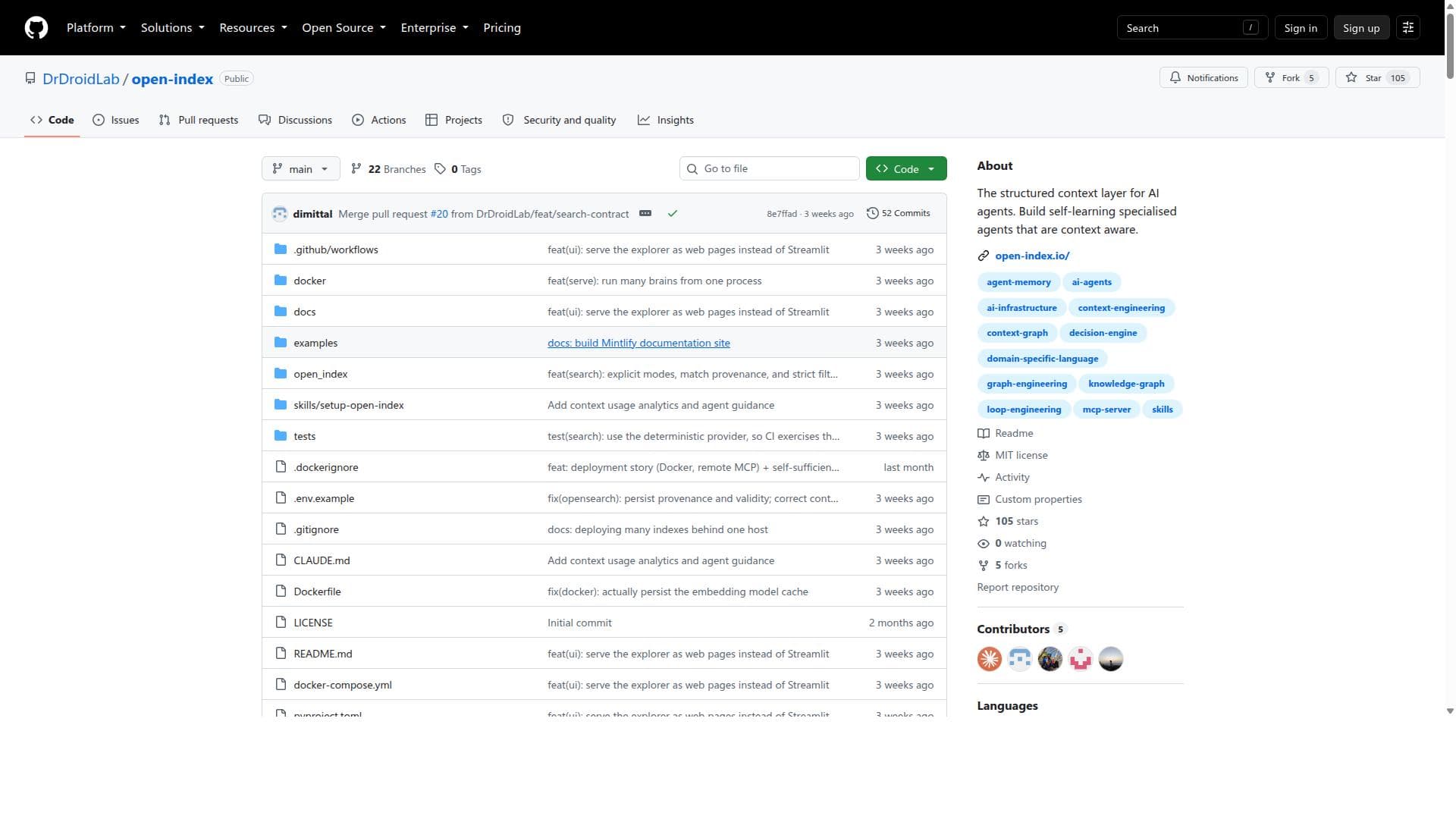
Open-index is a cutting-edge structured context layer that empowers AI agents to become self-learning and context-aware, significantly enhancing their adaptability and performance. Ideal for developers and researchers building specialized AI systems, it offers a flexible, open-source framework to create intelligent agents that evolve with their environment.

Deskripsi
Managing markdown based context comes with challenges like context poisoning, contradictions, non-determinism and context navigation difficulties. Over time, we built out a structured context management layer at our company (DrDroid) - with Open Index, we are sharing it with the ecosystem!
Deskripsi Detail
Open-index is an advanced structured context layer designed specifically for AI agents, aiming to enhance their ability to learn autonomously and operate with heightened context awareness. At its core, open-index provides a framework that allows AI systems to create, manage, and utilize structured contextual information effectively. This capability enables the development of specialized AI agents that can adapt to their environment and tasks by leveraging relevant contextual data, thereby improving their decision-making, responsiveness, and overall performance. One of the primary features of open-index is its structured context layer, which organizes information in a way that AI agents can easily interpret and apply. Unlike traditional AI models that often rely on unstructured data or static knowledge bases, open-index facilitates dynamic context management, allowing agents to update and refine their understanding continuously. This is particularly valuable for building self-learning agents that evolve over time, adapting to new information and changing conditions without requiring extensive manual reprogramming. Open-index supports the creation of specialized agents tailored to specific domains or tasks. By embedding context awareness into these agents, the tool enables them to comprehend the nuances and intricacies of their operational environment. This leads to more accurate predictions, better problem-solving capabilities, and enhanced interaction with users or other systems. The framework's flexibility allows developers to customize the context structures according to the unique requirements of their applications, whether in natural language processing, robotics, recommendation systems, or other AI-driven fields. The tool is particularly well-suited for AI researchers, developers, and organizations focused on building intelligent systems that require deep contextual understanding and adaptability. Use cases include autonomous customer support bots that learn from ongoing interactions, intelligent personal assistants that tailor responses based on user habits and preferences, and complex automation systems that adjust workflows dynamically. Open-index’s ability to maintain and leverage structured context makes it invaluable for projects where continuous learning and context-sensitive decision-making are critical. Regarding pricing, open-index is an open-source project hosted on GitHub, making it freely accessible to developers and organizations. This open availability encourages community contributions and collaborative improvements, fostering a robust ecosystem around the tool. Users can download, modify, and deploy open-index without licensing fees, which is advantageous for startups, academic research, and enterprises seeking cost-effective AI solutions. However, users should consider potential costs related to integration, customization, and maintenance depending on their specific use cases. When compared to alternative context management solutions, open-index stands out due to its focus on structured context layers specifically designed for AI agents. Many competing tools offer general-purpose knowledge bases or unstructured data handling but lack the specialized architecture that supports self-learning and context-aware agent development. Open-index’s modular design and emphasis on adaptability provide a competitive edge for developers aiming to build sophisticated AI systems that evolve with their environment. Despite its strengths, open-index does have some limitations. As an open-source framework, it requires a certain level of technical expertise to implement and customize effectively. Users without experience in AI agent development or context modeling may face a steep learning curve. Additionally, since it is community-driven, the availability of comprehensive documentation, support, and pre-built integrations may vary. Organizations should assess their internal capabilities and resources before adopting open-index to ensure successful deployment and ongoing management. In summary, open-index offers a powerful and flexible platform for building AI agents that are both self-learning and context-aware. Its structured context layer enables nuanced understanding and adaptability, making it ideal for advanced AI applications across various industries. While it demands technical proficiency and active engagement, the open-source nature and unique capabilities of open-index make it a compelling choice for developers and researchers committed to pushing the boundaries of AI agent intelligence.
Fitur Alat
- Structured context layer for AI agents
- Supports building self-learning specialized agents
- Enables context awareness in AI systems
Deskripsi
Open-index is a cutting-edge structured context layer that empowers AI agents to become self-learning and context-aware, significantly enhancing their adaptability and performance. Ideal for developers and researchers building specialized AI systems, it offers a flexible, open-source framework to create intelligent agents that evolve with their environment.
Managing markdown based context comes with challenges like context poisoning, contradictions, non-determinism and context navigation difficulties. Over time, we built out a structured context management layer at our company (DrDroid) - with Open Index, we are sharing it with the ecosystem!
Deskripsi Detail
Open-index is an advanced structured context layer designed specifically for AI agents, aiming to enhance their ability to learn autonomously and operate with heightened context awareness. At its core, open-index provides a framework that allows AI systems to create, manage, and utilize structured contextual information effectively. This capability enables the development of specialized AI agents that can adapt to their environment and tasks by leveraging relevant contextual data, thereby improving their decision-making, responsiveness, and overall performance. One of the primary features of open-index is its structured context layer, which organizes information in a way that AI agents can easily interpret and apply. Unlike traditional AI models that often rely on unstructured data or static knowledge bases, open-index facilitates dynamic context management, allowing agents to update and refine their understanding continuously. This is particularly valuable for building self-learning agents that evolve over time, adapting to new information and changing conditions without requiring extensive manual reprogramming. Open-index supports the creation of specialized agents tailored to specific domains or tasks. By embedding context awareness into these agents, the tool enables them to comprehend the nuances and intricacies of their operational environment. This leads to more accurate predictions, better problem-solving capabilities, and enhanced interaction with users or other systems. The framework's flexibility allows developers to customize the context structures according to the unique requirements of their applications, whether in natural language processing, robotics, recommendation systems, or other AI-driven fields. The tool is particularly well-suited for AI researchers, developers, and organizations focused on building intelligent systems that require deep contextual understanding and adaptability. Use cases include autonomous customer support bots that learn from ongoing interactions, intelligent personal assistants that tailor responses based on user habits and preferences, and complex automation systems that adjust workflows dynamically. Open-index’s ability to maintain and leverage structured context makes it invaluable for projects where continuous learning and context-sensitive decision-making are critical. Regarding pricing, open-index is an open-source project hosted on GitHub, making it freely accessible to developers and organizations. This open availability encourages community contributions and collaborative improvements, fostering a robust ecosystem around the tool. Users can download, modify, and deploy open-index without licensing fees, which is advantageous for startups, academic research, and enterprises seeking cost-effective AI solutions. However, users should consider potential costs related to integration, customization, and maintenance depending on their specific use cases. When compared to alternative context management solutions, open-index stands out due to its focus on structured context layers specifically designed for AI agents. Many competing tools offer general-purpose knowledge bases or unstructured data handling but lack the specialized architecture that supports self-learning and context-aware agent development. Open-index’s modular design and emphasis on adaptability provide a competitive edge for developers aiming to build sophisticated AI systems that evolve with their environment. Despite its strengths, open-index does have some limitations. As an open-source framework, it requires a certain level of technical expertise to implement and customize effectively. Users without experience in AI agent development or context modeling may face a steep learning curve. Additionally, since it is community-driven, the availability of comprehensive documentation, support, and pre-built integrations may vary. Organizations should assess their internal capabilities and resources before adopting open-index to ensure successful deployment and ongoing management. In summary, open-index offers a powerful and flexible platform for building AI agents that are both self-learning and context-aware. Its structured context layer enables nuanced understanding and adaptability, making it ideal for advanced AI applications across various industries. While it demands technical proficiency and active engagement, the open-source nature and unique capabilities of open-index make it a compelling choice for developers and researchers committed to pushing the boundaries of AI agent intelligence.
Pertanyaan yang Sering Diajukan
What is open-index?
Open-index is an open-source structured context layer designed for AI agents that enables the creation of self-learning, context-aware specialized agents. It helps AI systems manage and utilize structured contextual information to improve their adaptability and task performance.
How much does open-index cost?
Open-index is freely available as an open-source project on GitHub, so there are no licensing fees. Users can download, modify, and use the tool at no cost, though there may be indirect costs related to integration and customization.
Who is open-index best for?
Open-index is best suited for AI developers, researchers, and organizations focused on building advanced AI agents that require deep context awareness and self-learning capabilities. It is ideal for projects in natural language processing, robotics, automation, and other AI-driven domains.
What are the main features of open-index?
The main features include a structured context layer for organizing and managing contextual data, support for building self-learning specialized AI agents, and enabling context awareness to improve AI system adaptability and performance.
Does open-index offer a free trial?
Since open-index is an open-source tool available on GitHub, it can be freely accessed and used without the need for a trial period.
What integrations does open-index support?
Open-index is a framework that can be integrated with various AI systems and applications depending on the developer’s implementation. It does not come with predefined integrations but is designed to be flexible and extensible for custom integration.
How does open-index work?
Open-index works by providing a structured context layer that AI agents use to store, update, and interpret contextual information. This enables agents to learn from their environment continuously and make context-aware decisions, enhancing their autonomy and effectiveness.
Sosial
Gunakan AlatUlasan
Belum ada ulasan. Jadilah yang pertama berbagi pengalamanmu.