🚀 Zaprep : tes réseaux sociaux sous stéroïdes. Commencer gratuitement — automatise 1 000 DM/mois et transforme l'engagement en leads. avec 1 000 DM automatisés/mois.


C'est ton outil IA ? Réclame-le dès aujourd'hui.
Vérifie la propriété, gère ton profil et débloque des fonctionnalités de croissance.
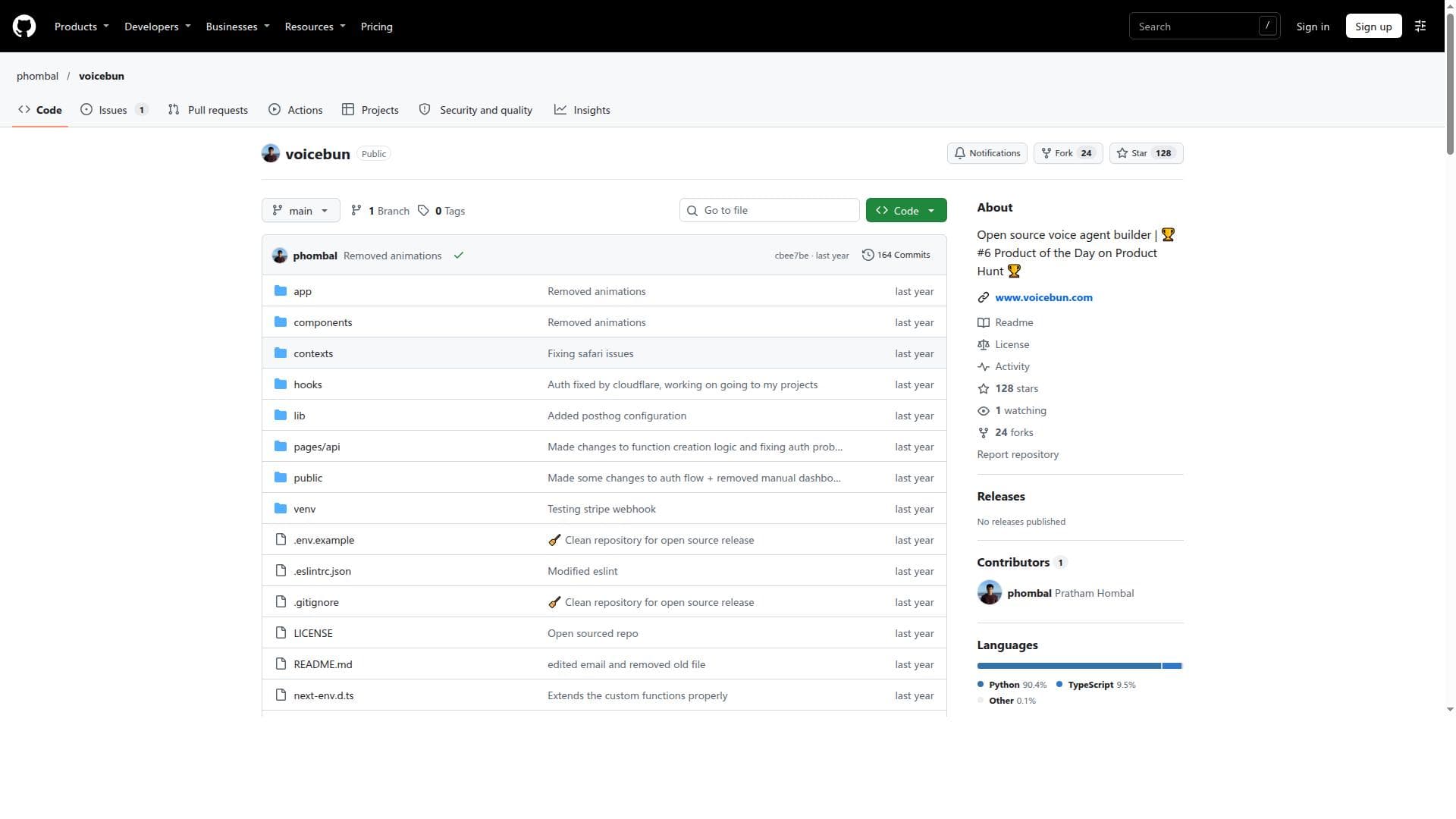
Voicebun is a powerful open source voice agent builder that enables developers to create fully customizable voice-enabled applications with seamless integration across various platforms. Ideal for developers and organizations seeking flexibility and control, Voicebun offers a cost-effective alternative to proprietary voice platforms by providing extensible tools for diverse voice interaction use cases.

Description
Build smart voice agents in minutes — no code needed. Automate calls, support, and scheduling with powerful AI workflows.
Description détaillée
Voicebun is an open source voice agent builder designed to empower developers to create custom voice-enabled applications and agents with ease. Its core purpose is to simplify the development of voice interaction systems by providing a comprehensive set of tools and frameworks that support integration with a wide range of platforms and APIs. By leveraging Voicebun, developers can build versatile voice agents tailored to specific use cases, ranging from customer support bots and virtual assistants to interactive voice response (IVR) systems and smart home controllers. At the heart of Voicebun’s capabilities is its open source nature, which allows developers to fully customize and extend the voice agents they create. This flexibility is crucial for adapting voice interactions to unique business requirements or user experiences. Voicebun supports integration with various platforms, enabling seamless connection to external APIs, databases, and services. This means developers can incorporate functionalities such as natural language understanding, speech recognition, and text-to-speech synthesis from different providers or custom-built modules. The framework facilitates the entire voice interaction development lifecycle, including intent recognition, dialogue management, and response generation, making it a robust foundation for diverse voice applications. Voicebun is particularly well-suited for developers, startups, and enterprises looking to build voice agents without being locked into proprietary platforms or costly licensing fees. Its open source model encourages collaboration and innovation, allowing users to contribute improvements or adapt the tool to emerging voice technologies. Use cases span multiple industries: customer service centers can deploy voicebun-powered agents to handle routine inquiries, healthcare providers can create voice assistants for patient engagement, and smart device manufacturers can integrate voicebun to enable voice control features. The tool’s adaptability also makes it ideal for educational projects and research in voice interaction design. Regarding pricing, Voicebun is freely available as an open source project on GitHub, which means there are no direct costs to use the software itself. Users only need to cover any infrastructure expenses related to hosting their voice agents or third-party API usage fees if applicable. This cost-effective approach contrasts with many commercial voice agent platforms that charge subscription or usage fees. However, users should consider the technical expertise required to deploy and maintain voicebun-based solutions, as it is primarily targeted at developers comfortable with coding and system integration. When compared to alternative voice agent builders, Voicebun stands out due to its open source licensing and extensibility. Unlike proprietary platforms such as Amazon Alexa Skills Kit or Google Dialogflow, Voicebun does not impose vendor lock-in or restrict customization. This makes it an attractive option for organizations seeking full control over their voice applications. However, unlike some commercial platforms that offer extensive pre-built integrations and user-friendly graphical interfaces, Voicebun may require more hands-on development effort and technical knowledge. It is best suited for teams that prioritize flexibility and open standards over turnkey solutions. Notable limitations of Voicebun include the absence of a polished graphical user interface for non-technical users, which can increase the learning curve for those unfamiliar with voice technology development. Additionally, since it is community-driven, the level of official support and documentation may vary compared to commercial offerings. Users should also be prepared to manage their own hosting and scaling infrastructure if deploying voice agents at scale. Despite these considerations, Voicebun remains a powerful and cost-effective tool for developers aiming to build custom voice agents tailored to their specific needs without the constraints of proprietary ecosystems.
Fonctionnalités de l'outil
- Open source voice agent builder
- Supports integration with various platforms and APIs
- Enables creation of custom voice agents
- Facilitates voice interaction development
- Designed for diverse use cases
Description
Voicebun is a powerful open source voice agent builder that enables developers to create fully customizable voice-enabled applications with seamless integration across various platforms. Ideal for developers and organizations seeking flexibility and control, Voicebun offers a cost-effective alternative to proprietary voice platforms by providing extensible tools for diverse voice interaction use cases.
Build smart voice agents in minutes — no code needed. Automate calls, support, and scheduling with powerful AI workflows.
Description détaillée
Voicebun is an open source voice agent builder designed to empower developers to create custom voice-enabled applications and agents with ease. Its core purpose is to simplify the development of voice interaction systems by providing a comprehensive set of tools and frameworks that support integration with a wide range of platforms and APIs. By leveraging Voicebun, developers can build versatile voice agents tailored to specific use cases, ranging from customer support bots and virtual assistants to interactive voice response (IVR) systems and smart home controllers. At the heart of Voicebun’s capabilities is its open source nature, which allows developers to fully customize and extend the voice agents they create. This flexibility is crucial for adapting voice interactions to unique business requirements or user experiences. Voicebun supports integration with various platforms, enabling seamless connection to external APIs, databases, and services. This means developers can incorporate functionalities such as natural language understanding, speech recognition, and text-to-speech synthesis from different providers or custom-built modules. The framework facilitates the entire voice interaction development lifecycle, including intent recognition, dialogue management, and response generation, making it a robust foundation for diverse voice applications. Voicebun is particularly well-suited for developers, startups, and enterprises looking to build voice agents without being locked into proprietary platforms or costly licensing fees. Its open source model encourages collaboration and innovation, allowing users to contribute improvements or adapt the tool to emerging voice technologies. Use cases span multiple industries: customer service centers can deploy voicebun-powered agents to handle routine inquiries, healthcare providers can create voice assistants for patient engagement, and smart device manufacturers can integrate voicebun to enable voice control features. The tool’s adaptability also makes it ideal for educational projects and research in voice interaction design. Regarding pricing, Voicebun is freely available as an open source project on GitHub, which means there are no direct costs to use the software itself. Users only need to cover any infrastructure expenses related to hosting their voice agents or third-party API usage fees if applicable. This cost-effective approach contrasts with many commercial voice agent platforms that charge subscription or usage fees. However, users should consider the technical expertise required to deploy and maintain voicebun-based solutions, as it is primarily targeted at developers comfortable with coding and system integration. When compared to alternative voice agent builders, Voicebun stands out due to its open source licensing and extensibility. Unlike proprietary platforms such as Amazon Alexa Skills Kit or Google Dialogflow, Voicebun does not impose vendor lock-in or restrict customization. This makes it an attractive option for organizations seeking full control over their voice applications. However, unlike some commercial platforms that offer extensive pre-built integrations and user-friendly graphical interfaces, Voicebun may require more hands-on development effort and technical knowledge. It is best suited for teams that prioritize flexibility and open standards over turnkey solutions. Notable limitations of Voicebun include the absence of a polished graphical user interface for non-technical users, which can increase the learning curve for those unfamiliar with voice technology development. Additionally, since it is community-driven, the level of official support and documentation may vary compared to commercial offerings. Users should also be prepared to manage their own hosting and scaling infrastructure if deploying voice agents at scale. Despite these considerations, Voicebun remains a powerful and cost-effective tool for developers aiming to build custom voice agents tailored to their specific needs without the constraints of proprietary ecosystems.
Questions fréquentes
What is voicebun?
Voicebun is an open source voice agent builder that allows developers to create custom voice-enabled applications and agents. It provides tools and frameworks to facilitate voice interaction development and supports integration with multiple platforms and APIs.
How much does voicebun cost?
Voicebun is free to use as an open source project. There are no licensing fees, but users may incur costs related to hosting their voice agents or using third-party APIs.
Who is voicebun best for?
Voicebun is best suited for developers, startups, and enterprises looking to build custom voice agents with full control and flexibility. It is ideal for those comfortable with coding and system integration who want to avoid vendor lock-in.
What are the main features of voicebun?
Key features include an open source voice agent builder framework, support for integration with various platforms and APIs, tools for creating custom voice agents, and facilitation of voice interaction development for diverse use cases.
Does voicebun offer a free trial?
As an open source project, voicebun is freely available to use without a trial period. Users can download and deploy it immediately from its GitHub repository.
What integrations does voicebun support?
Voicebun supports integration with a wide range of platforms and APIs, allowing developers to connect voice agents to external services such as natural language processing, speech recognition, and text-to-speech providers.
How does voicebun work?
Voicebun provides a framework and tools that enable developers to build voice agents by defining intents, managing dialogues, and generating responses. It integrates with various APIs and platforms to handle speech input/output and backend logic, facilitating the creation of custom voice-enabled applications.
Réseaux
Utiliser l'outilAvis
Pas encore d'avis. Sois le premier à partager ton expérience.
Outils sponsorisés






















Outils recommandés
Reste au courant des derniers outils IA
Reçois les derniers insights, rejoins notre newsletter
Lu et approuvé par 50,000+ lecteurs
Rejoins la plus grande communauté IA
Notre communauté et notre équipe sont là pour t'aider !
Tes retours aideront Alice AI à s'améliorer dans les prochaines versions.







Soumettre ton outil


PoweredByAI.app est un annuaire d'outils IA qui aide les particuliers, les entreprises et les créateurs à découvrir les meilleurs outils IA pour la rédaction, le code, le design, la productivité, et plus encore.
© 2026 , Un produit de011BQ. Tous droits réservés.