









C'est ton outil IA ? Réclame-le dès aujourd'hui.
Vérifie la propriété, gère ton profil et débloque des fonctionnalités de croissance.
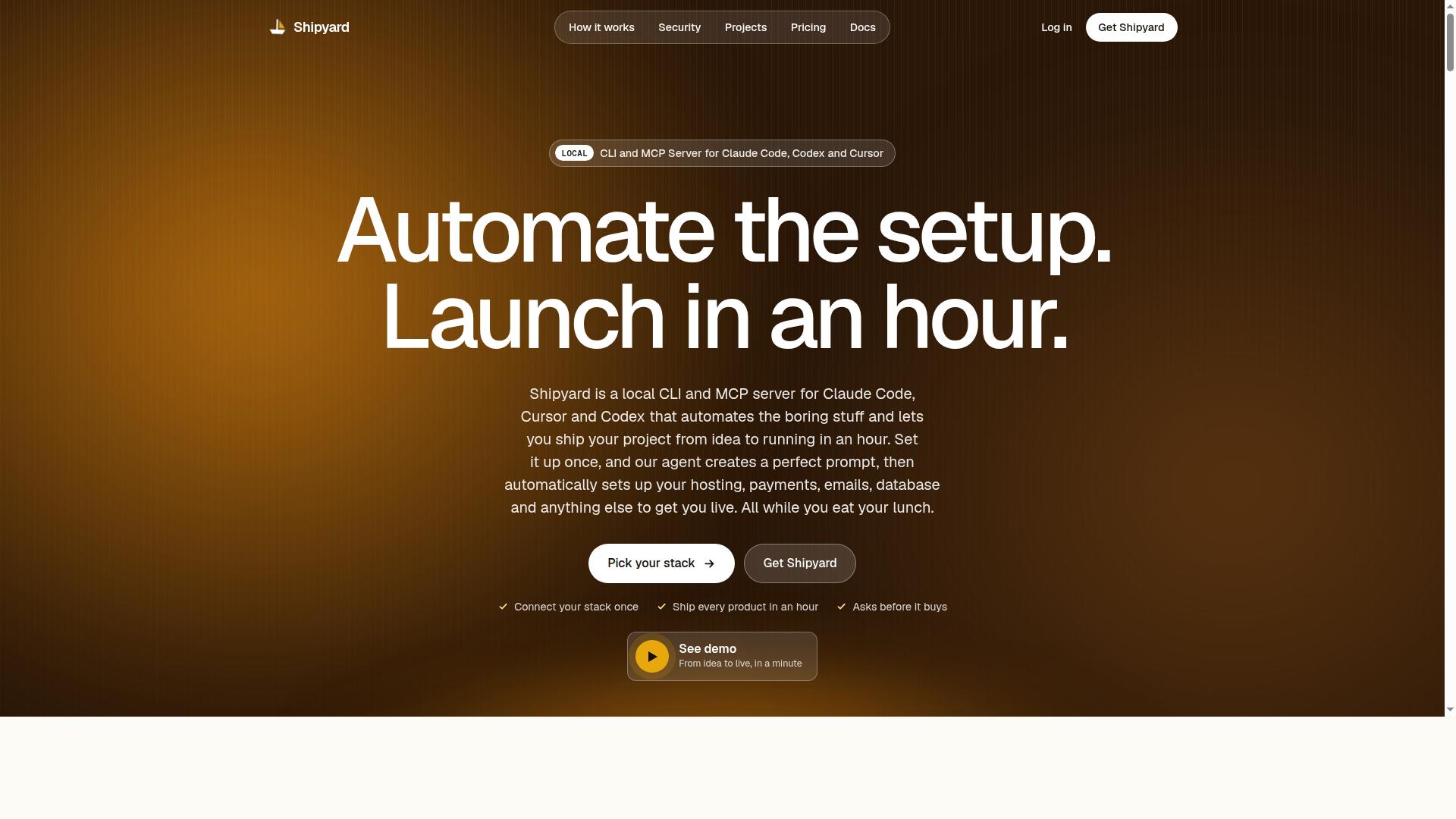
Shipyard is a powerful local CLI and MCP server that automates the entire project launch process—from domain registration to payments—using AI coding agents like Claude Code, Cursor, and Codex. Ideal for developers and startups, it enables shipping live products in about an hour by provisioning and wiring the full stack through official APIs with minimal manual effort.

Description
Built for the vibecoding era, where anyone can build an app in a night and the slow part is everything around it. Shipyard is a local CLI and MCP server for Claude Code, Cursor and Codex. Connect your accounts once, then every new product gets its domain, DNS, hosting, database, email and payments set up automatically in about an hour. Your AI gets a build prompt for the exact stack. Ship more ideas, faster. Your keys never leave your computer.
Description détaillée
Shipyard is an innovative local CLI and MCP server designed to streamline and automate the entire process of setting up and launching software projects. Its primary purpose is to enable developers and product creators to move from concept to a fully operational live product in about an hour. By leveraging advanced AI coding agents such as Claude Code, Cursor, and Codex, Shipyard automates the provisioning and wiring of the full technology stack through official APIs, covering critical infrastructure components like domain registration, hosting, databases, email services, and payment systems. This comprehensive automation drastically reduces the manual overhead typically involved in project launches, allowing users to focus on their core product ideas rather than infrastructure setup. Key features of Shipyard include its idempotent and resumable run capability, ensuring that the setup process can be safely restarted without unintended side effects. The tool operates through a local command-line interface combined with an MCP server that orchestrates the automation. Users provide minimal input—a project name, domain, and a descriptive paragraph—and Shipyard generates a precise build prompt for the coding agents to execute. It then sequentially provisions resources such as domain registration, hosting environments, Postgres databases, email configurations, and payment integrations through official provider APIs. Importantly, Shipyard pauses before any financial transactions, requesting user approval to prevent unintended purchases. Once the user connects their technology stack, Shipyard can be used repeatedly to ship multiple products rapidly, making it highly efficient for serial entrepreneurs and development teams. Shipyard is best suited for developers, startup founders, and small to medium-sized teams who want to accelerate their product launch cycles without investing extensive time in infrastructure setup. It is particularly useful for those who want to leverage AI coding agents to automate coding and deployment tasks, enabling a smooth transition from idea to live application. Use cases include launching SaaS products, MVPs, internal tools, or client projects where time-to-market is critical. The tool’s ability to automate complex backend wiring and provisioning makes it ideal for users who may not have deep DevOps expertise but require a reliable and repeatable deployment process. Regarding pricing, Shipyard offers various plans tailored to different user needs, including options for individuals and teams. While the website provides detailed pricing tiers, it typically includes a free tier or trial period to allow users to explore the platform’s capabilities before committing financially. Paid plans unlock advanced features, higher usage limits, and priority support. This flexible pricing structure ensures accessibility for hobbyists and startups while scaling to meet the demands of professional development teams. Compared to alternatives, Shipyard stands out by combining AI-driven coding automation with full-stack provisioning in a single local CLI tool. Unlike traditional deployment platforms that require manual configuration or separate services for domain, hosting, and payments, Shipyard integrates all these steps into one seamless workflow. Its idempotent and resumable runs provide robustness not commonly found in similar tools. While other platforms may offer partial automation or cloud-only solutions, Shipyard’s local server approach gives users more control and transparency during the launch process. Notable limitations include the current dependency on specific AI coding agents such as Claude Code, Cursor, and Codex, which may affect compatibility with other AI tools. Additionally, while Shipyard automates many setup steps, users must still provide accurate input and approve purchases manually, which requires some familiarity with the deployment components. The tool’s effectiveness also depends on the supported provider APIs, so users should verify compatibility with their preferred domain registrars, hosting providers, and payment gateways. Finally, as a relatively new and specialized tool, community support and third-party integrations may be more limited compared to more established deployment platforms.
Fonctionnalités de l'outil
- Automates setup of domain, hosting, database, email, and payments
- Local CLI and MCP server for Claude Code, Cursor, and Codex
- Creates build prompt for coding agents
- Idempotent and resumable run
- Stops before purchasing anything to ask for approval
- Connect your stack once and ship every product in an hour
- Supports provisioning through official provider APIs
Description
Shipyard is a powerful local CLI and MCP server that automates the entire project launch process—from domain registration to payments—using AI coding agents like Claude Code, Cursor, and Codex. Ideal for developers and startups, it enables shipping live products in about an hour by provisioning and wiring the full stack through official APIs with minimal manual effort.
Built for the vibecoding era, where anyone can build an app in a night and the slow part is everything around it. Shipyard is a local CLI and MCP server for Claude Code, Cursor and Codex. Connect your accounts once, then every new product gets its domain, DNS, hosting, database, email and payments set up automatically in about an hour. Your AI gets a build prompt for the exact stack. Ship more ideas, faster. Your keys never leave your computer.
Description détaillée
Shipyard is an innovative local CLI and MCP server designed to streamline and automate the entire process of setting up and launching software projects. Its primary purpose is to enable developers and product creators to move from concept to a fully operational live product in about an hour. By leveraging advanced AI coding agents such as Claude Code, Cursor, and Codex, Shipyard automates the provisioning and wiring of the full technology stack through official APIs, covering critical infrastructure components like domain registration, hosting, databases, email services, and payment systems. This comprehensive automation drastically reduces the manual overhead typically involved in project launches, allowing users to focus on their core product ideas rather than infrastructure setup. Key features of Shipyard include its idempotent and resumable run capability, ensuring that the setup process can be safely restarted without unintended side effects. The tool operates through a local command-line interface combined with an MCP server that orchestrates the automation. Users provide minimal input—a project name, domain, and a descriptive paragraph—and Shipyard generates a precise build prompt for the coding agents to execute. It then sequentially provisions resources such as domain registration, hosting environments, Postgres databases, email configurations, and payment integrations through official provider APIs. Importantly, Shipyard pauses before any financial transactions, requesting user approval to prevent unintended purchases. Once the user connects their technology stack, Shipyard can be used repeatedly to ship multiple products rapidly, making it highly efficient for serial entrepreneurs and development teams. Shipyard is best suited for developers, startup founders, and small to medium-sized teams who want to accelerate their product launch cycles without investing extensive time in infrastructure setup. It is particularly useful for those who want to leverage AI coding agents to automate coding and deployment tasks, enabling a smooth transition from idea to live application. Use cases include launching SaaS products, MVPs, internal tools, or client projects where time-to-market is critical. The tool’s ability to automate complex backend wiring and provisioning makes it ideal for users who may not have deep DevOps expertise but require a reliable and repeatable deployment process. Regarding pricing, Shipyard offers various plans tailored to different user needs, including options for individuals and teams. While the website provides detailed pricing tiers, it typically includes a free tier or trial period to allow users to explore the platform’s capabilities before committing financially. Paid plans unlock advanced features, higher usage limits, and priority support. This flexible pricing structure ensures accessibility for hobbyists and startups while scaling to meet the demands of professional development teams. Compared to alternatives, Shipyard stands out by combining AI-driven coding automation with full-stack provisioning in a single local CLI tool. Unlike traditional deployment platforms that require manual configuration or separate services for domain, hosting, and payments, Shipyard integrates all these steps into one seamless workflow. Its idempotent and resumable runs provide robustness not commonly found in similar tools. While other platforms may offer partial automation or cloud-only solutions, Shipyard’s local server approach gives users more control and transparency during the launch process. Notable limitations include the current dependency on specific AI coding agents such as Claude Code, Cursor, and Codex, which may affect compatibility with other AI tools. Additionally, while Shipyard automates many setup steps, users must still provide accurate input and approve purchases manually, which requires some familiarity with the deployment components. The tool’s effectiveness also depends on the supported provider APIs, so users should verify compatibility with their preferred domain registrars, hosting providers, and payment gateways. Finally, as a relatively new and specialized tool, community support and third-party integrations may be more limited compared to more established deployment platforms.
Questions fréquentes
What is Shipyard?
Shipyard is a local command-line interface and MCP server that automates the setup and launch of software projects by provisioning domains, hosting, databases, email, and payment systems through official APIs, using AI coding agents like Claude Code, Cursor, and Codex.
How much does Shipyard cost?
Shipyard offers multiple pricing plans tailored to different user needs, including free or trial options and paid tiers that provide advanced features and higher usage limits. Detailed pricing information is available on their website.
Who is Shipyard best for?
Shipyard is ideal for developers, startup founders, and small to medium-sized teams who want to accelerate product launches by automating infrastructure setup and deployment using AI coding agents, especially those seeking a repeatable and efficient workflow.
What are the main features of Shipyard?
Key features include automated provisioning of domain, hosting, database, email, and payments; local CLI and MCP server integration; AI-generated build prompts; idempotent and resumable runs; user approval before purchases; and support for official provider APIs.
Does Shipyard offer a free trial?
Yes, Shipyard typically offers a free tier or trial period that allows users to explore its capabilities before subscribing to paid plans.
What integrations does Shipyard support?
Shipyard supports provisioning through official APIs of various providers for domain registration, hosting, databases, email services, and payment gateways, enabling seamless integration with popular infrastructure components.
How does Shipyard work?
Users provide a project name, domain, and a brief description via the CLI. Shipyard then generates a build prompt for AI coding agents, automates provisioning and wiring of the full stack through official APIs, pauses for user approval before any purchases, and completes the launch to get the product live quickly.
Réseaux

Avis
Pas encore d'avis. Sois le premier à partager ton expérience.
Outils sponsorisés
































Outils recommandés
Reste au courant des derniers outils IA
Reçois les derniers insights, rejoins notre newsletter
Lu et approuvé par 50,000+ lecteurs
Rejoins la plus grande communauté IA
Notre communauté et notre équipe sont là pour t'aider !
Tes retours aideront Alice AI à s'améliorer dans les prochaines versions.





 , Un produit de