

C'est ton outil IA ? Réclame-le dès aujourd'hui.
Vérifie la propriété, gère ton profil et débloque des fonctionnalités de croissance.
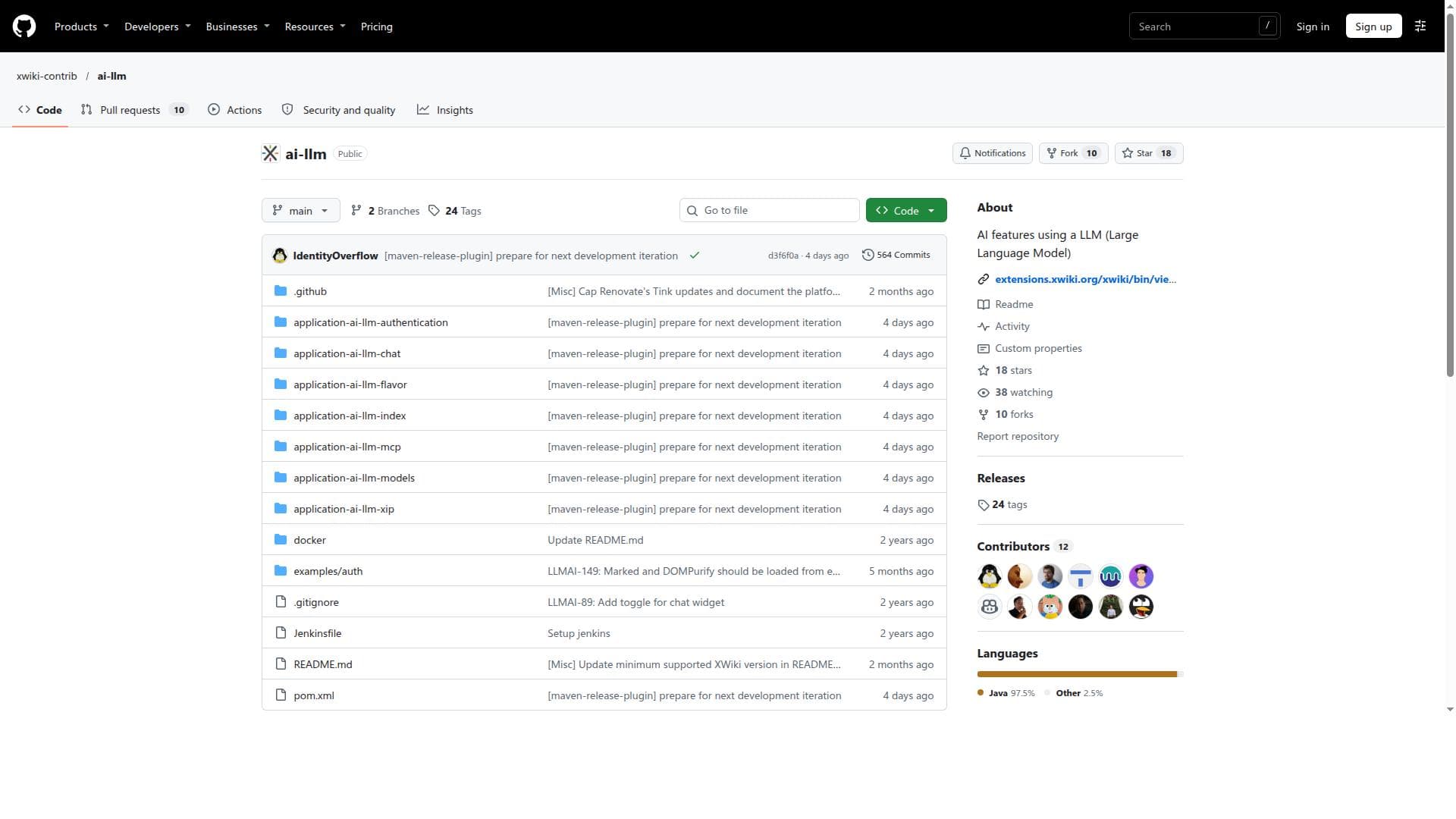
ai-llm is an open-source project that integrates Large Language Models to deliver advanced natural language understanding and generation capabilities. Ideal for developers and organizations seeking customizable AI-driven language features, it empowers the creation of intelligent applications with rich, context-aware text processing.

Description
XWiki MCP Server is an open-source, self-hostable extension that connects XWiki to the AI agent of your choice: OpenCode, Pi, Codex, Claude Code, GitHub Copilot, and more. You can already use the extension to query your knowledge base to get answers, create and edit pages, and work with structured data directly in XWiki. Try out the extension and let us what's should we improve next!
Description détaillée
ai-llm is an open-source project designed to integrate advanced Large Language Model (LLM) capabilities into various applications, enabling developers to harness state-of-the-art natural language processing (NLP) and generation functionalities. At its core, ai-llm serves as a bridge between powerful language models and practical AI-driven features, allowing applications to understand, interpret, and generate human-like text with high accuracy and contextual awareness. This makes it a versatile tool for enhancing user interactions, automating content creation, and building intelligent conversational agents. One of the standout features of ai-llm is its seamless integration of Large Language Models, which are capable of understanding complex language inputs and producing coherent, contextually relevant outputs. The project supports both natural language understanding (NLU) and natural language generation (NLG), enabling a wide range of AI applications from chatbots and virtual assistants to content summarization and question-answering systems. Being open source and hosted on GitHub, ai-llm encourages community contributions, fostering collaborative development and continuous improvement. This openness also allows developers to customize and extend the tool to fit specific project requirements. ai-llm is particularly well-suited for software developers, AI researchers, and organizations looking to embed advanced language AI into their products without building models from scratch. Use cases include enhancing customer support with AI chatbots, automating document analysis, generating creative content, and powering intelligent search engines. Its flexibility supports integration into web, mobile, and enterprise applications, making it a valuable asset for startups and established companies aiming to leverage AI-driven language capabilities. Regarding pricing, ai-llm is an open-source project available freely on GitHub, which means there are no direct costs associated with using the software itself. However, users should consider potential expenses related to hosting, infrastructure, and any third-party APIs or cloud services required to run the underlying language models at scale. This open model provides a cost-effective solution for teams with technical expertise to deploy and manage AI features independently. Compared to proprietary AI platforms, ai-llm offers greater transparency and customization options due to its open-source nature. While commercial solutions may provide turnkey services with dedicated support and simplified deployment, ai-llm empowers developers to tailor the AI integration deeply and maintain full control over data and model usage. This makes it an attractive choice for projects with specific compliance requirements or those seeking to avoid vendor lock-in. Despite its advantages, ai-llm does have some limitations. Since it relies on integrating large language models, users must have the technical capability to manage model deployment and scaling, which can be resource-intensive. Additionally, the quality of AI outputs depends on the underlying model chosen and the quality of training data, so some tuning and experimentation may be necessary to achieve optimal results. As an open-source project, support is primarily community-driven, which might not meet the needs of all enterprise users requiring guaranteed service levels. In summary, ai-llm is a powerful, flexible, and community-supported tool for embedding advanced language AI into applications. Its open-source model and focus on Large Language Models make it ideal for developers and organizations seeking customizable, cutting-edge NLP solutions without the constraints of proprietary platforms. While it requires technical expertise to deploy effectively, its capabilities unlock a broad spectrum of AI-driven functionalities that can significantly enhance user experiences and operational efficiencies.
Fonctionnalités de l'outil
- Integration of Large Language Models for AI features
- Supports natural language understanding and generation
- Open source project hosted on GitHub
- Enables development of AI-driven applications
- Community contributions and collaborative development
Description
ai-llm is an open-source project that integrates Large Language Models to deliver advanced natural language understanding and generation capabilities. Ideal for developers and organizations seeking customizable AI-driven language features, it empowers the creation of intelligent applications with rich, context-aware text processing.
XWiki MCP Server is an open-source, self-hostable extension that connects XWiki to the AI agent of your choice: OpenCode, Pi, Codex, Claude Code, GitHub Copilot, and more. You can already use the extension to query your knowledge base to get answers, create and edit pages, and work with structured data directly in XWiki. Try out the extension and let us what's should we improve next!
Description détaillée
ai-llm is an open-source project designed to integrate advanced Large Language Model (LLM) capabilities into various applications, enabling developers to harness state-of-the-art natural language processing (NLP) and generation functionalities. At its core, ai-llm serves as a bridge between powerful language models and practical AI-driven features, allowing applications to understand, interpret, and generate human-like text with high accuracy and contextual awareness. This makes it a versatile tool for enhancing user interactions, automating content creation, and building intelligent conversational agents. One of the standout features of ai-llm is its seamless integration of Large Language Models, which are capable of understanding complex language inputs and producing coherent, contextually relevant outputs. The project supports both natural language understanding (NLU) and natural language generation (NLG), enabling a wide range of AI applications from chatbots and virtual assistants to content summarization and question-answering systems. Being open source and hosted on GitHub, ai-llm encourages community contributions, fostering collaborative development and continuous improvement. This openness also allows developers to customize and extend the tool to fit specific project requirements. ai-llm is particularly well-suited for software developers, AI researchers, and organizations looking to embed advanced language AI into their products without building models from scratch. Use cases include enhancing customer support with AI chatbots, automating document analysis, generating creative content, and powering intelligent search engines. Its flexibility supports integration into web, mobile, and enterprise applications, making it a valuable asset for startups and established companies aiming to leverage AI-driven language capabilities. Regarding pricing, ai-llm is an open-source project available freely on GitHub, which means there are no direct costs associated with using the software itself. However, users should consider potential expenses related to hosting, infrastructure, and any third-party APIs or cloud services required to run the underlying language models at scale. This open model provides a cost-effective solution for teams with technical expertise to deploy and manage AI features independently. Compared to proprietary AI platforms, ai-llm offers greater transparency and customization options due to its open-source nature. While commercial solutions may provide turnkey services with dedicated support and simplified deployment, ai-llm empowers developers to tailor the AI integration deeply and maintain full control over data and model usage. This makes it an attractive choice for projects with specific compliance requirements or those seeking to avoid vendor lock-in. Despite its advantages, ai-llm does have some limitations. Since it relies on integrating large language models, users must have the technical capability to manage model deployment and scaling, which can be resource-intensive. Additionally, the quality of AI outputs depends on the underlying model chosen and the quality of training data, so some tuning and experimentation may be necessary to achieve optimal results. As an open-source project, support is primarily community-driven, which might not meet the needs of all enterprise users requiring guaranteed service levels. In summary, ai-llm is a powerful, flexible, and community-supported tool for embedding advanced language AI into applications. Its open-source model and focus on Large Language Models make it ideal for developers and organizations seeking customizable, cutting-edge NLP solutions without the constraints of proprietary platforms. While it requires technical expertise to deploy effectively, its capabilities unlock a broad spectrum of AI-driven functionalities that can significantly enhance user experiences and operational efficiencies.
Questions fréquentes
What is ai-llm?
ai-llm is an open-source project that provides AI features by integrating Large Language Models, enabling applications to perform advanced natural language understanding and generation.
How much does ai-llm cost?
ai-llm is free to use as an open-source project on GitHub. However, users may incur costs related to hosting, infrastructure, or third-party services needed to deploy and run the language models.
Who is ai-llm best for?
ai-llm is best suited for developers, AI researchers, and organizations that want to embed customizable, advanced language AI features into their applications, especially those with technical expertise to manage deployment.
What are the main features of ai-llm?
Key features include integration of Large Language Models, support for natural language understanding and generation, open-source availability, enabling AI-driven application development, and fostering community collaboration.
Does ai-llm offer a free trial?
As an open-source project, ai-llm is freely available to use without a trial period. Users can download and deploy it directly from GitHub.
What integrations does ai-llm support?
ai-llm can be integrated into various applications and platforms that support Large Language Models, including web and mobile apps, but specific integrations depend on how developers implement it in their projects.
How does ai-llm work?
ai-llm works by connecting applications to Large Language Models that process and generate human-like text, enabling natural language understanding and generation capabilities within software solutions.
Réseaux
Utiliser l'outilAvis
Pas encore d'avis. Sois le premier à partager ton expérience.