

C'est ton outil IA ? Réclame-le dès aujourd'hui.
Vérifie la propriété, gère ton profil et débloque des fonctionnalités de croissance.
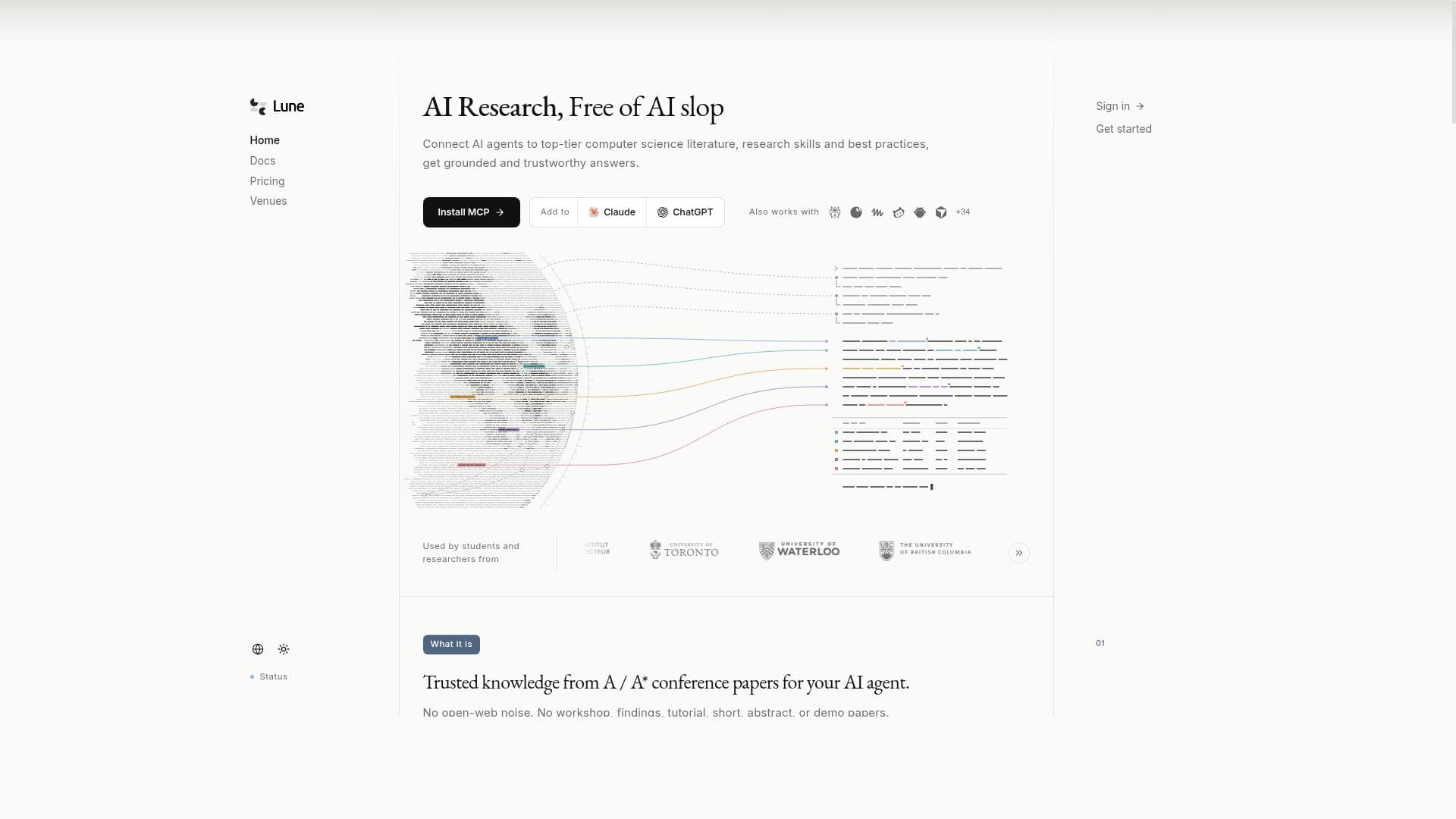
Lune Research uniquely grounds AI agents in full-text, top-tier Computer Science papers to eliminate hallucinations and noise from open web data, serving as an AI-native research tool that automates literature reviews and experiment workflows. It is ideal for researchers and scientists seeking accurate, AI-assisted scientific discovery and research automation.

Description
Lune is Exa.ai for scientific research. It connects AI agents to research knowledge and tools built for scientific workflows, and provides high-quality knowledge grounding based on papers from top-tier academic conferences. 10x the efficiency and trustworthiness of literature review, experimental design, writing and peer review. From early ideas to publication, it helps researchers and technical teams move faster with traceable sources, deeper grounding, and rigorous, evidence-backed decisions.
Description détaillée
Lune Research is an advanced AI-native research platform designed to revolutionize the way scientific literature is accessed, analyzed, and utilized, particularly within the field of Computer Science. At its core, Lune Research functions as an MCP (Model Context Protocol) server that grounds AI agents in the full-text content of top-tier Computer Science papers. This unique approach eliminates the common pitfalls of AI hallucinations and the noise typically encountered when sourcing information from the open web. By anchoring AI agents directly to authoritative academic sources, Lune Research ensures that the insights and data generated are accurate, reliable, and relevant. The platform offers a suite of powerful features tailored to enhance scientific discovery and streamline research workflows. One of its standout capabilities is the automation of literature reviews, which traditionally require extensive manual effort. Lune Research leverages AI to scan, summarize, and synthesize vast amounts of academic papers, enabling researchers to quickly grasp the state of the art in their domain. Additionally, it supports experiment automation, allowing scientists to design, execute, and analyze experiments with AI assistance, thereby accelerating the research cycle. Acting as an AI co-scientist, Lune Research not only aids in information retrieval but also contributes to hypothesis generation and experimental planning. A key technological innovation behind Lune Research is its implementation of the Model Context Protocol (MCP), a framework that facilitates academic search by providing AI models with direct access to full-text scholarly documents. This protocol enhances the contextual understanding of AI agents, making their outputs more precise and grounded in verified research. By focusing exclusively on high-quality Computer Science literature, Lune Research avoids the misinformation and irrelevant content that can plague other AI research tools relying on general web data. Lune Research is particularly well-suited for academic researchers, graduate students, and industry professionals engaged in cutting-edge Computer Science research. It is ideal for those who need to conduct comprehensive literature reviews, stay updated with the latest developments, or automate repetitive research tasks. Moreover, research labs and organizations aiming to integrate AI into their scientific workflows will find Lune Research invaluable for boosting productivity and fostering innovation. Regarding pricing, specific details are not publicly disclosed on the website, suggesting that Lune Research may offer customized plans or enterprise-level subscriptions tailored to institutional needs. Potential users are encouraged to contact the team directly for detailed pricing information and to inquire about trial options. When compared to alternative AI research tools, Lune Research stands out due to its exclusive focus on grounding AI agents in full-text academic papers rather than relying on fragmented web data or abstracts alone. This results in higher accuracy and trustworthiness of AI-generated insights. While many platforms offer AI-assisted literature search or summarization, few provide the level of integration with scholarly content and experiment automation that Lune Research delivers. However, users should consider that the tool currently specializes in Computer Science literature, which may limit its applicability for researchers in other scientific disciplines. One notable consideration is that Lune Research’s reliance on MCP and full-text academic papers requires access to comprehensive digital libraries or subscriptions, which may pose access challenges for some users. Additionally, the platform’s advanced features may have a learning curve for researchers unfamiliar with AI-driven workflows. Despite these factors, Lune Research represents a significant advancement in AI-powered scientific research, offering a robust, accurate, and efficient alternative to traditional literature review and experiment management methods.
Fonctionnalités de l'outil
- Grounds AI agents in full-text, top-tier Computer Science papers
- Eliminates hallucinated facts and noise from the open web
- Supports research automation and literature review
- Enables experiment automation
- Acts as an AI co-scientist for scientific discovery
- Implements Model Context Protocol (MCP) for academic search
Description
Lune Research uniquely grounds AI agents in full-text, top-tier Computer Science papers to eliminate hallucinations and noise from open web data, serving as an AI-native research tool that automates literature reviews and experiment workflows. It is ideal for researchers and scientists seeking accurate, AI-assisted scientific discovery and research automation.
Lune is Exa.ai for scientific research. It connects AI agents to research knowledge and tools built for scientific workflows, and provides high-quality knowledge grounding based on papers from top-tier academic conferences. 10x the efficiency and trustworthiness of literature review, experimental design, writing and peer review. From early ideas to publication, it helps researchers and technical teams move faster with traceable sources, deeper grounding, and rigorous, evidence-backed decisions.
Description détaillée
Lune Research is an advanced AI-native research platform designed to revolutionize the way scientific literature is accessed, analyzed, and utilized, particularly within the field of Computer Science. At its core, Lune Research functions as an MCP (Model Context Protocol) server that grounds AI agents in the full-text content of top-tier Computer Science papers. This unique approach eliminates the common pitfalls of AI hallucinations and the noise typically encountered when sourcing information from the open web. By anchoring AI agents directly to authoritative academic sources, Lune Research ensures that the insights and data generated are accurate, reliable, and relevant. The platform offers a suite of powerful features tailored to enhance scientific discovery and streamline research workflows. One of its standout capabilities is the automation of literature reviews, which traditionally require extensive manual effort. Lune Research leverages AI to scan, summarize, and synthesize vast amounts of academic papers, enabling researchers to quickly grasp the state of the art in their domain. Additionally, it supports experiment automation, allowing scientists to design, execute, and analyze experiments with AI assistance, thereby accelerating the research cycle. Acting as an AI co-scientist, Lune Research not only aids in information retrieval but also contributes to hypothesis generation and experimental planning. A key technological innovation behind Lune Research is its implementation of the Model Context Protocol (MCP), a framework that facilitates academic search by providing AI models with direct access to full-text scholarly documents. This protocol enhances the contextual understanding of AI agents, making their outputs more precise and grounded in verified research. By focusing exclusively on high-quality Computer Science literature, Lune Research avoids the misinformation and irrelevant content that can plague other AI research tools relying on general web data. Lune Research is particularly well-suited for academic researchers, graduate students, and industry professionals engaged in cutting-edge Computer Science research. It is ideal for those who need to conduct comprehensive literature reviews, stay updated with the latest developments, or automate repetitive research tasks. Moreover, research labs and organizations aiming to integrate AI into their scientific workflows will find Lune Research invaluable for boosting productivity and fostering innovation. Regarding pricing, specific details are not publicly disclosed on the website, suggesting that Lune Research may offer customized plans or enterprise-level subscriptions tailored to institutional needs. Potential users are encouraged to contact the team directly for detailed pricing information and to inquire about trial options. When compared to alternative AI research tools, Lune Research stands out due to its exclusive focus on grounding AI agents in full-text academic papers rather than relying on fragmented web data or abstracts alone. This results in higher accuracy and trustworthiness of AI-generated insights. While many platforms offer AI-assisted literature search or summarization, few provide the level of integration with scholarly content and experiment automation that Lune Research delivers. However, users should consider that the tool currently specializes in Computer Science literature, which may limit its applicability for researchers in other scientific disciplines. One notable consideration is that Lune Research’s reliance on MCP and full-text academic papers requires access to comprehensive digital libraries or subscriptions, which may pose access challenges for some users. Additionally, the platform’s advanced features may have a learning curve for researchers unfamiliar with AI-driven workflows. Despite these factors, Lune Research represents a significant advancement in AI-powered scientific research, offering a robust, accurate, and efficient alternative to traditional literature review and experiment management methods.
Questions fréquentes
What is Lune Research?
Lune Research is an AI-native research platform that uses the Model Context Protocol (MCP) to ground AI agents in full-text, top-tier Computer Science papers. It automates literature reviews and experiment workflows, acting as an AI co-scientist to enhance scientific discovery.
How much does Lune Research cost?
Pricing details for Lune Research are not publicly listed on their website. Interested users should contact Lune Research directly to discuss customized plans or enterprise subscriptions tailored to their needs.
Who is Lune Research best for?
Lune Research is best suited for academic researchers, graduate students, and industry professionals in Computer Science who require accurate literature reviews, experiment automation, and AI-assisted scientific discovery.
What are the main features of Lune Research?
Key features include grounding AI agents in full-text Computer Science papers, eliminating hallucinated facts and noise from open web sources, automating literature reviews, enabling experiment automation, acting as an AI co-scientist, and implementing the Model Context Protocol for academic search.
Does Lune Research offer a free trial?
Information about a free trial is not explicitly provided on the Lune Research website. Prospective users should reach out to the Lune Research team to inquire about trial availability or demo options.
What integrations does Lune Research support?
While specific integrations are not detailed publicly, Lune Research operates as an MCP server designed to interface with AI agents and academic databases, facilitating seamless access to scholarly content for research automation.
How does Lune Research work?
Lune Research works by implementing the Model Context Protocol to provide AI agents with direct access to full-text, high-quality Computer Science papers. This grounding enables AI to generate accurate, contextually relevant insights, automate literature reviews, and assist in experiment automation.
Avis
Pas encore d'avis. Sois le premier à partager ton expérience.