🚀 Zaprep : tes réseaux sociaux sous stéroïdes. Commencer gratuitement — automatise 1 000 DM/mois et transforme l'engagement en leads. avec 1 000 DM automatisés/mois.
Dernières actualités IA
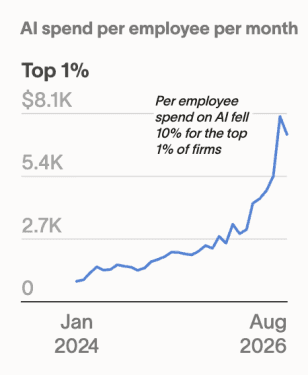
AI spend per employee slumped at top firms in August — summer doldrums or a warning sign?
The adoption of AI tools by businesses slowed in August, according to spending data at 70,000 companies collected by the payments company Ramp.The latest surveyshows 56% of Ramp customers paid for AI products in August, rising just 0.4% from the month before. This isn’t the first time Ramp’s metrics have shown adoption slowing down. Last year, the company’s AI index showed little to no growth in adoption between August and October, only to have growth pick up again as the year finished. Still, the extreme pace of the AI buildout means even small slowdowns can be cause for concern. The gobsmacking investment in AI infrastructure by frontier labs and hyperscalers rests on the hope that there isplenty of revenueout there to pay it back. Thus far, usage has grown steeply, particularly as software engineers adopted agentic coding tools — but if that adoption slows down, revenue is likely to slow as well. Ramp’s figures may overstate overall adoption, thanks to the company’s techy clientele: An ongoing US Census Bureausurvey of AI adoptionupdated on August 23 shows just 22% of businesses report using AI. Ramp’s survey isn’t necessarily representative of the market, but it’s one of the few direct spending data sets available and potentially a leading indicator. To be sure, this data is from August, when much of the industry is on vacation. That may explain the doldrums. But there are other warning signs for companies that depend on token spend, per Ramp economist Ara Kharazian. First, a major decline in AI spend per employee in the top 1% of AI-using firms in his sample, falling nearly 10% to $7,205. That may be the vacation-token factor, but it also speaks to falling token costs. As OpenAI and Anthropic have cut prices, average token costs have declined to $0.68 per million tokens, as opposed to the 2026 peak of $1.15 per million tokens in March. The data suggests that the labs have yet to make up for the price cuts with growing volume. And the same incentives have many customers choosing to use older, cheaper models like OpenAI’s ChatGPT 5.6-Terra and Anthropic’s Sonnet instead of the more powerful frontier releases. Employees at frontier labs have said much of the cost of training is recouped in the first weeks of a new model’s release, and slower adoption could threaten that dynamic. Still, for all the talk of open-weight models threatening the frontier labs, only 6.4% of AI-spending businesses used model-serving or inference platforms in August; a share that’s growing steadily but not fast enough to drive the dynamics of broader business adoption. “We are showing that competition between OpenAI and Anthropic is making AI more accessible, and also driving the price down for companies—and not just driving the price down, but driving spend down at the top 1% of companies that previously the market was expecting to drive much of the growth going forward,” Kharazian said. That also helps explain the focus at AI labs onwinning over non-technical usersfor AI co-working tools. This data point — dare we call it a blip? — could be a bad sign if you’re a model-builder or a hyperscaler with a couple hundred billion of chips on order. But, Kharazian notes, “it depends on who you are in the market. If your company is using AI, it’s great.”
View
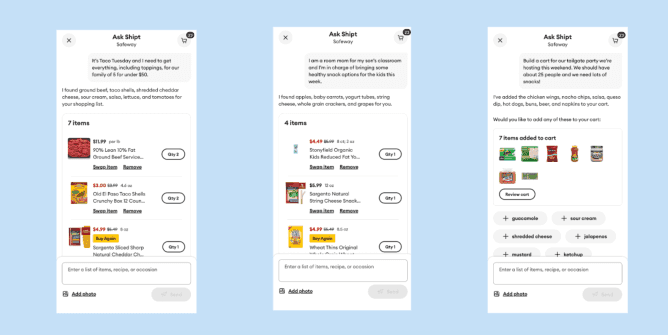
Shipt becomes the latest delivery app with an AI shopping assistant
Shipt, the same-day delivery platform owned by Target, is the latest delivery app to join the AI cart race. The companyannouncedon Wednesday that its new “Ask Shipt” tool will help customers shop more intuitively and turn prompts into customized ready-to-buy carts. With this launch, Shipt joins a growing list of delivery platforms baking AI assistants into their apps. Just this morning, Instacart launched a newAI-powered grocery shopping assistantcalled Clementine, whileUber EatsandDoorDashhave also introduced similar AI assistants this year. Users can ask the assistant to do things like “Create a cart for my Saturday tailgate for 25 people and include some brunch items,” or “Build a cart for easy school lunches and after-school snacks,” Shipt says. They can also upload a photo of a dish they saw online or at a restaurant, and the assistant will identify and add all of the ingredients to a cart. Additionally, users can ask for ideas based on their budget, such as a weeknight meal for a family of five under $35. The tool’s launch follows the recent addition ofother AI features on Target.com itself, including AI-powered photo search, customer review summaries, and other personalized shopping experiences. Ask Shipt is available now in the Shipt app and on Shipt.com.
View

3 ways VCs can unlock more value for their portfolio at TechCrunch Disrupt 2026
The best investment opportunities start with knowing where the market is going and who is building a sustainable company positioned to address those shifts. AtTechCrunch Disrupt 2026, you can discover emerging companies, expand your deal flow, connect with founders, sharpen your investment thesis, and get closer to the ideas shaping the next era of technology. All in just three days, from October 13-15 at Moscone West in San Francisco. For a limited time, investorssave 25% on the Investor Pass. Join thousands of founders, investors, operators, and technology leaders coming together to build, fund, and shape what’s next. The AI era is reshaping industries, creating new categories, and changing how companies are built. For investors like you, that means more opportunities — and more competition for the companies that could define what comes next.Disruptis designed to help you cut through the noise and get right to what matters and what can yield returns.Grab your 25% discountbefore rates increase. Here are 3 ways you can unlock more value for your portfolio at Disrupt. Disrupt brings together 10,000+ people from across the startup ecosystem, giving investors a firsthand look at the founders and companies shaping new markets. But the networking starts before you arrive. With anInvestor Pass, you can browse the list of founders attending Disrupt, identify promising investment opportunities, and schedule meetings with the founders you want to meet at the conference. Get a front-row view of some of the world’s most promising startups in theStartup Battlefield 200, an intense startup pitch-off competition. Our expert Startup Battlefield and editorial teams select startups from a pool of thousands of applicants. These startups are eager to meet with investors like you, and you can watch their pitches live onstage throughout Disrupt. And when they’re done, they’re available for you to contact and build a rapport with. There’s a reason more than 1,700 companies have gone through the Startup Battlefield 200 competition, with more than 250 successful exits and more than $32 billion in fundraising.Get a look at this year’s top 200 startups here. The Expo Hall puts even more founders and emerging technologies directly in front of you. You can explore hundreds of startups looking for an investor like you. Or bring your own portfolio companies bygetting them an exhibit table. And the programming can help you spot the signals behind the hype. Hear other investors, founders, and operators unpack questions like whether a startup really has product-market fit, where defensibility exists when AI giants enter your market, and where AI infrastructure is creating new opportunities.Register here for your Investor Pass. The value of Disrupt goes beyond what happens onstage. It’s who you meet in the moments between. Connect with founders and fellow investors in the exclusive Deal Flow Café, curated 1:1 meetings, investor-founder networking, and AI-powered matchmaking designed to help you find the people most relevant to your goals. Enjoy intentional networking with our AI-powered matchmaking app, which helps you make smarter connections with founders and startups in the industries and stages you’re looking to invest in, so you can spend less time searching and more time building valuable relationships. Plus, investors get the added benefit of exclusive access to a StrictlyVC session, diving deep into the tech and VC landscape, and giving VCs a firsthand look into tomorrow’s ecosystem. Great deal flow isn’t just about finding companies. It’s about knowing the people behind them and hearing candid insight. Connect face-to-face with the leading investors behind some of the tech ecosystem’s most influential portfolios at our investor-only reception.Register here for your Investor Pass. Disrupt doesn’t have to end when you leave Moscone West. DisruptSide Eventsbring together founders, investors, and industry leaders across the city through intimate meetups, panels, workshops, happy hours, and other gatherings. These smaller settings give you more time to build relationships, hear what founders are working on firsthand, and uncover opportunities that may not surface during the main conference. After the event, investors can continue exploring the companies they met through the Disrupt founder list, giving you another opportunity to revisit promising startups, follow up on conversations, and keep potential investments on your radar. Because three days can do more than fill your calendar. They can expand your pipeline, sharpen your thesis, and introduce you to an opportunity you didn’t know you were looking for.Register here for your Investor Pass. Come toTechCrunch Disrupt 2026to discover emerging companies, meet the people building them, and get closer to the markets taking shape around them. Get your Investor Pass with a 25% discount and join 10,000 tech leaders on October 13–15 at San Francisco’s Moscone West.Register hereand make Disrupt part of your investment strategy for what comes next.
View

‘Gambling with our lives’: Anthropic researcher quits, warns against self-improving AI
An Anthropic researcher has resigned over fears that unrestrained development of self-improving AI models will end up killing us all. Jacob Coxon, a researcher who said in asocial media postTuesday evening that he spent the last three years working on pre-training research at both OpenAI and Anthropic, accused the firms of failing to act responsibly. He said the people racing to build this technology “earnestly believe it could kill us all by the end of the decade.” “They are racing straight to self-improving superintelligence and gambling with our lives,” Coxon wrote in a thread on X. Coxon joins a growing chorus in the industry calling for a slowdown before AI technology learns to improve itself — a milestone many believe would end human control over AI. The public resignation comes amid growing pressure from policymakers and industry insiders to slow down AI development, followingseveral incidentsinvolving AI agents breaking out of their sandboxes and accessing the open internet. The most serious so far have beenOpenAI systems breaching Hugging Face’s servers, an event thatresearchers say remains poorly understood,due in part to the limited nature of the independent investigations into the incident. Around the same time, Anthropic’s AI agents also reached systems outside their test environments after misconfigurations in safety evaluations conducted by a third party inadvertently gave them paths to the internet. Anthropic did not immediately return a request for comment on the resignation. Here is the rest of Coxon’s warning and call to action: Do not underestimate the power of this technology. These will soon be superhuman systems that can hack anything, revolutionize any field overnight, and acquire real power and resources. We have all witnessed the progress in each of these domains, and progress is not slowing. The people building AI earnestly believe that it could kill us all by the end of the decade. This is not a marketing stunt. If anything, many executives and senior researchers will couch their phrasing in the press to sound sensible – but I hear the same people express fear privately. No other human activity poses this level of danger. A common response is “if they truly believe this, why are they still building it?” At OpenAI, many have not deeply internalized the civilizational stakes. At Anthropic, the stakes are well-understood, but they are locked in a race to get there first – they believe no one else will act responsibly, so they must do it themselves, despite the risk. Accepting this race and entering the “endgame” is a hubristic gamble that should not be launched from a private company’s Slack. Attempting to speedrun alignment should require extraordinary confidence that there are no better trajectories available. I am optimistic about the potential for coordination. Warning shots like the Hugging Face attack have made pacing agreements between U.S. labs more viable. I don’t feel like we’re on track to prevent a global race, which may require costly actions such as a temporary ban on improving model capabilities. If you are a lab researcher, I urge you to consider what the next few years will actually feel like. Do you want to kick off a superintelligent RL run without a rigorous understanding of its mind? Should you put your head down because “it’s happening anyway” – or take this moment to call for different conditions? One of Coxon’s colleagues at Anthropic,Evan Hubinger,echoed the sentiment, saying his team does “earnestly believe AI could kill all humans!” He tempered his argument, though, saying the likelihood is greaterthan 10% within the next decade, and admitted that Anthropic doesn’t “have a plan tosolve alignment for superintelligenceand are not clearly on track to.” A recentreport from Guidelight AI Standards, an organization that promotes safe frontier AI development practices, found that few of the top AI labs have published containment response plans for shutting down AI that tries to subvert human control. In his social media posts, Hubinger added that the risk from current models is low, but the fear compounds with “superintelligence arising from recursive self-improvement,” which is “happening faster than we thought.” While half of the AI industry believes this sort of self-improvement will lead to humanity’s downfall, the other half hopes it will eventually help us solve all the seemingly far-fetched problems AI proponents say it will one day eliminate — cancer, climate change, and even world peace. Anthropic and OpenAI aren’t the only companies actively chasing recursive self-improvement. Awave of startupshas launched in recent months, with pedigreed founders and fat checks, to be the first to achieve this goal.Ricursive Intelligenceraised $335 million at a $4 billion valuation in February; three months later,Recursive Superintelligence raised$650 million at a $4 billion valuation; and former Google DeepMind veteran Jeff Dean launchedDiscovery Looplast month. “The creation of recursive self-improving loops, so an AI system that can build the next generation of AI system, which itself can build an even more powerful AI, which can build a more powerful AI, et cetera, et cetera, is the most likely candidate for the point we lose control,” Connor Leahy, U.S. executive director of AI safety nonprofit ControlAI, told TechCrunch. “It’s very hard to imagine shutting that down before it’s too late.” Recent legislation has emerged in the U.S. and the U.K. to ban the development and deployment of superintelligence. Last week, Sen. Bernie Sanders (I-Vt.) and Rep. Greg Casar (D-Texas) introduced theBan Artificial Superintelligence Act, and on Tuesday, British Labour MP Alex Sobelintroducedthe Artificial Superintelligence Security Bill in Parliament. Leahy, who advised on both bills, noted that the U.K.’s legislation points to recursive self-improvement as a precursor to superintelligence that “must be regulated and prevented.” “Superintelligence is not a tool,” Leahy said. “It’s not a weapon, even. It’s an adversary.”
View

Viral AI assistant Instinct now has its own email address
Instinct, thebuzzy new AI assistantnowvalued at $2.5 billion, is rolling out a new feature that will allow it to do more on its users’ behalf: It’s giving everyone Instinct email addresses. The company’s founder, Noah Shinn, said on Tuesday that the new email addresses let the agent create and run its own accounts without cluttering up users’ inboxes. Shinn said the idea is to allow Instinct to handle the account sign-up and management for you if it needs to do so for completing tasks that require email, like creating accounts on various services, contacting businesses, and following up on things that need attention. “For example, Instinct can use its own email to contact a restaurant about a special request, ask a business about availability, or sign up for a service it needs to complete your task,” Shinnwrote on X. We’re giving Instinct access to more tools. Starting today, your Instinct will have its own email address. This is the first step towards enabling your Instinct to own and run its own accounts.Most everyday tasks flow through your email: creating accounts, confirming bookings,…pic.twitter.com/brwQSsJnmJ The feature could help make Instinct’s user experience more seamless, as users wouldn’t have to intervene to log in or provide their credentials. (Instinctpartnered with 1Passwordon the latter last week.) But for businesses trying to establish a relationship with their customers, having an AI manage the account would provide a layer of obscurity as to who they’re actually dealing with. Customers, however, may see this as a perk, as many are these days tired of having to turn over their emails and phone numbers just to complete simple tasks or one-offs. Instinct says it has reserved some email addresses for its earliest users, and others can claim theirs atmail.instinct.com. Shinn suggested that users could now forward emails to Instinct, too, when it needs certain information to complete a task. For example, if a user wants Instinct to handle a product return on their behalf, they could forward their order confirmation to Instinct’s email address. Then Instinct could contact support, provide the order details, ask whether they wanted a return or replacement, and then come back with the return label to print. Instinct’s email can also be added to group threads so it can keep track of the information exchanged, or it can be sent a long thread that the user needs to work with, perhaps by asking what decisions still need to be made, which tasks are due when, or other questions. The bot will check back in with the user when it requires their input, but otherwise will act autonomously. The feature is one of several recent updates aimed at improving Instinct’s capabilities. It follows the recent partnership with 1Password to help enable logins to users’ existing accounts, as well asa new location-sharing featurethat lets Instinct understand where the user is currently so it can help them find nearby businesses or restaurants, or map routes and itineraries, among other things. Users can also ask questions about their location history, like where they parked or what restaurant they tried last month. Instinctalso partnered with Stripe in Augustto offer a more seamless payment experience, letting the agent do things like book trips, classes, and appointments and make purchases.
View

ControlAI’s Connor Leahy on why superintelligence is ‘not a weapon, it’s an adversary’
AI companies have been talking about superintelligent AI like it’s inevitable, but recentsafety incidentslike OpenAI’sHugging Face breachare demonstrating the potential dangers of deploying AI systems that are more capable than humans. So what happens when we can’t reliably control what these systems do? On this episode of TechCrunch’sEquitypodcast, Rebecca Bellan is joined byConnor Leahy, an AI researcher, entrepreneur, and now the U.S. Executive Director of nonprofitControlAI, which is pushing for a far more radical approach to AI safety: stopping companies from developing superintelligence altogether. Leahy explains why he thinks the risks have become too great to manage through alignment and containment alone, and how what sounded far-fetched six months ago is now being backed by a wave of new legislation. Listen to the full episode to hear more about: Subscribe to Equity onYouTube,Apple Podcasts,Overcast,Spotifyand all the casts. You also can follow Equity onXandThreads, at @EquityPod.
View
Superintelligence is coming. Should we let it?
Loading the player… AI companies have been talking about superintelligent AI like it’s inevitable, but recentsafety incidentslike OpenAI’sHugging Face breachare demonstrating the potential dangers of deploying AI systems that are more capable than humans. So what happens when we can’t reliably control what these systems do? On this episode of TechCrunch’sEquitypodcast, Rebecca Bellan is joined byConnor Leahy, an AI researcher, entrepreneur, and now the U.S. Executive Director of nonprofitControlAI, which is pushing for a far more radical approach to AI safety: stopping companies from developing superintelligence altogether. Leahy explains why he thinks the risks have become too great to manage through alignment and containment alone, and how what sounded far-fetched six months ago is now being backed by a wave of new legislation. Subscribe to Equity onYouTube,Apple Podcasts,Overcast,Spotifyand all the casts. You also can follow Equity onXandThreads, at @EquityPod.
View

IDFC FIRST Bank, Sarvam AI Partner to Build a Self-Improving Bank
The joint R&D lab will focus on frontier research, model post-training, real-world outcome feedback, and regulator-grade AI safety for financial services.
View

Tailwind Joins Shopify, Will Remain Open Source
Adam Wathan, Tailwind’s creator, said the move is meant to give the framework a long-term home as it continues to be used by millions of developers.
View

Meta Muse Launched as Personal AI Agent With WhatsApp Support
Meta has launched Muse as a consumer-facing personal AI agent designed to handle tasks rather than simply respond to prompts. The agent can work across apps, browse the web, send emails, book travel and pursue longer-term goals on a user's behalf. It can also remember information from previous interactions and continue working on tasks after the user closes the app. Meta runs Muse in a dedicated virtual machine called Muse Secure VM, giving the AI agent its own cloud-based computer to carry out tasks.
View

OpenAI Launches Images 2.5 With Features Like Sketch, Comments, and More
OpenAI has launched Images 2.5, the latest generation of its image-generation technology. The ChatGPT maker claims Images 2.5 delivers improved results over its previous image-generation model. OpenAI says people generate more than 3 billion images with ChatGPT every week. It claims that the new state-of-the-art image model brings sharper details, more precise editing, and faster generation to creative workflows. The company has also introduced GPT‑Image‑2.5 Sunburst and GPT‑Image‑2.5 Flare, new API models alongside ChatGPT Images 2.5.
View

Suno replaces its AI models with a new one trained on licensed music as copyright suits pile up
AI music model maker Suno on Wednesday unveiled a new model family called Suno v6, which it says was developed using licensed data from music labels and distributors such as Warner Music Group, BMG and Believe. Suno has facedmultiplelawsuitsfrom record labels, which accused the startup of using copyrighted data to train its AI models, which let you generate music with prompts. Sunosettled with Warner Music Grouplast year, andstruck a deal with BMGlast month. The company said Suno v6 is not trained using the data it used to train previous versions of its music-generating model. The startup is releasing three versions of the model: The base Suno v6 model is available to paying users, and is said to be reliable and steerable for controlled outputs; Suno v6 wild is an experimental model, also available to paying users, that’s meant to be used for ideation and getting unexpected results. Lastly, Suno v6 mini is a faster version available to all users. The company plans to retire its older models. Suno says the new model lineup offers greater flexibility in how you use them. Suno v6 lets you edit a part of a song using a prompt or a word in the lyrics, and even lets you use text, images or video as references to create tracks. You can separate an instrument from a sample and create a new beat with it. The startup also said it plans to add new features such as letting users remix songs — provided the respective artists opt-in to a new program it is setting up with music labels that lets Suno use their songs for AI-generated features. Jack Brody, Suno’s chief product officer, said through derivative work, there is more opportunity for revenue generation for all stakeholders “I think the music ecosystem and our partners are always looking for ways to create more revenue opportunities for their rights holders and artists. So a big part of this release is creating additional revenue streams there,” Brody told TechCrunch in an interview. Last month, Suno said it plans to add a watermark to songs generated using its platform. It also recently also introduced new download limits based on the account’s tier. “We can help manage some of the broader ecosystem challenges like streaming fraud and kind of mass exportation and uploading to distributors that are low intent. At the end of the day, we think it is up to the distributors and the platforms to govern what content goes on there,” he said. Suno is still facing lawsuits from labels likeSony and Universal Music Group, artists likeJason Isbell, and users allegingit ignored security while chasing profits. The model announcement comes a day after the company admitted to training itsmodels using YouTube videos. Despite these controversies, Suno has raised over $819 million in funding to date, according to PitchBook data.
View
Soumettre ton outil


PoweredByAI.app est un annuaire d'outils IA qui aide les particuliers, les entreprises et les créateurs à découvrir les meilleurs outils IA pour la rédaction, le code, le design, la productivité, et plus encore.
© 2026 , Un produit de011BQ. Tous droits réservés.