🚀 Zaprep: Tus redes sociales al máximo. Empezar gratis — automatiza 1,000 DMs/mes y convierte el engagement en leads. con 1,000 DMs automatizados/mes.


¿Es esta tu herramienta de IA? Reclámala hoy.
Verifica la propiedad, gestiona tu perfil y desbloquea funciones de crecimiento.
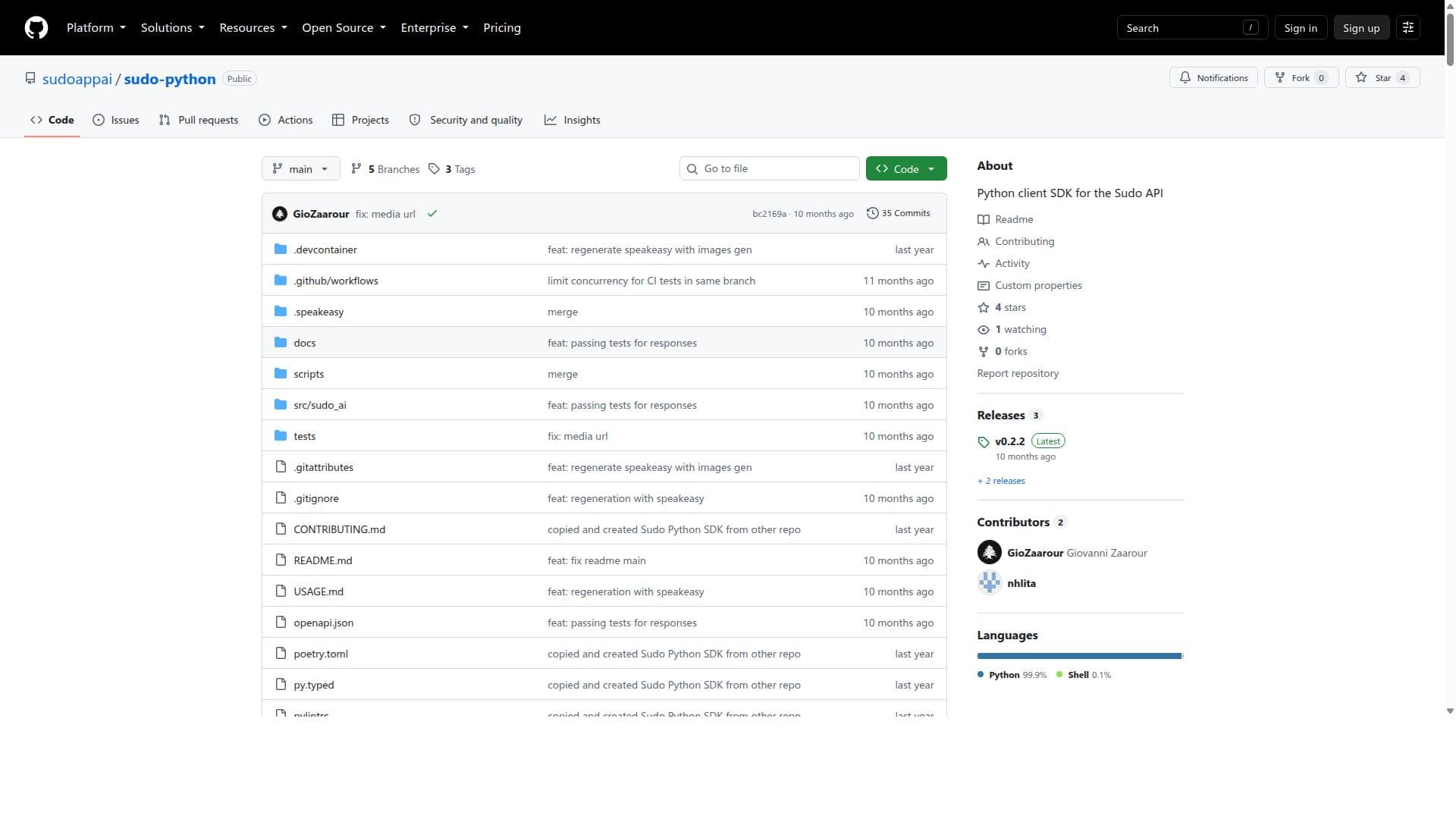
sudo-python is an open-source Python SDK that simplifies integrating the Sudo API into Python applications, enabling efficient backend service communication. It is ideal for Python developers seeking a streamlined, community-supported way to leverage Sudo’s platform capabilities within their projects.

Descripción
Sudo is a unified API for LLMs — the faster, cheaper way to route across OpenAI, Anthropic, Gemini, and more. One endpoint for lower latency, higher throughput, and lower costs than alternatives. Build smarter, scale faster, and do so with zero lock-in
Descripción detallada
sudo-python is a specialized Python client SDK designed to facilitate seamless interaction with the Sudo API, a platform that provides various backend services and functionalities. Its core purpose is to enable developers to easily integrate the capabilities of the Sudo platform into their Python applications, streamlining API communication and operational workflows. By providing a dedicated SDK, sudo-python abstracts the complexities of direct API calls, allowing developers to focus on building features rather than managing low-level HTTP requests and responses. At its heart, sudo-python offers a robust and intuitive interface for accessing the Sudo platform’s services. Key features include comprehensive support for all API endpoints exposed by Sudo, enabling developers to perform operations such as user authentication, data management, and service orchestration directly from Python code. The SDK handles authentication tokens, request formatting, and error handling internally, which simplifies development and reduces the chance of integration errors. Being open source and hosted on GitHub, sudo-python encourages community contributions, making it a continuously evolving tool that benefits from collaborative improvements and transparency. The SDK is particularly well-suited for Python developers building applications that require backend integration with the Sudo platform. This includes web developers, data scientists, and software engineers who want to leverage Sudo’s API for tasks such as managing user identities, accessing secure data storage, or orchestrating backend workflows. Use cases range from building secure mobile or web apps to automating backend processes that rely on Sudo’s services. Its Python-native design makes it an excellent choice for teams already invested in the Python ecosystem who want to maintain consistency in their technology stack. Regarding pricing, sudo-python itself is an open-source SDK and is freely available to use and modify. However, usage of the underlying Sudo API platform may be subject to its own pricing plans, which typically depend on API call volume, feature access, or subscription tiers. Developers should review the Sudo platform’s pricing details on their official website to understand any costs associated with API usage. The open-source nature of sudo-python means there are no additional fees for the SDK itself, making it a cost-effective option for integrating Sudo’s services. When compared to alternatives, sudo-python stands out by offering a dedicated, Python-centric client that is specifically tailored for the Sudo API. While generic HTTP clients or REST API wrappers can be used to interact with Sudo, sudo-python provides a higher level of abstraction, reducing boilerplate code and improving developer productivity. Its open-source status also contrasts with some proprietary SDKs, offering greater flexibility and community-driven enhancements. However, it is specialized for Sudo’s ecosystem, so developers working with multiple APIs might need additional tools for other services. Notable limitations include its dependency on the Sudo platform’s API availability and stability. Since sudo-python is a client SDK, any changes or downtime in the Sudo API can directly impact applications using the SDK. Additionally, as an open-source project, the level of official support may vary, and users might need to rely on community forums or contribute to the codebase themselves for fixes and feature requests. Finally, while the SDK simplifies integration, developers still need familiarity with Python programming and API concepts to effectively use the tool. In summary, sudo-python is a powerful, open-source Python SDK that streamlines integration with the Sudo API, making it an ideal choice for developers looking to embed Sudo’s backend services into their Python applications. Its feature-rich design, community-driven development, and ease of use provide significant advantages, especially for those already working within the Python ecosystem.
Características de la herramienta
- Python client SDK for the Sudo API
- Enables integration with Sudo platform
- Facilitates API communication in Python applications
- Open source and available on GitHub
- Supports development and contribution by community
Descripción
sudo-python is an open-source Python SDK that simplifies integrating the Sudo API into Python applications, enabling efficient backend service communication. It is ideal for Python developers seeking a streamlined, community-supported way to leverage Sudo’s platform capabilities within their projects.
Sudo is a unified API for LLMs — the faster, cheaper way to route across OpenAI, Anthropic, Gemini, and more. One endpoint for lower latency, higher throughput, and lower costs than alternatives. Build smarter, scale faster, and do so with zero lock-in
Descripción detallada
sudo-python is a specialized Python client SDK designed to facilitate seamless interaction with the Sudo API, a platform that provides various backend services and functionalities. Its core purpose is to enable developers to easily integrate the capabilities of the Sudo platform into their Python applications, streamlining API communication and operational workflows. By providing a dedicated SDK, sudo-python abstracts the complexities of direct API calls, allowing developers to focus on building features rather than managing low-level HTTP requests and responses. At its heart, sudo-python offers a robust and intuitive interface for accessing the Sudo platform’s services. Key features include comprehensive support for all API endpoints exposed by Sudo, enabling developers to perform operations such as user authentication, data management, and service orchestration directly from Python code. The SDK handles authentication tokens, request formatting, and error handling internally, which simplifies development and reduces the chance of integration errors. Being open source and hosted on GitHub, sudo-python encourages community contributions, making it a continuously evolving tool that benefits from collaborative improvements and transparency. The SDK is particularly well-suited for Python developers building applications that require backend integration with the Sudo platform. This includes web developers, data scientists, and software engineers who want to leverage Sudo’s API for tasks such as managing user identities, accessing secure data storage, or orchestrating backend workflows. Use cases range from building secure mobile or web apps to automating backend processes that rely on Sudo’s services. Its Python-native design makes it an excellent choice for teams already invested in the Python ecosystem who want to maintain consistency in their technology stack. Regarding pricing, sudo-python itself is an open-source SDK and is freely available to use and modify. However, usage of the underlying Sudo API platform may be subject to its own pricing plans, which typically depend on API call volume, feature access, or subscription tiers. Developers should review the Sudo platform’s pricing details on their official website to understand any costs associated with API usage. The open-source nature of sudo-python means there are no additional fees for the SDK itself, making it a cost-effective option for integrating Sudo’s services. When compared to alternatives, sudo-python stands out by offering a dedicated, Python-centric client that is specifically tailored for the Sudo API. While generic HTTP clients or REST API wrappers can be used to interact with Sudo, sudo-python provides a higher level of abstraction, reducing boilerplate code and improving developer productivity. Its open-source status also contrasts with some proprietary SDKs, offering greater flexibility and community-driven enhancements. However, it is specialized for Sudo’s ecosystem, so developers working with multiple APIs might need additional tools for other services. Notable limitations include its dependency on the Sudo platform’s API availability and stability. Since sudo-python is a client SDK, any changes or downtime in the Sudo API can directly impact applications using the SDK. Additionally, as an open-source project, the level of official support may vary, and users might need to rely on community forums or contribute to the codebase themselves for fixes and feature requests. Finally, while the SDK simplifies integration, developers still need familiarity with Python programming and API concepts to effectively use the tool. In summary, sudo-python is a powerful, open-source Python SDK that streamlines integration with the Sudo API, making it an ideal choice for developers looking to embed Sudo’s backend services into their Python applications. Its feature-rich design, community-driven development, and ease of use provide significant advantages, especially for those already working within the Python ecosystem.
Preguntas frecuentes
What is sudo-python?
sudo-python is a Python client SDK designed to interact with the Sudo API, allowing developers to integrate and utilize Sudo platform functionalities within their Python applications.
How much does sudo-python cost?
sudo-python is an open-source SDK available for free. However, using the underlying Sudo API platform may involve costs depending on the API usage and subscription plans offered by Sudo.
Who is sudo-python best for?
sudo-python is best suited for Python developers and software engineers who want to integrate Sudo platform services into their applications, including web developers, data scientists, and backend engineers.
What are the main features of sudo-python?
Key features include a Python-native client for the Sudo API, support for all API endpoints, built-in authentication handling, error management, and an open-source codebase encouraging community contributions.
Does sudo-python offer a free trial?
As an open-source SDK, sudo-python itself is free to use without a trial. Access to the Sudo API platform may have its own trial or free tier options, which should be checked on Sudo’s official site.
What integrations does sudo-python support?
sudo-python integrates directly with the Sudo API platform, enabling Python applications to access and utilize the full range of services provided by Sudo.
How does sudo-python work?
sudo-python works by providing a Python interface that wraps the Sudo API endpoints, managing authentication, request formatting, and response handling to simplify API communication within Python applications.
Redes sociales
Usar herramientaReseñas
Aún no hay reseñas. Sé el primero en compartir tu experiencia.
Herramientas patrocinadas

























Herramientas recomendadas
Mantente al día con las últimas herramientas de IA
Obtén las últimas novedades, únete a nuestro boletín
Leído y confiado por 50,000+ lectores
Únete a la comunidad de IA más grande
¡Nuestra comunidad y equipo están aquí para ayudarte!
Tus comentarios ayudarán a Alice AI a mejorar en futuras versiones.








Enviar tu herramienta


PoweredByAI.app es un directorio de herramientas de IA que ayuda a personas, empresas y creadores a descubrir las mejores herramientas de IA para escritura, programación, diseño, productividad y más.
© 2026 , Producto de011BQ. Todos los derechos reservados.