🚀 Zaprep: Tus redes sociales al máximo. Empezar gratis — automatiza 1,000 DMs/mes y convierte el engagement en leads. con 1,000 DMs automatizados/mes.


¿Es esta tu herramienta de IA? Reclámala hoy.
Verifica la propiedad, gestiona tu perfil y desbloquea funciones de crecimiento.
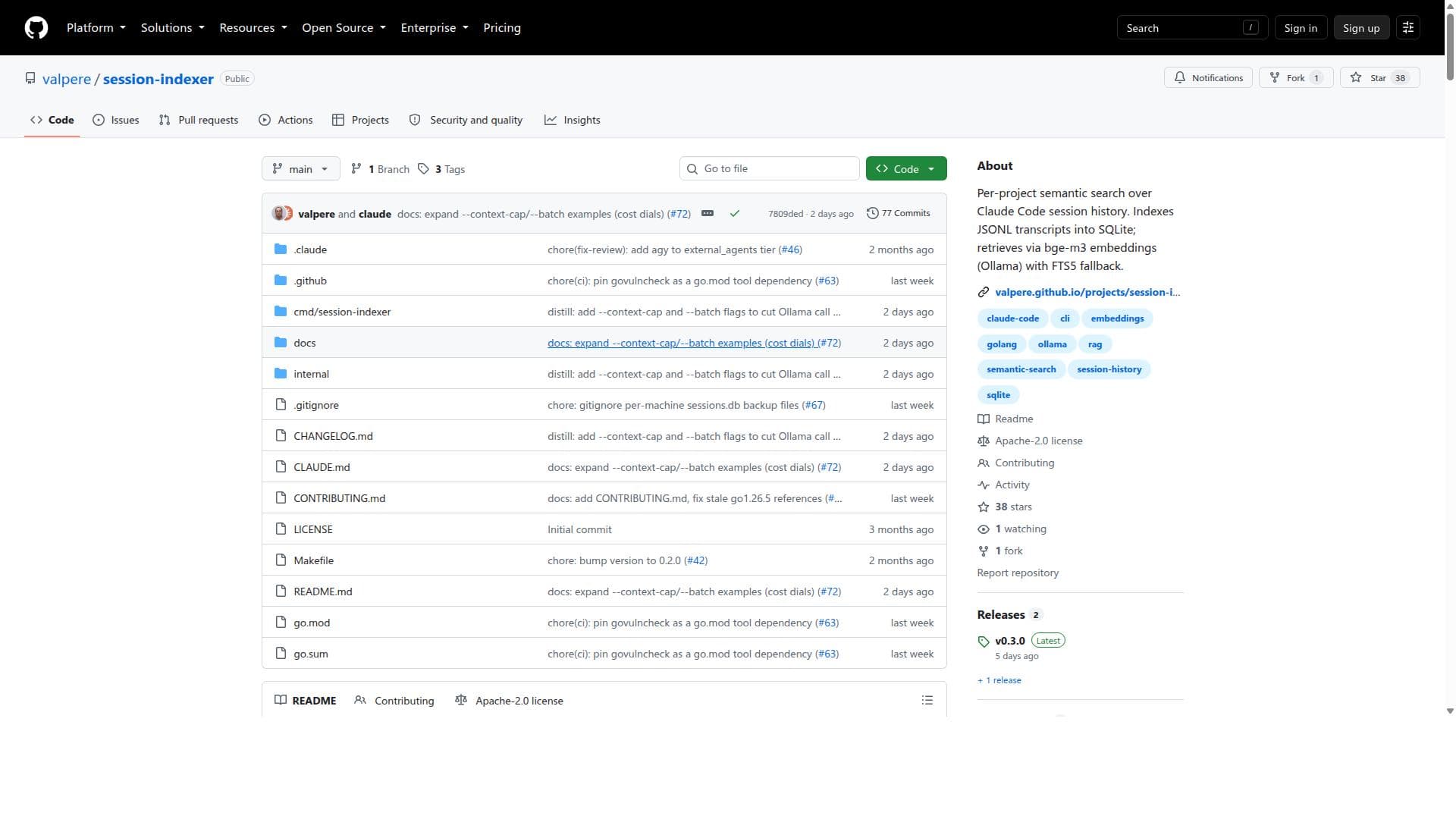
Session-indexer offers developers a powerful way to semantically search their Claude Code session histories on a per-project basis by indexing transcripts into SQLite and leveraging advanced embeddings. Ideal for software engineers and teams, it transforms raw session data into an easily navigable knowledge base, boosting productivity and code recall.

Descripción
Per-project semantic search over your Claude Code session history — not a shared or centralized memory store. Indexes JSONL transcripts into a local SQLite file, retrieves via bge-m3 embeddings (Ollama) with automatic FTS5 BM25 fallback, and auto-injects relevant past context at session start. Companion to session-end: session-end gives "where I left off," session-indexer gives "what we decided" — same Stop/SessionStart hooks. Apache 2.0, 75 passing tests, go install and nothing to deploy.
Descripción detallada
Session-indexer is a specialized tool designed to enhance the way developers and teams interact with their Claude Code session histories by enabling per-project semantic search capabilities. At its core, session-indexer processes JSONL transcript files generated from Claude Code sessions and indexes them into a SQLite database. This indexing allows users to perform efficient and meaningful semantic queries over their session data, rather than relying solely on traditional keyword-based search. By leveraging advanced embedding models and fallback mechanisms, session-indexer transforms raw session transcripts into a searchable knowledge base that can be queried with natural language or semantic intent. One of the standout features of session-indexer is its use of bge-m3 embeddings provided by Ollama. These embeddings convert textual session data into high-dimensional vector representations that capture semantic meaning, enabling the tool to retrieve relevant session snippets even when exact keywords are not present. This semantic retrieval is complemented by an FTS5 (Full-Text Search 5) fallback mechanism within SQLite, which ensures that if embedding-based search does not yield results, a traditional full-text search is performed. This dual approach guarantees robust and comprehensive search results across diverse query types. Session-indexer is designed with a per-project focus, meaning that each project’s Claude Code session history is indexed and searched independently. This organization allows users to maintain contextually relevant search results tied to specific projects, which is particularly valuable for developers juggling multiple codebases or clients. The tool’s reliance on SQLite for storage ensures lightweight, fast, and portable indexing without the need for complex database infrastructure. The primary audience for session-indexer includes software developers, engineering teams, and technical project managers who use Claude Code for coding assistance and want to efficiently revisit past sessions. It is especially useful for those who need to quickly locate previous code snippets, discussions, or problem-solving steps within their session history without manually sifting through lengthy transcripts. By enabling semantic search, session-indexer helps users save time, reduce cognitive load, and improve productivity when referencing prior work. Regarding pricing, session-indexer is an open-source project available on GitHub, which means it is free to use and modify. Users can download and deploy the tool without licensing fees, making it accessible for individual developers and organizations alike. However, users should consider potential costs related to running Ollama’s embedding models, depending on their deployment and usage scenarios. Compared to alternative session search tools, session-indexer’s unique combination of semantic embeddings and SQLite-based indexing offers a lightweight yet powerful solution. While some tools rely solely on keyword search or require heavy cloud infrastructure, session-indexer balances semantic depth with local database efficiency. Its integration with Claude Code session history also distinguishes it from generic code search tools, providing tailored functionality for users of Claude Code. Despite its strengths, session-indexer has some limitations. Its effectiveness depends on the quality and completeness of the JSONL transcripts from Claude Code sessions. Additionally, users must have access to Ollama’s bge-m3 embeddings, which may require setup and familiarity with the Ollama environment. The fallback to FTS5, while useful, may not always match the semantic precision of embeddings. Finally, as an open-source tool, it may lack dedicated commercial support or a polished user interface, which could be a consideration for enterprise users. In summary, session-indexer is a robust, open-source semantic search tool tailored for developers who want to efficiently query their Claude Code session histories on a per-project basis. Its intelligent use of embeddings combined with SQLite indexing makes it a practical choice for improving code session recall and productivity, especially for those invested in the Claude Code ecosystem.
Características de la herramienta
- Per-project semantic search over Claude Code session history
- Indexes JSONL transcripts into SQLite
- Retrieves data via bge-m3 embeddings (Ollama)
- Uses FTS5 fallback for retrieval
Descripción
Session-indexer offers developers a powerful way to semantically search their Claude Code session histories on a per-project basis by indexing transcripts into SQLite and leveraging advanced embeddings. Ideal for software engineers and teams, it transforms raw session data into an easily navigable knowledge base, boosting productivity and code recall.
Per-project semantic search over your Claude Code session history — not a shared or centralized memory store. Indexes JSONL transcripts into a local SQLite file, retrieves via bge-m3 embeddings (Ollama) with automatic FTS5 BM25 fallback, and auto-injects relevant past context at session start. Companion to session-end: session-end gives "where I left off," session-indexer gives "what we decided" — same Stop/SessionStart hooks. Apache 2.0, 75 passing tests, go install and nothing to deploy.
Descripción detallada
Session-indexer is a specialized tool designed to enhance the way developers and teams interact with their Claude Code session histories by enabling per-project semantic search capabilities. At its core, session-indexer processes JSONL transcript files generated from Claude Code sessions and indexes them into a SQLite database. This indexing allows users to perform efficient and meaningful semantic queries over their session data, rather than relying solely on traditional keyword-based search. By leveraging advanced embedding models and fallback mechanisms, session-indexer transforms raw session transcripts into a searchable knowledge base that can be queried with natural language or semantic intent. One of the standout features of session-indexer is its use of bge-m3 embeddings provided by Ollama. These embeddings convert textual session data into high-dimensional vector representations that capture semantic meaning, enabling the tool to retrieve relevant session snippets even when exact keywords are not present. This semantic retrieval is complemented by an FTS5 (Full-Text Search 5) fallback mechanism within SQLite, which ensures that if embedding-based search does not yield results, a traditional full-text search is performed. This dual approach guarantees robust and comprehensive search results across diverse query types. Session-indexer is designed with a per-project focus, meaning that each project’s Claude Code session history is indexed and searched independently. This organization allows users to maintain contextually relevant search results tied to specific projects, which is particularly valuable for developers juggling multiple codebases or clients. The tool’s reliance on SQLite for storage ensures lightweight, fast, and portable indexing without the need for complex database infrastructure. The primary audience for session-indexer includes software developers, engineering teams, and technical project managers who use Claude Code for coding assistance and want to efficiently revisit past sessions. It is especially useful for those who need to quickly locate previous code snippets, discussions, or problem-solving steps within their session history without manually sifting through lengthy transcripts. By enabling semantic search, session-indexer helps users save time, reduce cognitive load, and improve productivity when referencing prior work. Regarding pricing, session-indexer is an open-source project available on GitHub, which means it is free to use and modify. Users can download and deploy the tool without licensing fees, making it accessible for individual developers and organizations alike. However, users should consider potential costs related to running Ollama’s embedding models, depending on their deployment and usage scenarios. Compared to alternative session search tools, session-indexer’s unique combination of semantic embeddings and SQLite-based indexing offers a lightweight yet powerful solution. While some tools rely solely on keyword search or require heavy cloud infrastructure, session-indexer balances semantic depth with local database efficiency. Its integration with Claude Code session history also distinguishes it from generic code search tools, providing tailored functionality for users of Claude Code. Despite its strengths, session-indexer has some limitations. Its effectiveness depends on the quality and completeness of the JSONL transcripts from Claude Code sessions. Additionally, users must have access to Ollama’s bge-m3 embeddings, which may require setup and familiarity with the Ollama environment. The fallback to FTS5, while useful, may not always match the semantic precision of embeddings. Finally, as an open-source tool, it may lack dedicated commercial support or a polished user interface, which could be a consideration for enterprise users. In summary, session-indexer is a robust, open-source semantic search tool tailored for developers who want to efficiently query their Claude Code session histories on a per-project basis. Its intelligent use of embeddings combined with SQLite indexing makes it a practical choice for improving code session recall and productivity, especially for those invested in the Claude Code ecosystem.
Preguntas frecuentes
What is session-indexer?
Session-indexer is an open-source tool that enables semantic search over Claude Code session histories by indexing JSONL transcripts into a SQLite database and retrieving relevant data using advanced embeddings and fallback full-text search.
How much does session-indexer cost?
Session-indexer is free to use and open-source, available on GitHub. However, users may incur costs related to running Ollama’s embedding models depending on their setup.
Who is session-indexer best for?
It is best suited for software developers, engineering teams, and technical project managers who use Claude Code and want to efficiently search and reference their past coding sessions on a per-project basis.
What are the main features of session-indexer?
Key features include per-project semantic search over Claude Code session history, indexing JSONL transcripts into SQLite, retrieval using bge-m3 embeddings from Ollama, and an FTS5 fallback for robust search results.
Does session-indexer offer a free trial?
As an open-source tool, session-indexer is freely available without a trial period. Users can download and use it immediately from its GitHub repository.
What integrations does session-indexer support?
Session-indexer primarily integrates with Claude Code by indexing its JSONL session transcripts and uses Ollama’s bge-m3 embedding model for semantic retrieval.
How does session-indexer work?
It works by ingesting JSONL transcripts from Claude Code sessions, indexing them into a SQLite database, and enabling semantic search via vector embeddings generated by Ollama’s bge-m3 model, with a fallback to SQLite’s FTS5 full-text search for comprehensive retrieval.
Redes sociales
Usar herramientaReseñas
Aún no hay reseñas. Sé el primero en compartir tu experiencia.
Herramientas patrocinadas





















Herramientas recomendadas
Mantente al día con las últimas herramientas de IA
Obtén las últimas novedades, únete a nuestro boletín
Leído y confiado por 50,000+ lectores
Únete a la comunidad de IA más grande
¡Nuestra comunidad y equipo están aquí para ayudarte!
Tus comentarios ayudarán a Alice AI a mejorar en futuras versiones.








Enviar tu herramienta


PoweredByAI.app es un directorio de herramientas de IA que ayuda a personas, empresas y creadores a descubrir las mejores herramientas de IA para escritura, programación, diseño, productividad y más.
© 2026 , Producto de011BQ. Todos los derechos reservados.