🚀 Zaprep: Tus redes sociales al máximo. Empezar gratis — automatiza 1,000 DMs/mes y convierte el engagement en leads. con 1,000 DMs automatizados/mes.


¿Es esta tu herramienta de IA? Reclámala hoy.
Verifica la propiedad, gestiona tu perfil y desbloquea funciones de crecimiento.
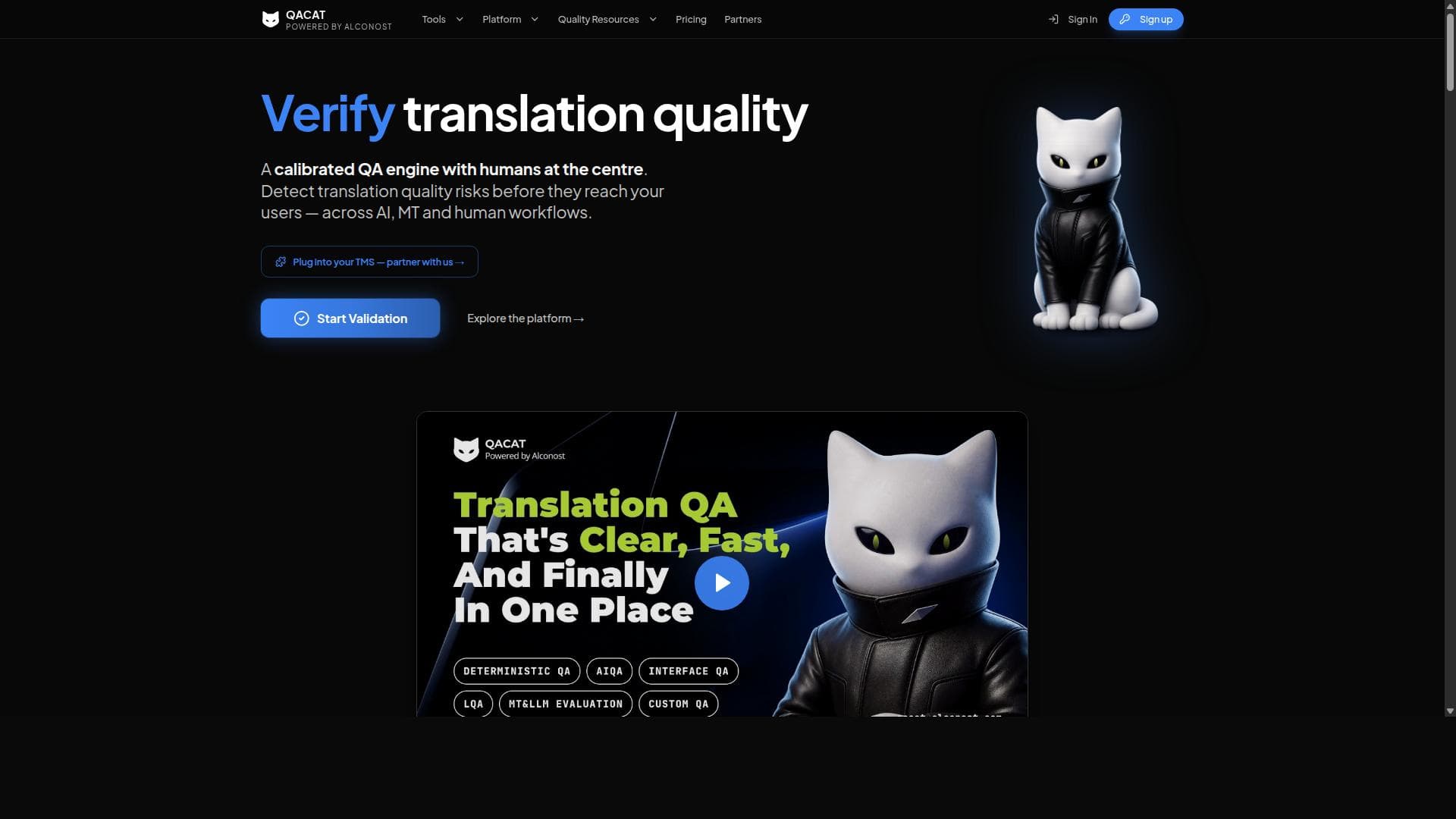
QACAT is a powerful localization quality assurance platform that uniquely combines rule-based automation, AI-driven analysis, and expert human review to ensure top-tier translation quality. Ideal for translation teams and localization agencies, it streamlines QA workflows with integrations to Crowdin and Smartcat, making it an indispensable tool for managing multilingual content with precision and efficiency.

Descripción
QACAT is a hybrid translation QA platform combining automated rule checks, AI analysis, and expert human review. Upload screenshots and review translations in real product UI — built-in OCR pulls the text for you. Every run gives a structured, scored report with severity breakdowns and an AI summary of what to fix. Works across 100+ languages. Powered by Alconost.
Descripción detallada
QACAT is a comprehensive localization quality assurance platform designed to elevate the accuracy, consistency, and overall quality of translations for global products and services. Its core purpose is to provide translation teams and localization agencies with an integrated suite of tools that combine automated, AI-driven, and human linguistic quality assurance methods. By merging deterministic rule-based automated quality assurance (AQA), scalable AI-powered quality analysis (AIQA), expert human linguistic QA (LQA), and in-context linguistic testing (LQT), QACAT offers a multi-layered approach to translation quality control. This ensures that localized content not only meets linguistic standards but also aligns with contextual and cultural expectations, ultimately enhancing user experience across languages and regions. At the heart of QACAT’s capabilities is its AQA feature, which performs deterministic, rule-based checks to identify common translation errors such as inconsistencies, missing tags, formatting issues, and terminology deviations. This automated layer quickly flags straightforward mistakes, accelerating the initial quality control process. Complementing this is AIQA, which leverages curated large language models (LLMs) to conduct scalable, AI-driven quality analysis. AIQA can assess translation quality beyond simple rule violations by evaluating fluency, adequacy, and style, providing a nuanced quality score that helps prioritize human review efforts. For the most critical evaluations, QACAT offers LQA, a human linguistic quality assurance process that uses MQM-style scorecards to deliver expert assessments of translation quality, error typology, and severity. This human-in-the-loop approach ensures that complex linguistic nuances and cultural appropriateness are thoroughly vetted. QACAT also supports in-context linguistic testing (LQT), enabling reviewers to test translations directly within the product interface using screenshots. This feature is crucial for identifying context-specific issues that may not be apparent in isolated text strings, such as UI truncations, layout problems, or contextual mistranslations. Additionally, QACAT includes machine translation (MT) evaluation tools that score MT output quality, helping teams benchmark and improve their MT engines. The platform integrates seamlessly with popular localization management systems Crowdin and Smartcat, allowing translation teams to incorporate QACAT’s QA workflows directly into their existing processes. It also provides glossary and reference file management to maintain terminology consistency, as well as linguist performance analytics and API access for advanced customization and reporting. QACAT is best suited for professional translation teams, localization agencies, and enterprises managing multilingual content at scale. It is particularly valuable for organizations that require rigorous quality assurance across multiple languages and content types, including software, websites, marketing materials, and documentation. Use cases include pre-release translation validation, continuous localization QA in agile workflows, MT output evaluation, and linguistic testing of UI elements. By combining automated, AI, and human QA, QACAT helps reduce costly post-release errors, improve translator productivity, and ensure a high-quality localized user experience. Regarding pricing, QACAT offers tiered plans ranging from $15 to $250 USD, catering to different team sizes and usage needs. The pricing structure includes multiple offers to accommodate small teams, growing agencies, and large enterprises, with details available on their website. This flexible pricing allows organizations to scale their QA capabilities according to project complexity and volume. Compared to alternatives, QACAT stands out by integrating multiple QA methodologies into a single platform, combining rule-based automation, AI-driven analysis, and human expertise. Many competitors focus on either automated checks or human review separately, but QACAT’s hybrid approach provides a more comprehensive quality assurance process. Its direct integrations with Crowdin and Smartcat also streamline workflows for teams already using these popular localization platforms. However, while QACAT excels in linguistic QA, organizations seeking broader localization project management or CAT tool functionalities may need to complement it with other specialized software. One notable consideration is that QACAT’s advanced AIQA and LQA features may require some onboarding and training to maximize their effectiveness, especially for teams new to MQM-style evaluations or AI-driven quality metrics. Additionally, while the platform supports API access, technical resources may be needed to fully integrate QACAT into complex localization pipelines. Finally, as with any AI-powered tool, users should validate AIQA results with human review to ensure accuracy and cultural appropriateness. Overall, QACAT offers a powerful, multi-faceted solution for organizations committed to delivering high-quality localized content efficiently and reliably.
Características de la herramienta
- AQA — deterministic rule-based QA checks
- AIQA — scalable AI-driven quality analysis with curated LLM models
- LQA — expert human evaluation using MQM-style scorecards
- LQT — in-context linguistic testing with screenshots
- MT Evaluation — machine translation quality scoring
- Crowdin integration
- Smartcat integration
- Glossary and reference file management
- Linguist performance analytics
- API access
Descripción
QACAT is a powerful localization quality assurance platform that uniquely combines rule-based automation, AI-driven analysis, and expert human review to ensure top-tier translation quality. Ideal for translation teams and localization agencies, it streamlines QA workflows with integrations to Crowdin and Smartcat, making it an indispensable tool for managing multilingual content with precision and efficiency.
QACAT is a hybrid translation QA platform combining automated rule checks, AI analysis, and expert human review. Upload screenshots and review translations in real product UI — built-in OCR pulls the text for you. Every run gives a structured, scored report with severity breakdowns and an AI summary of what to fix. Works across 100+ languages. Powered by Alconost.
Descripción detallada
QACAT is a comprehensive localization quality assurance platform designed to elevate the accuracy, consistency, and overall quality of translations for global products and services. Its core purpose is to provide translation teams and localization agencies with an integrated suite of tools that combine automated, AI-driven, and human linguistic quality assurance methods. By merging deterministic rule-based automated quality assurance (AQA), scalable AI-powered quality analysis (AIQA), expert human linguistic QA (LQA), and in-context linguistic testing (LQT), QACAT offers a multi-layered approach to translation quality control. This ensures that localized content not only meets linguistic standards but also aligns with contextual and cultural expectations, ultimately enhancing user experience across languages and regions. At the heart of QACAT’s capabilities is its AQA feature, which performs deterministic, rule-based checks to identify common translation errors such as inconsistencies, missing tags, formatting issues, and terminology deviations. This automated layer quickly flags straightforward mistakes, accelerating the initial quality control process. Complementing this is AIQA, which leverages curated large language models (LLMs) to conduct scalable, AI-driven quality analysis. AIQA can assess translation quality beyond simple rule violations by evaluating fluency, adequacy, and style, providing a nuanced quality score that helps prioritize human review efforts. For the most critical evaluations, QACAT offers LQA, a human linguistic quality assurance process that uses MQM-style scorecards to deliver expert assessments of translation quality, error typology, and severity. This human-in-the-loop approach ensures that complex linguistic nuances and cultural appropriateness are thoroughly vetted. QACAT also supports in-context linguistic testing (LQT), enabling reviewers to test translations directly within the product interface using screenshots. This feature is crucial for identifying context-specific issues that may not be apparent in isolated text strings, such as UI truncations, layout problems, or contextual mistranslations. Additionally, QACAT includes machine translation (MT) evaluation tools that score MT output quality, helping teams benchmark and improve their MT engines. The platform integrates seamlessly with popular localization management systems Crowdin and Smartcat, allowing translation teams to incorporate QACAT’s QA workflows directly into their existing processes. It also provides glossary and reference file management to maintain terminology consistency, as well as linguist performance analytics and API access for advanced customization and reporting. QACAT is best suited for professional translation teams, localization agencies, and enterprises managing multilingual content at scale. It is particularly valuable for organizations that require rigorous quality assurance across multiple languages and content types, including software, websites, marketing materials, and documentation. Use cases include pre-release translation validation, continuous localization QA in agile workflows, MT output evaluation, and linguistic testing of UI elements. By combining automated, AI, and human QA, QACAT helps reduce costly post-release errors, improve translator productivity, and ensure a high-quality localized user experience. Regarding pricing, QACAT offers tiered plans ranging from $15 to $250 USD, catering to different team sizes and usage needs. The pricing structure includes multiple offers to accommodate small teams, growing agencies, and large enterprises, with details available on their website. This flexible pricing allows organizations to scale their QA capabilities according to project complexity and volume. Compared to alternatives, QACAT stands out by integrating multiple QA methodologies into a single platform, combining rule-based automation, AI-driven analysis, and human expertise. Many competitors focus on either automated checks or human review separately, but QACAT’s hybrid approach provides a more comprehensive quality assurance process. Its direct integrations with Crowdin and Smartcat also streamline workflows for teams already using these popular localization platforms. However, while QACAT excels in linguistic QA, organizations seeking broader localization project management or CAT tool functionalities may need to complement it with other specialized software. One notable consideration is that QACAT’s advanced AIQA and LQA features may require some onboarding and training to maximize their effectiveness, especially for teams new to MQM-style evaluations or AI-driven quality metrics. Additionally, while the platform supports API access, technical resources may be needed to fully integrate QACAT into complex localization pipelines. Finally, as with any AI-powered tool, users should validate AIQA results with human review to ensure accuracy and cultural appropriateness. Overall, QACAT offers a powerful, multi-faceted solution for organizations committed to delivering high-quality localized content efficiently and reliably.
Preguntas frecuentes
What is QACAT?
QACAT is a localization quality assurance platform that integrates rule-based automated checks, AI-driven quality analysis, human linguistic QA, and in-context linguistic testing to help translation teams and localization agencies ensure high-quality translations.
How much does QACAT cost?
QACAT offers tiered pricing plans ranging from $15 to $250 USD, designed to accommodate different team sizes and usage requirements. Detailed pricing information is available on their website.
Who is QACAT best for?
QACAT is best suited for professional translation teams, localization agencies, and enterprises managing multilingual content who need comprehensive quality assurance across automated, AI-driven, and human review processes.
What are the main features of QACAT?
Key features include deterministic rule-based QA checks (AQA), scalable AI-driven quality analysis with curated LLM models (AIQA), expert human evaluation using MQM-style scorecards (LQA), in-context linguistic testing with screenshots (LQT), machine translation quality scoring, integrations with Crowdin and Smartcat, glossary and reference file management, linguist performance analytics, and API access.
Does QACAT offer a free trial?
The available information does not explicitly mention a free trial. Interested users should contact QACAT directly via their website or support email to inquire about trial options.
What integrations does QACAT support?
QACAT integrates directly with popular localization management platforms Crowdin and Smartcat, enabling seamless incorporation of QA workflows into existing translation processes.
How does QACAT work?
QACAT works by combining multiple QA approaches: it uses rule-based automated checks to catch common errors, AI-driven analysis to evaluate translation quality at scale, human expert reviews for detailed linguistic evaluation, and in-context testing to verify translations within the actual product interface. These layers work together to provide comprehensive translation quality assurance.
Redes sociales
Usar herramientaReseñas
Aún no hay reseñas. Sé el primero en compartir tu experiencia.
Herramientas patrocinadas






























Herramientas recomendadas
Mantente al día con las últimas herramientas de IA
Obtén las últimas novedades, únete a nuestro boletín
Leído y confiado por 50,000+ lectores
Únete a la comunidad de IA más grande
¡Nuestra comunidad y equipo están aquí para ayudarte!
Tus comentarios ayudarán a Alice AI a mejorar en futuras versiones.








Enviar tu herramienta


PoweredByAI.app es un directorio de herramientas de IA que ayuda a personas, empresas y creadores a descubrir las mejores herramientas de IA para escritura, programación, diseño, productividad y más.
© 2026 , Producto de011BQ. Todos los derechos reservados.