🚀 Zaprep: Tus redes sociales al máximo. Empezar gratis — automatiza 1,000 DMs/mes y convierte el engagement en leads. con 1,000 DMs automatizados/mes.


¿Es esta tu herramienta de IA? Reclámala hoy.
Verifica la propiedad, gestiona tu perfil y desbloquea funciones de crecimiento.
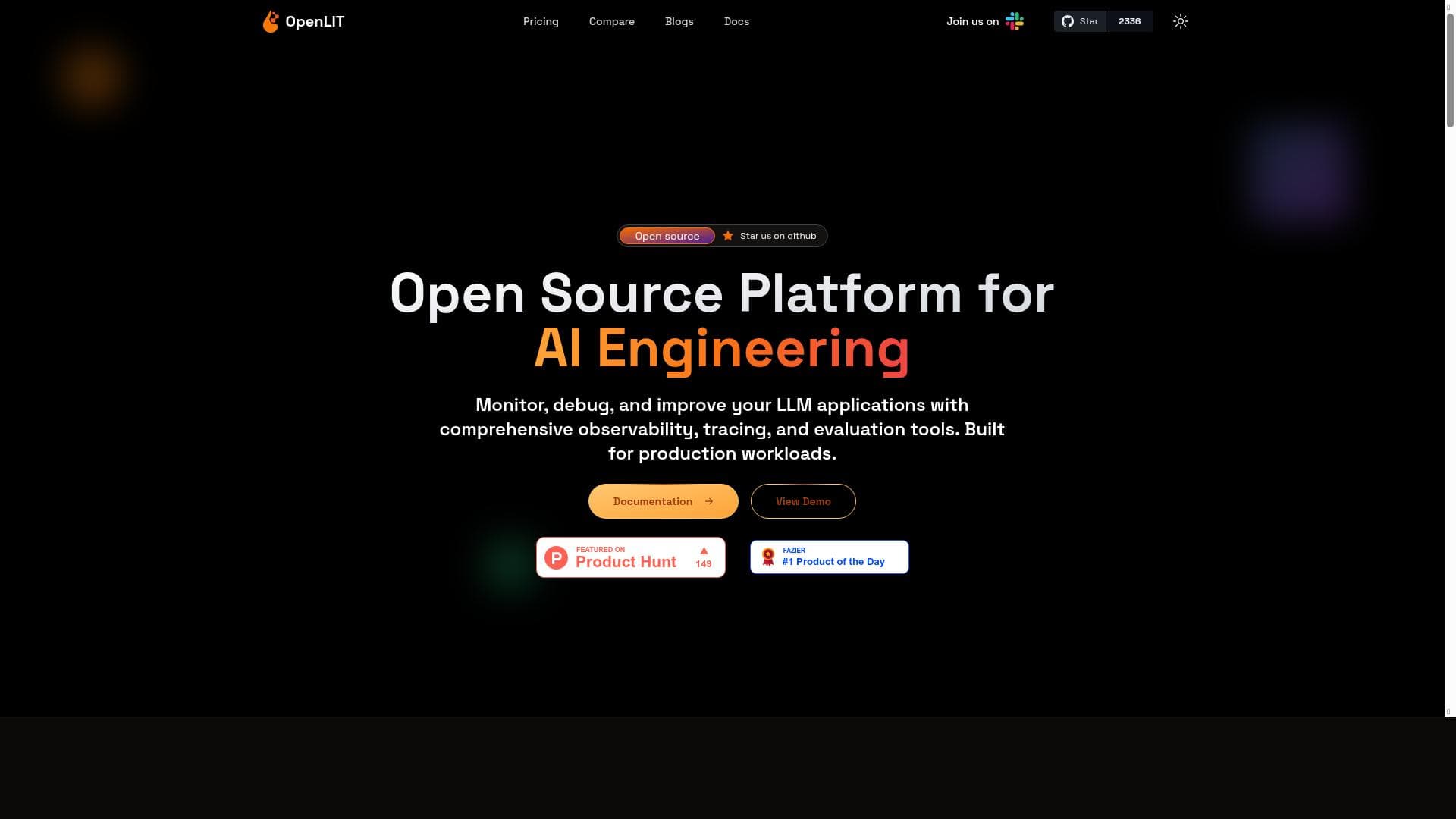
OpenLIT 2.0 is an open-source, self-hosted platform that empowers developers to experiment with large language models while ensuring security and deep observability through OpenTelemetry integration. Ideal for teams needing prompt management, secure API key handling, and scalable AI deployments, it offers a robust, cost-free solution for building and managing AI applications with full control.

Descripción
OpenLIT is an open-source, self-hosted tool for developing AI apps. It allows for LLM experimentation, prompt management, secure API key handling, and protection against prompt injection. It also offers OpenTelemetry-native observability for the GenAI stack.
Descripción detallada
OpenLIT 2.0 is a comprehensive, open-source, and self-hosted platform designed specifically for developing AI applications with a strong emphasis on large language model (LLM) experimentation and management. Its core purpose is to empower developers, data scientists, and AI practitioners to build, test, and deploy AI-driven solutions while ensuring security, observability, and operational control. By providing a unified environment that integrates prompt management, secure API key handling, and robust protection against prompt injection attacks, OpenLIT 2.0 addresses many of the challenges associated with managing AI models and their interactions in production settings. One of the standout aspects of OpenLIT 2.0 is its rich feature set that caters to the entire AI development lifecycle. The platform offers Unified Traces and Metrics, which consolidate observability data across the AI stack, enabling users to monitor performance and diagnose issues effectively. Its native support for OpenTelemetry means that OpenLIT seamlessly integrates with industry-standard observability tools, providing detailed insights into the behavior of generative AI models. The LLM Observability feature further enhances transparency by allowing users to track model outputs and interactions, which is crucial for debugging and improving AI applications. OpenLIT 2.0 also includes specialized hubs such as Fleet Hub and Prompt Hub. Fleet Hub facilitates the management and orchestration of multiple AI model instances, making it easier to scale and maintain AI deployments. Prompt Hub serves as a centralized repository for prompt templates and experiments, streamlining prompt engineering workflows and fostering collaboration among teams. Security is a key focus, with Vault providing secure storage and handling of API keys and sensitive credentials, while built-in protections guard against prompt injection attacks that could compromise AI outputs or system integrity. For deployment and infrastructure management, OpenLIT 2.0 offers a Kubernetes Operator, enabling seamless integration with Kubernetes clusters for scalable, containerized deployments. OpenGround, another component, supports data and model versioning, ensuring reproducibility and governance over AI assets. OpenLIT 2.0 is best suited for organizations and developers who require a high degree of control and customization over their AI applications. It is ideal for teams experimenting with LLMs who need to manage multiple models, prompts, and API keys securely within a self-hosted environment. Use cases include AI research labs, enterprises building proprietary AI solutions, and startups focused on generative AI products that demand observability and security compliance. The platform is offered completely free of charge, reflecting its open-source nature. This makes it an attractive option for budget-conscious teams and those who prefer to avoid vendor lock-in. Users can download, deploy, and customize OpenLIT 2.0 without licensing fees, though they will need to manage their own hosting infrastructure. Compared to alternative AI development tools, OpenLIT 2.0 stands out due to its combination of open-source accessibility, comprehensive observability features, and strong security mechanisms. While many commercial platforms offer similar capabilities, they often come with higher costs and less flexibility. OpenLIT’s Kubernetes Operator and OpenTelemetry integration provide advanced operational benefits that are not always available in competing solutions. However, there are some considerations to keep in mind. Being self-hosted, OpenLIT 2.0 requires users to have the technical expertise and resources to manage their own infrastructure, which may be a barrier for smaller teams or those without DevOps capabilities. Additionally, as an open-source project, support and documentation may vary compared to commercial offerings. Users should also consider the ongoing maintenance and updates necessary to keep the platform secure and performant. In summary, OpenLIT 2.0 is a powerful, secure, and observability-focused platform for AI app development, particularly suited for organizations that prioritize control, transparency, and customization in their AI workflows. Its extensive feature set and open-source model make it a compelling choice for advanced AI experimentation and deployment.
Características de la herramienta
- Unified Traces and Metrics
- OpenTelemetry Support
- LLM Observability
- Fleet Hub
- Prompt Hub
- Vault
- OpenGround
- Kubernetes Operator
Descripción
OpenLIT 2.0 is an open-source, self-hosted platform that empowers developers to experiment with large language models while ensuring security and deep observability through OpenTelemetry integration. Ideal for teams needing prompt management, secure API key handling, and scalable AI deployments, it offers a robust, cost-free solution for building and managing AI applications with full control.
OpenLIT is an open-source, self-hosted tool for developing AI apps. It allows for LLM experimentation, prompt management, secure API key handling, and protection against prompt injection. It also offers OpenTelemetry-native observability for the GenAI stack.
Descripción detallada
OpenLIT 2.0 is a comprehensive, open-source, and self-hosted platform designed specifically for developing AI applications with a strong emphasis on large language model (LLM) experimentation and management. Its core purpose is to empower developers, data scientists, and AI practitioners to build, test, and deploy AI-driven solutions while ensuring security, observability, and operational control. By providing a unified environment that integrates prompt management, secure API key handling, and robust protection against prompt injection attacks, OpenLIT 2.0 addresses many of the challenges associated with managing AI models and their interactions in production settings. One of the standout aspects of OpenLIT 2.0 is its rich feature set that caters to the entire AI development lifecycle. The platform offers Unified Traces and Metrics, which consolidate observability data across the AI stack, enabling users to monitor performance and diagnose issues effectively. Its native support for OpenTelemetry means that OpenLIT seamlessly integrates with industry-standard observability tools, providing detailed insights into the behavior of generative AI models. The LLM Observability feature further enhances transparency by allowing users to track model outputs and interactions, which is crucial for debugging and improving AI applications. OpenLIT 2.0 also includes specialized hubs such as Fleet Hub and Prompt Hub. Fleet Hub facilitates the management and orchestration of multiple AI model instances, making it easier to scale and maintain AI deployments. Prompt Hub serves as a centralized repository for prompt templates and experiments, streamlining prompt engineering workflows and fostering collaboration among teams. Security is a key focus, with Vault providing secure storage and handling of API keys and sensitive credentials, while built-in protections guard against prompt injection attacks that could compromise AI outputs or system integrity. For deployment and infrastructure management, OpenLIT 2.0 offers a Kubernetes Operator, enabling seamless integration with Kubernetes clusters for scalable, containerized deployments. OpenGround, another component, supports data and model versioning, ensuring reproducibility and governance over AI assets. OpenLIT 2.0 is best suited for organizations and developers who require a high degree of control and customization over their AI applications. It is ideal for teams experimenting with LLMs who need to manage multiple models, prompts, and API keys securely within a self-hosted environment. Use cases include AI research labs, enterprises building proprietary AI solutions, and startups focused on generative AI products that demand observability and security compliance. The platform is offered completely free of charge, reflecting its open-source nature. This makes it an attractive option for budget-conscious teams and those who prefer to avoid vendor lock-in. Users can download, deploy, and customize OpenLIT 2.0 without licensing fees, though they will need to manage their own hosting infrastructure. Compared to alternative AI development tools, OpenLIT 2.0 stands out due to its combination of open-source accessibility, comprehensive observability features, and strong security mechanisms. While many commercial platforms offer similar capabilities, they often come with higher costs and less flexibility. OpenLIT’s Kubernetes Operator and OpenTelemetry integration provide advanced operational benefits that are not always available in competing solutions. However, there are some considerations to keep in mind. Being self-hosted, OpenLIT 2.0 requires users to have the technical expertise and resources to manage their own infrastructure, which may be a barrier for smaller teams or those without DevOps capabilities. Additionally, as an open-source project, support and documentation may vary compared to commercial offerings. Users should also consider the ongoing maintenance and updates necessary to keep the platform secure and performant. In summary, OpenLIT 2.0 is a powerful, secure, and observability-focused platform for AI app development, particularly suited for organizations that prioritize control, transparency, and customization in their AI workflows. Its extensive feature set and open-source model make it a compelling choice for advanced AI experimentation and deployment.
Preguntas frecuentes
What is OpenLIT 2.0?
OpenLIT 2.0 is an open-source, self-hosted tool designed for developing AI applications, particularly those involving large language models. It provides features for LLM experimentation, prompt management, secure API key handling, protection against prompt injection, and OpenTelemetry-native observability for the generative AI stack.
How much does OpenLIT 2.0 cost?
OpenLIT 2.0 is completely free to use as it is an open-source platform. Users can download and deploy it without any licensing fees, though they are responsible for their own hosting and infrastructure costs.
Who is OpenLIT 2.0 best for?
OpenLIT 2.0 is best suited for developers, AI researchers, and organizations that require a self-hosted, secure, and customizable environment for building and managing AI applications. It is particularly valuable for teams experimenting with large language models and needing advanced observability and prompt management capabilities.
What are the main features of OpenLIT 2.0?
Key features include Unified Traces and Metrics for consolidated observability, native OpenTelemetry support, LLM Observability to track model behavior, Fleet Hub for managing multiple AI model instances, Prompt Hub for centralized prompt management, Vault for secure API key storage, OpenGround for data and model versioning, and a Kubernetes Operator for scalable deployments.
Does OpenLIT 2.0 offer a free trial?
Since OpenLIT 2.0 is an open-source and free-to-use platform, there is no need for a free trial. Users can immediately download and deploy the software without cost.
What integrations does OpenLIT 2.0 support?
OpenLIT 2.0 supports OpenTelemetry integration for observability and includes a Kubernetes Operator for deployment on Kubernetes clusters. It also integrates with various AI models and APIs through its secure API key management system, though specific third-party integrations depend on user configuration.
How does OpenLIT 2.0 work?
OpenLIT 2.0 operates as a self-hosted platform where users deploy the software on their own infrastructure. It provides tools to experiment with large language models, manage prompts, securely handle API keys, and monitor AI application performance through OpenTelemetry-native observability. Its modular components like Fleet Hub and Prompt Hub facilitate scaling and prompt engineering workflows.
Redes sociales
Usar herramientaReseñas
Aún no hay reseñas. Sé el primero en compartir tu experiencia.
Herramientas patrocinadas






























Herramientas recomendadas
Mantente al día con las últimas herramientas de IA
Obtén las últimas novedades, únete a nuestro boletín
Leído y confiado por 50,000+ lectores
Únete a la comunidad de IA más grande
¡Nuestra comunidad y equipo están aquí para ayudarte!
Tus comentarios ayudarán a Alice AI a mejorar en futuras versiones.








Enviar tu herramienta


PoweredByAI.app es un directorio de herramientas de IA que ayuda a personas, empresas y creadores a descubrir las mejores herramientas de IA para escritura, programación, diseño, productividad y más.
© 2026 , Producto de011BQ. Todos los derechos reservados.