🚀 Zaprep: Tus redes sociales al máximo. Empezar gratis — automatiza 1,000 DMs/mes y convierte el engagement en leads. con 1,000 DMs automatizados/mes.


¿Es esta tu herramienta de IA? Reclámala hoy.
Verifica la propiedad, gestiona tu perfil y desbloquea funciones de crecimiento.
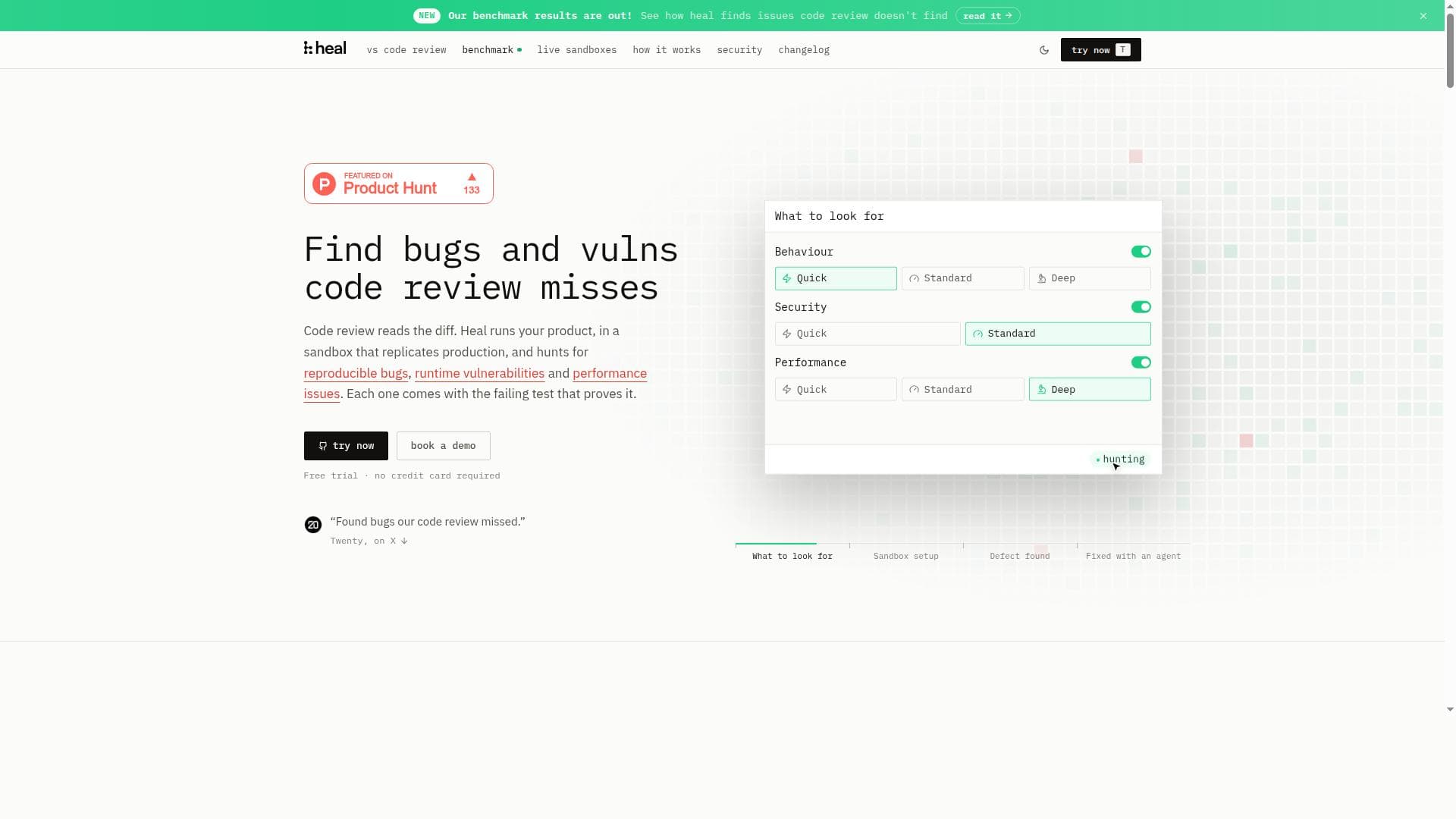
Heal revolutionizes software testing by running your product in a sandbox that mirrors production, uncovering bugs and runtime vulnerabilities missed by code reviews. Ideal for developers and security teams, it provides reproducible failing tests and runs seamlessly locally or in the cloud to boost testing accuracy and application security.

Descripción
Code review catches what’s wrong in a diff. Heal catches what breaks when the app runs. Heal learns how to run your application, builds a production-like sandbox with external services stubbed, then hunts for bugs, performance regressions, and runtime vulnerabilities users would hit. It reproduces every defect before reporting it, so you get real bugs to fix, not a backlog of AI-generated suspicions.
Descripción detallada
Heal is an advanced developer tool designed to significantly enhance the software testing and security process by building a sandbox environment that replicates production systems. Its core purpose is to identify reproducible bugs and runtime vulnerabilities that traditional code reviews often miss. Unlike code reviews that analyze code diffs statically, Heal dynamically runs the actual product within a controlled sandbox, enabling it to uncover issues that only manifest during runtime. This approach ensures that developers can detect and address hidden bugs and security flaws before they reach production, improving overall software quality and reliability. At the heart of Heal's capabilities is its ability to create a sandbox environment that closely mimics the production environment. This replication includes dependencies, configurations, and runtime conditions, allowing Heal to execute the application as it would run in real-world scenarios. By doing so, it can detect subtle bugs and vulnerabilities that are difficult to spot through static analysis or manual code reviews. Once an issue is detected, Heal automatically generates failing tests that prove the existence of each bug or vulnerability. These tests serve as concrete evidence for developers, making it easier to reproduce, debug, and fix the problems. Heal supports running tests both locally on developers' machines and in the cloud, providing flexibility in how teams integrate it into their workflows. Its automated mocking capabilities simplify the setup of complex dependencies, reducing the overhead typically associated with integration and end-to-end testing. Additionally, Heal incorporates application security testing features that focus on runtime vulnerabilities, an area often overlooked by conventional security tools. This combination of automated mocking, sandbox replication, and security testing makes Heal a comprehensive solution for improving software robustness. Heal is particularly well-suited for development teams, QA engineers, and security professionals who want to go beyond traditional code reviews and static analysis. It is ideal for organizations that deploy complex applications where runtime behavior can introduce unexpected bugs or security risks. Use cases include identifying hard-to-reproduce bugs, validating fixes with failing tests, and enhancing security posture by detecting runtime vulnerabilities early in the development cycle. Heal’s ability to run both locally and in the cloud also makes it adaptable for individual developers, small teams, and large enterprises. Regarding pricing and plans, Heal offers a demo accessible via its website, but specific pricing details are not publicly disclosed and may require direct contact with the vendor. This approach suggests a tailored pricing model likely based on usage, team size, or deployment preferences. Potential users are encouraged to request a demo to evaluate how Heal fits their needs before committing. Compared to alternative tools, Heal stands out by focusing on runtime analysis within a sandbox that replicates production environments, rather than relying solely on static code analysis or traditional testing frameworks. While many testing tools emphasize unit tests or static security scans, Heal’s unique value lies in its ability to find bugs and vulnerabilities that only appear when the application is executed in a realistic environment. This makes it complementary to existing QA and security processes, filling gaps left by code reviews and static tools. However, some considerations include the need to configure and maintain sandbox environments that accurately reflect production, which might require initial setup effort. Additionally, since Heal runs the product dynamically, it may require sufficient computational resources, especially when used in cloud environments. Users should also verify compatibility with their specific tech stack and workflows. In summary, Heal is a powerful developer tool that enhances software testing and security by dynamically replicating production environments to find elusive bugs and runtime vulnerabilities. Its automated generation of failing tests and flexible deployment options make it a valuable asset for teams committed to delivering high-quality, secure software.
Características de la herramienta
- Builds a sandbox that replicates production environment
- Finds reproducible bugs and runtime vulnerabilities
- Provides failing tests that prove each bug
- Runs locally or in the cloud
- Enhances software testing beyond code review
- Automated mocking and application security testing
Descripción
Heal revolutionizes software testing by running your product in a sandbox that mirrors production, uncovering bugs and runtime vulnerabilities missed by code reviews. Ideal for developers and security teams, it provides reproducible failing tests and runs seamlessly locally or in the cloud to boost testing accuracy and application security.
Code review catches what’s wrong in a diff. Heal catches what breaks when the app runs. Heal learns how to run your application, builds a production-like sandbox with external services stubbed, then hunts for bugs, performance regressions, and runtime vulnerabilities users would hit. It reproduces every defect before reporting it, so you get real bugs to fix, not a backlog of AI-generated suspicions.
Descripción detallada
Heal is an advanced developer tool designed to significantly enhance the software testing and security process by building a sandbox environment that replicates production systems. Its core purpose is to identify reproducible bugs and runtime vulnerabilities that traditional code reviews often miss. Unlike code reviews that analyze code diffs statically, Heal dynamically runs the actual product within a controlled sandbox, enabling it to uncover issues that only manifest during runtime. This approach ensures that developers can detect and address hidden bugs and security flaws before they reach production, improving overall software quality and reliability. At the heart of Heal's capabilities is its ability to create a sandbox environment that closely mimics the production environment. This replication includes dependencies, configurations, and runtime conditions, allowing Heal to execute the application as it would run in real-world scenarios. By doing so, it can detect subtle bugs and vulnerabilities that are difficult to spot through static analysis or manual code reviews. Once an issue is detected, Heal automatically generates failing tests that prove the existence of each bug or vulnerability. These tests serve as concrete evidence for developers, making it easier to reproduce, debug, and fix the problems. Heal supports running tests both locally on developers' machines and in the cloud, providing flexibility in how teams integrate it into their workflows. Its automated mocking capabilities simplify the setup of complex dependencies, reducing the overhead typically associated with integration and end-to-end testing. Additionally, Heal incorporates application security testing features that focus on runtime vulnerabilities, an area often overlooked by conventional security tools. This combination of automated mocking, sandbox replication, and security testing makes Heal a comprehensive solution for improving software robustness. Heal is particularly well-suited for development teams, QA engineers, and security professionals who want to go beyond traditional code reviews and static analysis. It is ideal for organizations that deploy complex applications where runtime behavior can introduce unexpected bugs or security risks. Use cases include identifying hard-to-reproduce bugs, validating fixes with failing tests, and enhancing security posture by detecting runtime vulnerabilities early in the development cycle. Heal’s ability to run both locally and in the cloud also makes it adaptable for individual developers, small teams, and large enterprises. Regarding pricing and plans, Heal offers a demo accessible via its website, but specific pricing details are not publicly disclosed and may require direct contact with the vendor. This approach suggests a tailored pricing model likely based on usage, team size, or deployment preferences. Potential users are encouraged to request a demo to evaluate how Heal fits their needs before committing. Compared to alternative tools, Heal stands out by focusing on runtime analysis within a sandbox that replicates production environments, rather than relying solely on static code analysis or traditional testing frameworks. While many testing tools emphasize unit tests or static security scans, Heal’s unique value lies in its ability to find bugs and vulnerabilities that only appear when the application is executed in a realistic environment. This makes it complementary to existing QA and security processes, filling gaps left by code reviews and static tools. However, some considerations include the need to configure and maintain sandbox environments that accurately reflect production, which might require initial setup effort. Additionally, since Heal runs the product dynamically, it may require sufficient computational resources, especially when used in cloud environments. Users should also verify compatibility with their specific tech stack and workflows. In summary, Heal is a powerful developer tool that enhances software testing and security by dynamically replicating production environments to find elusive bugs and runtime vulnerabilities. Its automated generation of failing tests and flexible deployment options make it a valuable asset for teams committed to delivering high-quality, secure software.
Preguntas frecuentes
What is heal?
Heal is a developer tool that builds a sandbox replicating production environments to detect reproducible bugs and runtime vulnerabilities that traditional code reviews often miss. It automatically generates failing tests to prove each issue and can operate locally or in the cloud.
How much does heal cost?
Heal does not publicly disclose specific pricing details on its website. Interested users can request a demo to explore the tool and discuss pricing options tailored to their needs.
Who is heal best for?
Heal is best suited for development teams, QA engineers, and security professionals who want to enhance their testing and security processes by finding runtime bugs and vulnerabilities that static code reviews and traditional testing might miss.
What are the main features of heal?
Key features include sandbox creation that replicates production environments, detection of reproducible bugs and runtime vulnerabilities, automatic generation of failing tests for each issue, support for running locally or in the cloud, automated mocking, and application security testing.
Does heal offer a free trial?
While Heal offers a demo accessible through its website, there is no explicit mention of a free trial. Prospective users should contact the vendor to inquire about trial options.
What integrations does heal support?
The available information does not specify particular integrations. However, Heal is designed to work with various development environments by replicating production setups and running tests locally or in the cloud, implying compatibility with common development and CI/CD workflows.
How does heal work?
Heal works by building a sandbox environment that closely replicates the production environment, then running the application within this sandbox to dynamically detect bugs and runtime vulnerabilities. It automatically produces failing tests that prove each detected issue, enabling developers to reproduce and fix problems effectively.
Redes sociales
Usar herramientaReseñas
Aún no hay reseñas. Sé el primero en compartir tu experiencia.
Herramientas patrocinadas

























Herramientas recomendadas
Mantente al día con las últimas herramientas de IA
Obtén las últimas novedades, únete a nuestro boletín
Leído y confiado por 50,000+ lectores
Únete a la comunidad de IA más grande
¡Nuestra comunidad y equipo están aquí para ayudarte!
Tus comentarios ayudarán a Alice AI a mejorar en futuras versiones.








Enviar tu herramienta


PoweredByAI.app es un directorio de herramientas de IA que ayuda a personas, empresas y creadores a descubrir las mejores herramientas de IA para escritura, programación, diseño, productividad y más.
© 2026 , Producto de011BQ. Todos los derechos reservados.