

¿Es esta tu herramienta de IA? Reclámala hoy.
Verifica la propiedad, gestiona tu perfil y desbloquea funciones de crecimiento.
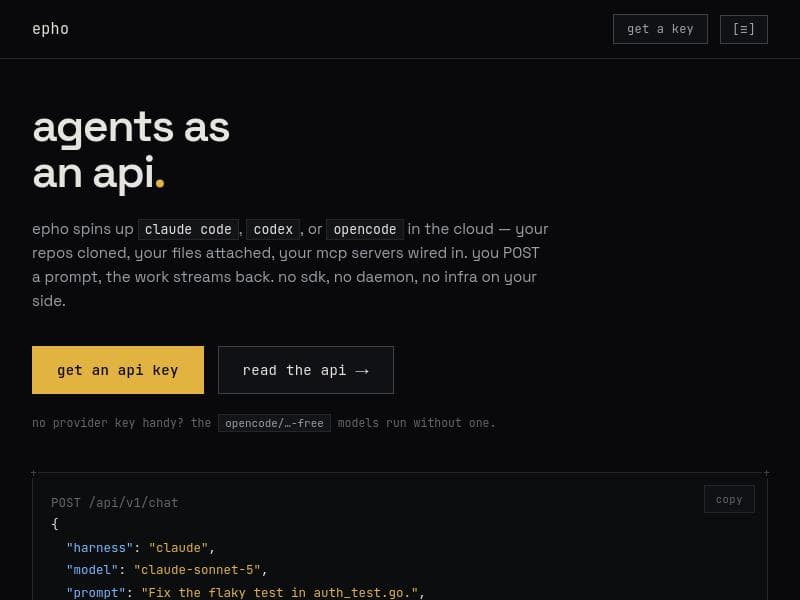
epho offers a seamless cloud API to run AI agents like Claude Code, Codex, and OpenCode without any local infrastructure, enabling developers to POST prompts and stream AI-generated code in real time. Perfect for developers and teams looking to integrate AI-powered coding workflows effortlessly, epho simplifies complex automation with repository cloning and file attachments directly in the cloud.

Descripción
Epho runs claude code, codex, or opencode in the cloud. POST a message, stream back the work. no sdk, no daemon, no infra on your side. Epho manages the underlying sandboxes, fallbacks, event streaming, and agent configuration for you. With a single API call, you can easily launch a Claude Code session that is already connected to your repo, understands your context, and runs in a serverless sandbox.
Descripción detallada
epho is a sophisticated cloud-based API platform designed to run AI agents such as Claude Code, Codex, or OpenCode seamlessly in the cloud. Its core purpose is to simplify the integration and execution of AI-driven code generation and automation workflows for developers without the need to manage any local SDKs, daemons, or infrastructure. By providing a straightforward API endpoint, epho allows developers to POST prompts and receive streamed responses in real-time, enabling efficient and scalable AI-powered development processes. One of epho's standout features is its ability to clone repositories and attach files directly within the cloud environment, which means developers can work with their existing codebases effortlessly. This capability is complemented by the platform's support for wiring MCP (multi-cloud provider) servers, facilitating robust and flexible agent execution. epho streams results over Server-Sent Events (SSE), allowing continuous and incremental delivery of AI-generated outputs, which is particularly useful for long-running or complex tasks. Additionally, epho offers API key registration to manage access securely and supports free usage with certain open-source or free models like opencode/…-free, which do not require a provider key. The platform is ideally suited for software developers, AI researchers, and teams looking to incorporate advanced code generation and AI automation into their workflows without the overhead of maintaining infrastructure. Use cases include automated code fixes, test generation, code review assistance, and rapid prototyping. By offloading the heavy lifting to the cloud, epho enables users to focus on crafting prompts and integrating AI outputs into their applications or development pipelines. Regarding pricing, epho provides a flexible model that includes free access to certain open-source models without requiring a provider key, making it accessible for experimentation and small projects. For more advanced usage involving proprietary models like Claude or Codex, users must register for an API key, which likely corresponds to a paid tier or usage-based billing, although specific pricing details should be confirmed on their official website or documentation. Compared to alternatives, epho distinguishes itself by eliminating the need for local SDKs or infrastructure, offering a truly serverless experience for running AI agents. While many platforms require complex setup or dedicated environments, epho’s API-centric approach streamlines integration and reduces operational complexity. Its support for multiple AI agent types and the ability to handle repository cloning and file attachments directly in the cloud further enhance its versatility. However, epho may have some limitations to consider. Since it relies on cloud execution, users must have reliable internet connectivity and may face latency depending on their location and workload size. The platform’s dependency on third-party AI models means that performance and capabilities can vary based on the underlying model’s strengths and limitations. Additionally, while epho supports free usage with open models, access to premium models requires API keys and potentially incurs costs, which might be a barrier for some users. In summary, epho is a powerful and developer-friendly platform that brings AI agents to the cloud with minimal friction. Its unique combination of repository integration, streaming responses, and multi-agent support makes it an excellent choice for developers seeking to harness AI for code automation and enhancement without the complexity of managing infrastructure or SDKs.
Características de la herramienta
- Runs claude code, codex, or opencode in the cloud
- No SDK, no daemon, no infrastructure required on user side
- Supports POSTing a prompt and streaming back the work
- Clones your repos and attaches your files
- Streams results over Server-Sent Events (SSE)
- Provides API key registration for access
- Supports free usage with opencode/…-free models without provider key
Descripción
epho offers a seamless cloud API to run AI agents like Claude Code, Codex, and OpenCode without any local infrastructure, enabling developers to POST prompts and stream AI-generated code in real time. Perfect for developers and teams looking to integrate AI-powered coding workflows effortlessly, epho simplifies complex automation with repository cloning and file attachments directly in the cloud.
Epho runs claude code, codex, or opencode in the cloud. POST a message, stream back the work. no sdk, no daemon, no infra on your side. Epho manages the underlying sandboxes, fallbacks, event streaming, and agent configuration for you. With a single API call, you can easily launch a Claude Code session that is already connected to your repo, understands your context, and runs in a serverless sandbox.
Descripción detallada
epho is a sophisticated cloud-based API platform designed to run AI agents such as Claude Code, Codex, or OpenCode seamlessly in the cloud. Its core purpose is to simplify the integration and execution of AI-driven code generation and automation workflows for developers without the need to manage any local SDKs, daemons, or infrastructure. By providing a straightforward API endpoint, epho allows developers to POST prompts and receive streamed responses in real-time, enabling efficient and scalable AI-powered development processes. One of epho's standout features is its ability to clone repositories and attach files directly within the cloud environment, which means developers can work with their existing codebases effortlessly. This capability is complemented by the platform's support for wiring MCP (multi-cloud provider) servers, facilitating robust and flexible agent execution. epho streams results over Server-Sent Events (SSE), allowing continuous and incremental delivery of AI-generated outputs, which is particularly useful for long-running or complex tasks. Additionally, epho offers API key registration to manage access securely and supports free usage with certain open-source or free models like opencode/…-free, which do not require a provider key. The platform is ideally suited for software developers, AI researchers, and teams looking to incorporate advanced code generation and AI automation into their workflows without the overhead of maintaining infrastructure. Use cases include automated code fixes, test generation, code review assistance, and rapid prototyping. By offloading the heavy lifting to the cloud, epho enables users to focus on crafting prompts and integrating AI outputs into their applications or development pipelines. Regarding pricing, epho provides a flexible model that includes free access to certain open-source models without requiring a provider key, making it accessible for experimentation and small projects. For more advanced usage involving proprietary models like Claude or Codex, users must register for an API key, which likely corresponds to a paid tier or usage-based billing, although specific pricing details should be confirmed on their official website or documentation. Compared to alternatives, epho distinguishes itself by eliminating the need for local SDKs or infrastructure, offering a truly serverless experience for running AI agents. While many platforms require complex setup or dedicated environments, epho’s API-centric approach streamlines integration and reduces operational complexity. Its support for multiple AI agent types and the ability to handle repository cloning and file attachments directly in the cloud further enhance its versatility. However, epho may have some limitations to consider. Since it relies on cloud execution, users must have reliable internet connectivity and may face latency depending on their location and workload size. The platform’s dependency on third-party AI models means that performance and capabilities can vary based on the underlying model’s strengths and limitations. Additionally, while epho supports free usage with open models, access to premium models requires API keys and potentially incurs costs, which might be a barrier for some users. In summary, epho is a powerful and developer-friendly platform that brings AI agents to the cloud with minimal friction. Its unique combination of repository integration, streaming responses, and multi-agent support makes it an excellent choice for developers seeking to harness AI for code automation and enhancement without the complexity of managing infrastructure or SDKs.
Preguntas frecuentes
What is epho?
epho is a cloud-based API platform that runs AI agents such as Claude Code, Codex, or OpenCode to perform code generation and automation tasks. It allows developers to send prompts via a simple API call and receive streamed results without needing to manage any local SDKs, daemons, or infrastructure.
How much does epho cost?
epho offers free usage with certain open-source or free models like opencode/…-free that do not require a provider key. For access to proprietary models such as Claude or Codex, users must register for an API key, which likely corresponds to a paid plan or usage-based pricing. Specific pricing details can be found on epho's official website.
Who is epho best for?
epho is best suited for software developers, AI researchers, and development teams who want to integrate AI-powered code generation and automation into their workflows without managing infrastructure. It is ideal for use cases like automated code fixes, test generation, and rapid prototyping.
What are the main features of epho?
Key features of epho include running multiple AI agents (Claude Code, Codex, OpenCode) in the cloud, no requirement for SDKs or local infrastructure, support for POSTing prompts and streaming results via Server-Sent Events (SSE), cloning repositories and attaching files in the cloud, wiring MCP servers for agent execution, and API key registration for secure access.
Does epho offer a free trial?
Yes, epho supports free usage with open-source or free models such as opencode/…-free that do not require a provider key, allowing users to try the platform without cost. Access to proprietary models may require registration and payment.
What integrations does epho support?
epho integrates with code repositories by cloning them directly in the cloud and supports attaching files to enhance AI agent context. It also wires MCP servers to facilitate seamless multi-cloud agent execution. The platform is API-driven, making it easy to integrate with existing development workflows.
How does epho work?
Developers send a POST request to epho's API with a prompt and optional repository URLs or attached files. epho then spins up the specified AI agent in the cloud, clones the repos, attaches files, and executes the task. Results are streamed back in real time over Server-Sent Events (SSE), allowing developers to receive incremental outputs without managing any local infrastructure.
Reseñas
Aún no hay reseñas. Sé el primero en compartir tu experiencia.