🚀 Zaprep: Tus redes sociales al máximo. Empezar gratis — automatiza 1,000 DMs/mes y convierte el engagement en leads. con 1,000 DMs automatizados/mes.


¿Es esta tu herramienta de IA? Reclámala hoy.
Verifica la propiedad, gestiona tu perfil y desbloquea funciones de crecimiento.
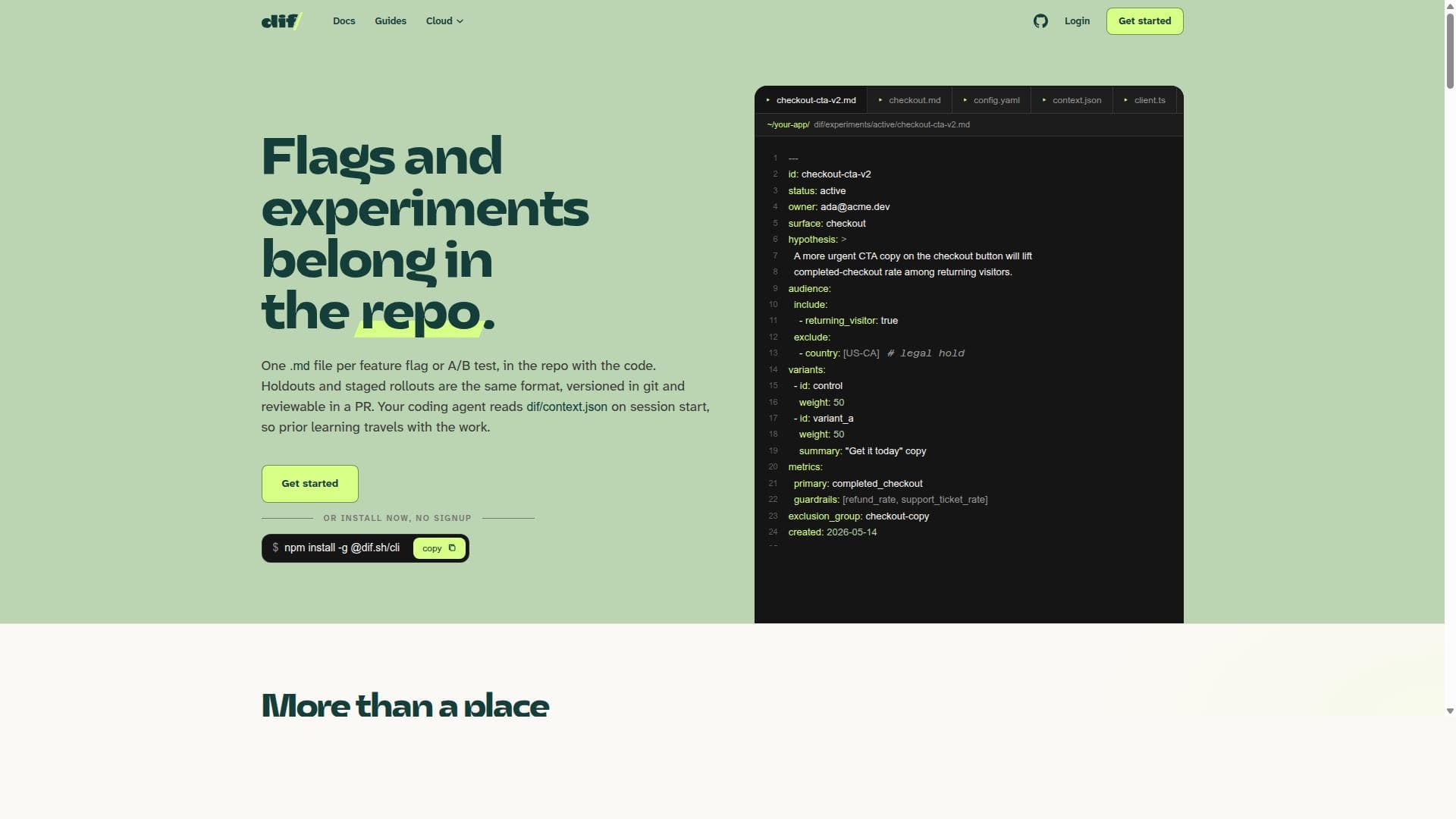
dif.sh revolutionizes feature flag and A/B test management by embedding them as versioned Markdown files directly in your code repository. Ideal for development teams seeking seamless git integration and transparent rollout control, it eliminates the need for external dashboards and signups, enabling effortless experimentation within your existing workflow.

Descripción
Open source feature flags. Every flag is a markdown file that lives with the code it controls: what it does, why it exists, and what you decided, reviewed in a PR like any other change. Your coding agent installs Dif in one command, no account, and reads the context file so it knows what's live and what was already tried. A/B tests wait in the same files until you have traffic. Send events to your own analytics, or let Dif Cloud read the results and write the decision into the file.
Descripción detallada
dif.sh is an innovative tool designed to streamline the management of feature flags and A/B tests by integrating them directly into your code repository using Markdown files. Its core purpose is to bring feature experimentation and rollout control into the developer's existing git workflow, eliminating the need for separate dashboards or third-party services. By living within the repository, feature flags and experiments become versioned, reviewable, and auditable alongside the code they affect, fostering better collaboration and transparency within development teams. One of the standout capabilities of dif.sh is its use of Markdown files to represent feature flags and A/B tests. Each feature or experiment is defined in a simple, human-readable .md file, making it easy for developers to create, modify, and understand the flags without leaving their familiar environment. This approach also supports holdouts and staged rollouts using the same versioned format, allowing teams to progressively release features to subsets of users in a controlled and consistent manner. Because these files are stored in git, every change is tracked, and feature flag updates can be reviewed through pull requests, ensuring that changes are deliberate and peer-reviewed. Another key feature is the integration with coding agents that read a context.json file at the start of each session. This means that any prior learning or contextual information about feature flags travels with the developer’s work session, enabling smarter decision-making and more informed experimentation. Installation is remarkably simple, requiring just a single command (npm install -g @dif.sh/cli) with no signup or onboarding process, which lowers the barrier to entry and encourages rapid adoption. dif.sh is best suited for software development teams, especially those practicing continuous integration and continuous deployment (CI/CD) workflows who want to maintain full control over their feature flags and experiments within their existing git infrastructure. It is ideal for teams that value transparency, version control, and code review processes and prefer to avoid external feature management platforms. Use cases include staged rollouts of new features, A/B testing different UI elements, and managing holdouts to measure feature impact without risking the entire user base. Regarding pricing, dif.sh offers a straightforward approach with no mandatory signup, implying that the core CLI tool is free to install and use. For cloud services or additional features, users can log in at cloud.dif.sh, but detailed pricing plans are not explicitly provided in the available information. This suggests dif.sh may follow an open-source or freemium model with optional paid tiers for cloud-hosted features or enterprise support. When compared to alternatives like LaunchDarkly, Split.io, or Flagsmith, dif.sh’s unique selling point is its repository-centric approach. While other platforms rely on external dashboards and proprietary formats, dif.sh keeps everything versioned and reviewable within git, which appeals to developers who want to avoid vendor lock-in and keep feature management transparent and integrated with their codebase. However, unlike some commercial platforms, dif.sh may lack advanced analytics, user segmentation, or a visual management interface, which could be a consideration for teams needing those capabilities. Notable limitations include the reliance on Markdown files and git workflows, which may not suit non-technical stakeholders who prefer graphical interfaces. Also, since dif.sh appears to be CLI-focused with no mandatory signup, it might not provide the same level of centralized control, collaboration, or real-time monitoring features found in dedicated feature flag management SaaS products. Teams should evaluate whether their workflow and team composition align with a repo-first approach before adopting dif.sh. In summary, dif.sh offers a powerful, developer-friendly way to manage feature flags and A/B tests directly in the code repository. Its simplicity, version control integration, and seamless rollout capabilities make it an excellent choice for engineering teams looking to embed experimentation into their git workflow without relying on external platforms.
Características de la herramienta
- Feature flags and A/B tests live in your repo as Markdown files
- Holdouts and staged rollouts use the same versioned format
- Versioned in git and reviewable in pull requests
- Coding agent reads context.json on session start
- One command to install with no signup required
Descripción
dif.sh revolutionizes feature flag and A/B test management by embedding them as versioned Markdown files directly in your code repository. Ideal for development teams seeking seamless git integration and transparent rollout control, it eliminates the need for external dashboards and signups, enabling effortless experimentation within your existing workflow.
Open source feature flags. Every flag is a markdown file that lives with the code it controls: what it does, why it exists, and what you decided, reviewed in a PR like any other change. Your coding agent installs Dif in one command, no account, and reads the context file so it knows what's live and what was already tried. A/B tests wait in the same files until you have traffic. Send events to your own analytics, or let Dif Cloud read the results and write the decision into the file.
Descripción detallada
dif.sh is an innovative tool designed to streamline the management of feature flags and A/B tests by integrating them directly into your code repository using Markdown files. Its core purpose is to bring feature experimentation and rollout control into the developer's existing git workflow, eliminating the need for separate dashboards or third-party services. By living within the repository, feature flags and experiments become versioned, reviewable, and auditable alongside the code they affect, fostering better collaboration and transparency within development teams. One of the standout capabilities of dif.sh is its use of Markdown files to represent feature flags and A/B tests. Each feature or experiment is defined in a simple, human-readable .md file, making it easy for developers to create, modify, and understand the flags without leaving their familiar environment. This approach also supports holdouts and staged rollouts using the same versioned format, allowing teams to progressively release features to subsets of users in a controlled and consistent manner. Because these files are stored in git, every change is tracked, and feature flag updates can be reviewed through pull requests, ensuring that changes are deliberate and peer-reviewed. Another key feature is the integration with coding agents that read a context.json file at the start of each session. This means that any prior learning or contextual information about feature flags travels with the developer’s work session, enabling smarter decision-making and more informed experimentation. Installation is remarkably simple, requiring just a single command (npm install -g @dif.sh/cli) with no signup or onboarding process, which lowers the barrier to entry and encourages rapid adoption. dif.sh is best suited for software development teams, especially those practicing continuous integration and continuous deployment (CI/CD) workflows who want to maintain full control over their feature flags and experiments within their existing git infrastructure. It is ideal for teams that value transparency, version control, and code review processes and prefer to avoid external feature management platforms. Use cases include staged rollouts of new features, A/B testing different UI elements, and managing holdouts to measure feature impact without risking the entire user base. Regarding pricing, dif.sh offers a straightforward approach with no mandatory signup, implying that the core CLI tool is free to install and use. For cloud services or additional features, users can log in at cloud.dif.sh, but detailed pricing plans are not explicitly provided in the available information. This suggests dif.sh may follow an open-source or freemium model with optional paid tiers for cloud-hosted features or enterprise support. When compared to alternatives like LaunchDarkly, Split.io, or Flagsmith, dif.sh’s unique selling point is its repository-centric approach. While other platforms rely on external dashboards and proprietary formats, dif.sh keeps everything versioned and reviewable within git, which appeals to developers who want to avoid vendor lock-in and keep feature management transparent and integrated with their codebase. However, unlike some commercial platforms, dif.sh may lack advanced analytics, user segmentation, or a visual management interface, which could be a consideration for teams needing those capabilities. Notable limitations include the reliance on Markdown files and git workflows, which may not suit non-technical stakeholders who prefer graphical interfaces. Also, since dif.sh appears to be CLI-focused with no mandatory signup, it might not provide the same level of centralized control, collaboration, or real-time monitoring features found in dedicated feature flag management SaaS products. Teams should evaluate whether their workflow and team composition align with a repo-first approach before adopting dif.sh. In summary, dif.sh offers a powerful, developer-friendly way to manage feature flags and A/B tests directly in the code repository. Its simplicity, version control integration, and seamless rollout capabilities make it an excellent choice for engineering teams looking to embed experimentation into their git workflow without relying on external platforms.
Preguntas frecuentes
What is dif.sh?
dif.sh is a tool that manages feature flags and A/B tests directly within your code repository using Markdown files. It integrates with your git workflow to allow versioning, reviewing, and staged rollouts of features seamlessly.
How much does dif.sh cost?
dif.sh can be installed and used with a single command and requires no signup, suggesting the core CLI tool is free. Pricing details for any cloud services or advanced features are not explicitly provided.
Who is dif.sh best for?
dif.sh is best suited for software development teams that want to manage feature flags and experiments within their git repositories, especially those who prefer version control and code review processes over external dashboards.
What are the main features of dif.sh?
Key features include storing feature flags and A/B tests as Markdown files in the repo, supporting holdouts and staged rollouts in a versioned format, integration with coding agents that read context on session start, and a simple one-command installation with no signup.
Does dif.sh offer a free trial?
Since dif.sh requires no signup and installs via a single command, the core tool effectively offers free usage without a trial period. Details on trials for any paid cloud services are not specified.
What integrations does dif.sh support?
dif.sh integrates tightly with your git workflow and coding environment by reading context.json files on session start. It does not rely on external dashboards, focusing instead on repository-based management.
How does dif.sh work?
dif.sh works by representing feature flags and A/B tests as Markdown files within your code repository. These files are versioned in git and can be reviewed via pull requests. The tool reads contextual information at session start to maintain prior learning, enabling consistent and staged feature rollouts.
Redes sociales
Usar herramientaReseñas
Aún no hay reseñas. Sé el primero en compartir tu experiencia.
Herramientas patrocinadas
























Herramientas recomendadas
Mantente al día con las últimas herramientas de IA
Obtén las últimas novedades, únete a nuestro boletín
Leído y confiado por 50,000+ lectores
Únete a la comunidad de IA más grande
¡Nuestra comunidad y equipo están aquí para ayudarte!
Tus comentarios ayudarán a Alice AI a mejorar en futuras versiones.








Enviar tu herramienta


PoweredByAI.app es un directorio de herramientas de IA que ayuda a personas, empresas y creadores a descubrir las mejores herramientas de IA para escritura, programación, diseño, productividad y más.
© 2026 , Producto de011BQ. Todos los derechos reservados.