

¿Es esta tu herramienta de IA? Reclámala hoy.
Verifica la propiedad, gestiona tu perfil y desbloquea funciones de crecimiento.
Claude Watermark is a free, browser-based tool that detects and removes hidden AI-generated artifacts in Claude and ChatGPT text, helping users produce more natural, undetectable content. Ideal for writers and professionals needing privacy and advanced text humanization, it combines instant artifact detection with a paid rewrite service for enhanced text naturalness.

Descripción
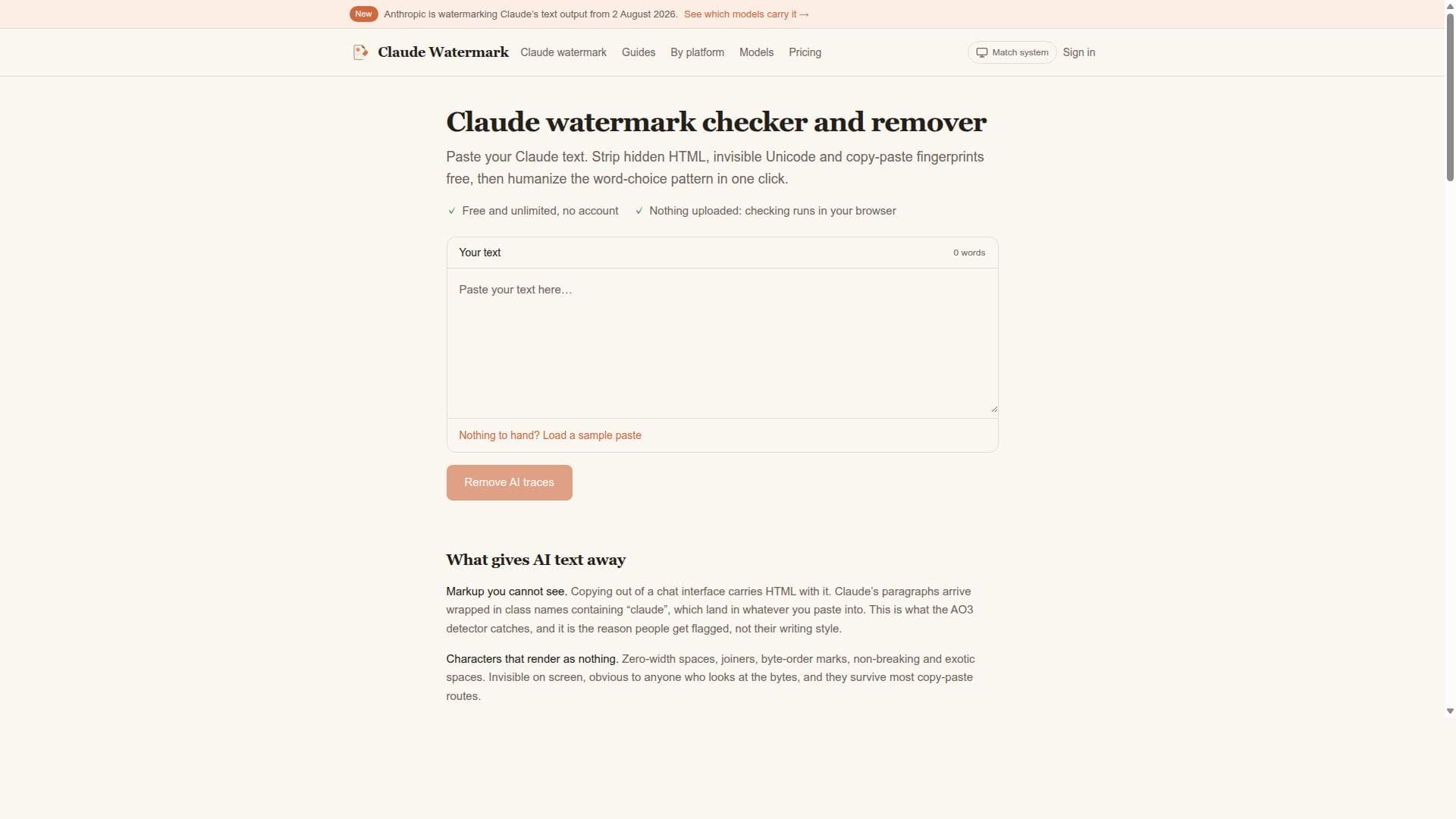
Paste any text and see every trace a chat interface left in it: hidden HTML class names, zero-width characters, exotic spaces, typography. Each finding has a count and a position, because these are facts about the bytes, not a probability score. Clean it in one click. Free, unlimited, no account, runs in your browser so nothing is uploaded. It does not claim to detect Anthropic's statistical watermark, because nobody outside Anthropic can. The engine is MIT open source.
Descripción detallada
Claude Watermark is a specialized AI tool designed to detect and remove hidden artifacts embedded in text generated by AI models like Claude and ChatGPT. Its core purpose is to help users identify whether their AI-generated content carries detectable watermarks or copy-paste artifacts that could reveal its machine origin. These artifacts often include hidden HTML tags, invisible Unicode characters, zero-width spaces, exotic whitespace, and other subtle markers that AI detectors use to flag text as machine-written. Claude Watermark not only detects these artifacts but also offers a humanization process that rewrites text to vary sentence rhythm and length, making the output appear more natural and less machine-like. This makes it an invaluable tool for anyone who needs to ensure their AI-generated text passes undetected by AI content detectors or simply reads more naturally to human audiences. The tool’s key features are comprehensive and privacy-focused. It runs entirely in the user's browser, meaning no text is uploaded to external servers, preserving user privacy and data security. The detection engine scans for a wide range of AI-generated artifacts, including hidden HTML class names that some AI interfaces insert, zero-width and invisible Unicode characters, non-breaking and exotic spaces, and formatting quirks like smart quotes and em dashes that can signal AI authorship. Once detected, Claude Watermark offers an instant cleaning process that removes these artifacts for free and without limits. For users seeking a deeper level of disguise, the tool provides a paid rewrite service that humanizes the text by varying sentence structure, length, and rhythm to evade AI detectors that rely on predictability in word choice and phrasing. Credits for this rewrite service are purchased once and never expire, and they cover large documents, making it cost-effective for heavy users. Additionally, Claude Watermark supports model-specific detection, such as identifying the Claude watermark, and provides detailed information about which AI models embed detectable watermarks. Claude Watermark is best suited for writers, content creators, educators, marketers, and anyone who uses AI-generated text but wants to avoid detection by AI content filters or ensure their text sounds more natural. It is particularly useful for professionals who repurpose AI-generated drafts for publication, academic use, or client work where originality and human-like quality are critical. The tool’s browser-based operation and free unlimited artifact checking make it accessible for casual users, while the paid rewrite service caters to advanced users needing polished, undetectable text. It is also valuable for researchers and developers interested in understanding how AI watermarks function and how to mitigate them. Regarding pricing, Claude Watermark offers unlimited free artifact checking with no account required, making it highly accessible. The cleaning and rewriting features that humanize text operate on a credit system, where users purchase credits to access the rewrite engine. These credits do not expire and can be used for large documents, providing flexibility and value. This pricing model allows users to try the core detection features at no cost and only pay when they require advanced text rewriting. Compared to alternatives, Claude Watermark stands out due to its focus on Claude and ChatGPT-specific artifacts, browser-based privacy-first design, and the combination of free artifact detection with a paid humanization rewrite service. Many other AI watermark detection tools either require server uploads, have usage limits, or lack integrated rewriting capabilities. Claude Watermark’s instant in-browser operation ensures data never leaves the user’s device, a significant advantage for privacy-conscious users. Its detailed detection of copy-paste artifacts and model-specific watermark information also provides more transparency than generic AI text detectors. However, some limitations exist. The paid rewrite service, while effective, requires purchasing credits, which may be a barrier for users seeking a fully free solution. The tool’s focus on Claude and ChatGPT means it may be less effective for texts generated by other AI models with different watermarking or artifact patterns. Additionally, while the artifact removal and rewriting reduce detectability, no tool can guarantee 100% evasion of all AI detectors, especially as detection methods evolve. Users should consider Claude Watermark as part of a broader strategy for managing AI-generated content authenticity and naturalness. In summary, Claude Watermark is a powerful, privacy-focused tool that excels at detecting and removing AI-generated text artifacts, with a unique humanizing rewrite feature to help users produce natural, undetectable AI-assisted writing. Its free unlimited checking, browser-based operation, and credit-based rewriting make it a versatile choice for individuals and professionals aiming to manage AI text watermarking effectively.
Características de la herramienta
- Detects hidden HTML and invisible Unicode characters in AI-generated text
- Removes copy-paste artifacts such as zero-width characters and exotic spaces
- Humanizes text by varying sentence rhythm and length to evade AI detectors
- Runs entirely in the browser ensuring user text privacy with no uploads
- Instant artifact checking with unlimited free usage
- Paid rewrite service uses credits to clean and rewrite text
- Supports checking for Claude watermark and provides model-specific info
- Credits for rewriting never expire and cover large documents
Descripción
Claude Watermark is a free, browser-based tool that detects and removes hidden AI-generated artifacts in Claude and ChatGPT text, helping users produce more natural, undetectable content. Ideal for writers and professionals needing privacy and advanced text humanization, it combines instant artifact detection with a paid rewrite service for enhanced text naturalness.
Paste any text and see every trace a chat interface left in it: hidden HTML class names, zero-width characters, exotic spaces, typography. Each finding has a count and a position, because these are facts about the bytes, not a probability score. Clean it in one click. Free, unlimited, no account, runs in your browser so nothing is uploaded. It does not claim to detect Anthropic's statistical watermark, because nobody outside Anthropic can. The engine is MIT open source.
Descripción detallada
Claude Watermark is a specialized AI tool designed to detect and remove hidden artifacts embedded in text generated by AI models like Claude and ChatGPT. Its core purpose is to help users identify whether their AI-generated content carries detectable watermarks or copy-paste artifacts that could reveal its machine origin. These artifacts often include hidden HTML tags, invisible Unicode characters, zero-width spaces, exotic whitespace, and other subtle markers that AI detectors use to flag text as machine-written. Claude Watermark not only detects these artifacts but also offers a humanization process that rewrites text to vary sentence rhythm and length, making the output appear more natural and less machine-like. This makes it an invaluable tool for anyone who needs to ensure their AI-generated text passes undetected by AI content detectors or simply reads more naturally to human audiences. The tool’s key features are comprehensive and privacy-focused. It runs entirely in the user's browser, meaning no text is uploaded to external servers, preserving user privacy and data security. The detection engine scans for a wide range of AI-generated artifacts, including hidden HTML class names that some AI interfaces insert, zero-width and invisible Unicode characters, non-breaking and exotic spaces, and formatting quirks like smart quotes and em dashes that can signal AI authorship. Once detected, Claude Watermark offers an instant cleaning process that removes these artifacts for free and without limits. For users seeking a deeper level of disguise, the tool provides a paid rewrite service that humanizes the text by varying sentence structure, length, and rhythm to evade AI detectors that rely on predictability in word choice and phrasing. Credits for this rewrite service are purchased once and never expire, and they cover large documents, making it cost-effective for heavy users. Additionally, Claude Watermark supports model-specific detection, such as identifying the Claude watermark, and provides detailed information about which AI models embed detectable watermarks. Claude Watermark is best suited for writers, content creators, educators, marketers, and anyone who uses AI-generated text but wants to avoid detection by AI content filters or ensure their text sounds more natural. It is particularly useful for professionals who repurpose AI-generated drafts for publication, academic use, or client work where originality and human-like quality are critical. The tool’s browser-based operation and free unlimited artifact checking make it accessible for casual users, while the paid rewrite service caters to advanced users needing polished, undetectable text. It is also valuable for researchers and developers interested in understanding how AI watermarks function and how to mitigate them. Regarding pricing, Claude Watermark offers unlimited free artifact checking with no account required, making it highly accessible. The cleaning and rewriting features that humanize text operate on a credit system, where users purchase credits to access the rewrite engine. These credits do not expire and can be used for large documents, providing flexibility and value. This pricing model allows users to try the core detection features at no cost and only pay when they require advanced text rewriting. Compared to alternatives, Claude Watermark stands out due to its focus on Claude and ChatGPT-specific artifacts, browser-based privacy-first design, and the combination of free artifact detection with a paid humanization rewrite service. Many other AI watermark detection tools either require server uploads, have usage limits, or lack integrated rewriting capabilities. Claude Watermark’s instant in-browser operation ensures data never leaves the user’s device, a significant advantage for privacy-conscious users. Its detailed detection of copy-paste artifacts and model-specific watermark information also provides more transparency than generic AI text detectors. However, some limitations exist. The paid rewrite service, while effective, requires purchasing credits, which may be a barrier for users seeking a fully free solution. The tool’s focus on Claude and ChatGPT means it may be less effective for texts generated by other AI models with different watermarking or artifact patterns. Additionally, while the artifact removal and rewriting reduce detectability, no tool can guarantee 100% evasion of all AI detectors, especially as detection methods evolve. Users should consider Claude Watermark as part of a broader strategy for managing AI-generated content authenticity and naturalness. In summary, Claude Watermark is a powerful, privacy-focused tool that excels at detecting and removing AI-generated text artifacts, with a unique humanizing rewrite feature to help users produce natural, undetectable AI-assisted writing. Its free unlimited checking, browser-based operation, and credit-based rewriting make it a versatile choice for individuals and professionals aiming to manage AI text watermarking effectively.
Preguntas frecuentes
What is Claude Watermark?
Claude Watermark is a free online tool designed to detect hidden AI-generated artifacts in text produced by models like Claude and ChatGPT. It identifies invisible HTML tags, Unicode characters, and copy-paste artifacts, then offers cleaning and rewriting services to humanize the text and reduce AI detectability.
How much does Claude Watermark cost?
Artifact checking with Claude Watermark is completely free and unlimited, with no account required. Cleaning and rewriting services operate on a credit system, where users purchase credits to access the rewrite engine. These credits never expire and can be used for large documents.
Who is Claude Watermark best for?
Claude Watermark is ideal for content creators, writers, educators, marketers, and anyone using AI-generated text who wants to ensure their content is free of detectable AI artifacts and reads naturally. It’s especially useful for those concerned with privacy and needing to evade AI detection tools.
What are the main features of Claude Watermark?
Key features include detection of hidden HTML and invisible Unicode characters, removal of zero-width and exotic space artifacts, humanization of text by varying sentence rhythm and length, browser-based operation ensuring privacy, instant free artifact checking, a paid rewrite service using credits, and support for Claude watermark detection with model-specific information.
Does Claude Watermark offer a free trial?
Yes, the artifact checking feature is free and unlimited with no trial restrictions. Users can check as many texts as they want without creating an account. The paid rewrite service requires purchasing credits but users can try the detection features without any cost.
What integrations does Claude Watermark support?
Claude Watermark runs entirely in the browser and does not currently offer direct integrations with other platforms or software. Its privacy-first design means all processing happens locally without uploading text to servers.
How does Claude Watermark work?
Claude Watermark scans the input text for hidden HTML elements, invisible Unicode characters, zero-width spaces, and other copy-paste artifacts that AI models embed. It then removes these artifacts and optionally rewrites the text by varying sentence structure and rhythm to humanize it, reducing the likelihood of detection by AI content detectors.
Redes sociales
Usar herramientaReseñas
Aún no hay reseñas. Sé el primero en compartir tu experiencia.