🚀 Zaprep: Tus redes sociales al máximo. Empezar gratis — automatiza 1,000 DMs/mes y convierte el engagement en leads. con 1,000 DMs automatizados/mes.
Enviar tu herramienta
Últimas Noticias de IA

Indian Govt Sites are Too Exposed, But AI Alone Can’t Patch Cyber Gaps
Ethical hackers like Nisarga Adhikary, Rylen Anil, and Tanmay Bakshi have exposed vulnerabilities in not just exam portals but even Indian visa applications.
View

Wipro Expands Databricks Partnership; Sets Up Dedicated AI and Data Business Practice
The new business unit will focus on building industry-specific AI offerings using Databricks' platform, as Wipro looks to help enterprises move beyond AI pilots to large-scale deployments.
View

Algoleap Certified as a Best Firm for Data Scientists
Algoleap, a global AI and cloud native digtal engineering firm has earned AIM's certification, with employee feedback highlighting hands-on AI work, approachable leadership, and strong learning opportunities.
View

Anthropic Stands Alone Against Open Models
From NVIDIA to the White House, the battle over open-weight AI has become a debate over security, innovation, and geopolitical leadership
View

LTM, Cognition to Reduce Cyber Risk in Financial Services with Devin
LTM has partnered with AI startup Cognition to deploy autonomous software engineering agent Devin as part of its cybersecurity platform.
View

Mysuru Can Be India's Next AI and Quantum Hub, But Not Without Govt Support
Mysore Quantum AI has submitted plans to both the Karnataka government and the National Quantum Mission to establish dedicated AI infrastructure in Mysuru.
View

France Fines Infosys €175,000 Over Employee Time-Recording System
French labour authorities imposed a €175,000 fine on Infosys after finding its working time recording system failed to meet local legal requirements for certain employee categories.
View
NVIDIA in Talks to Back $250 Bn OpenAI Data Centre Deal: Report
The proposed guarantee would support financing for a 10 GW Ohio AI campus that could cost more than $500 billion once NVIDIA chips are included.
View

Why India's IT Giants are Swapping Bloated LLMs for Small Language Models
Infosys, HCLTech, and TCS think the real enterprise AI opportunity lies in small language models, which are cheaper to run and can offer data sovereignty.
View
Are brain waves the next unlock for physical AI?
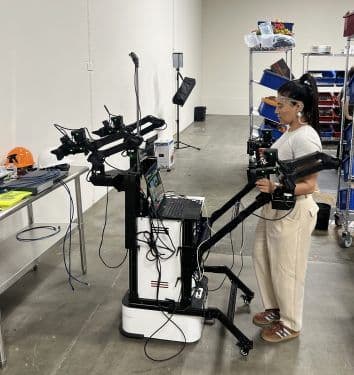
The frontier of physical AI is a Jenga game in a warehouse in San Leandro, California. That warehouse is occupied byEncord, a company that builds data tooling used to train AI models. Andrew Ceja is a pilot—the company’s term for its robotic trainers—and he’s carefully pulling wooden blocks from a tottering tower while wearing a headset with a camera that tracks what he sees. That alone is fairly common for collecting robot training data, but this headset includes sensors that measure his brain waves as he carefully disassembles the block tower. Encord is one of a small but growing number of startups betting the next real constraint on humanoid and warehouse robotics won’t be model architecture but instead the sheer scarcity of real-world physical training data. Rather than just helping robotics companies manage the data they have, Encord is building a business around manufacturing the data they don’t. The brain wave headset Ceja is wearing was built byZander Labs, a German neuroscience startup that’s betting measuring brain activity — to deduce mental states like error, intent and surprise — can create a more useful data set to train models. Encord’s work with Zander is currently a trial run; Encord says the goal is to build an initial brain wave-tagged data set, run it through customer robotics models, and evaluate whether it actually improves performance before deciding whether to scale it up. Lucas Gehrke, a Zander neuroscientist supervising the work, says that the amount of brain activity used at any point during a given task offers clues for model builders trying to figure out when they need to deploy their highest-effort models. This is the “bleeding edge” of the effort to solve the robotics data bottleneck, according to Vineeth Velmurugan, Encord’s head of robot learning. A veteran of OpenAI’s robot lab and Berkshire Grey, the warehouse automation firm, Velmurugan joined Encord to build the company’s internal data-creation team. Encord was founded to help companies building machine-vision applications annotate data and evaluate models. As their customers—Velmurugan says they work with many leading robotics firms but that he’s not authorized to name them—began to apply end-to-end learning to robotic manipulation tasks, executives realized they would have to produce training data themselves, rather than simply manage it. “The data simply does not exist,” Velmurugan said. The bet that generative AI can do for robots what it’s done for chatbots keeps running into this same wall. Self-driving car companies collect physical-world data themselves, but that’s hard to scale. Training from video can work, but it lacks the fidelity of real world data. Velmurugan says it will take a data set something like five times the size of YouTube’s video corpus to break through—a scale that helps explain why data-generation itself has become a business and not just a research problem. Companies building robot brains are now turning to two main sources: “egocentric” video collected by workers wearing cameras, often augmented with additional camera angles and other metrics, anddata from robotsoperated remotely. Encord does both, drawing egocentric data from several factories around the globe, and using its San Leandro facility to experiment with new modalities, like brain waves, or collect data sets around specific skills for fine-tuning. When TechCrunch visited, pilots were using leader-follower rigs — paired robotic arms, one controlled directly by a human operator and one that mimics its movements —to create data about tasks like pouring coffee from a pot into mugs (very sloshy) and stacking poker chips. “Every humanoid company has asked us for these pieces,” Velmurugan says. Storage racks held cartons of fake flowers in vases, books, plastic vegetables, kitty litter trays and scoops, bags and bundles of wires, the stock in trade for training manipulators for household tasks. At one of these stations, another pilot, Sofia Infante, maneuvers robotic arms to plug and unplug ethernet cables from the back of a server—the kind of work data center operators would love to be automated, if only robots could manipulate them with the required precision. Taking a spin behind the controls, I was able to see why that’s still out of reach: Pincers are far less dextrous than human fingers and lack the degrees of freedom we take for granted in our arms. Another new data modality that Encord is developing uses a set of sensors strapped to the forearm to detect electrical signals in muscles. Video taken of human hands manipulating objects typically doesn’t capture the entire hand, but Velmurugan hopes to build a 3D depiction of where the hand is at any time based on the arm sensors, creating a more robust understanding for models. Encord’s data sets are annotated with physical descriptions of what each video contains—”right hand tightens bolt”—to aid LLM-based models in understanding what is happening. Velmurugan estimates this kind of dense annotation is worth 100 times as much as “junky ego data” for training specific tasks, and it only costs 20 times more to produce, which is a good trade, on paper. But “20 times more” is still real money, and that’s the catch: scraping text off the internet, the way LLM makers built their models by pulling from Stack Overflow and the rest of the web, cost frontier labs next to nothing. Generating physical training data does not, and that’s the limit of the physical-AI-as-LLM comparison. This kind of data has to be manufactured, not just collected, and that changes the economics of building these models. Velmurugan says that progress is being made—with Encord’s visibility into programs across the industry, he’s able to see start-ups and frontier labs alike figure out what works and what doesn’t to improve physical AI models. That vantage point—sitting between many robotics companies at once—is also part of Encord’s pitch. It can spot which data techniques are gaining traction industry-wide before any single customer can. That will keep the dozen or so pilots at Encord’s facility busy. Both Infante and Ceja are part of a burgeoning workforce developing the building blocks for neural networks; they previously worked at Scale, another AI data annotation firm, before joining Encord. Ceja had worked at a waste management company where his interest in technology found him in charge of keeping a robotic trash sorter in good working order. Now, as the Jenga tower topples, he says he enjoys the challenge of solving training tasks for robots —”It’s something new every day!”
View

Making sense of the panic over Chinese AI
The launch of the latest AI model from a Chinese company — Moonshot AI’s Kimi — reignited debates around American competitiveness and open versus proprietary AI. While there wasplenty of conversation on social media, it seems the debate is also happening behind the scenes in Washington, D.C., where OpenAI and Anthropic havereportedly lobbied regulatorswith concern about open Chinese models. On the latest episode ofTechCrunch’s Equity podcast, Kirsten Korosec, Sean O’Kane, and I discussed why this seems to be such a hot button issue. Beyond suggesting that certain folks should “touch grass” rather than spending their weekends arguing on X, Sean noted that in many ways, this “feels like we’re seeing repeats of prior freakouts,” with everyone in Silicon Valley “expecting that something is going to arrive and blow everything else away.” And Kirsten noted that putting heavy restrictions on Chinese AI models could primarily benefit a handful of companies: “Are we accelerating and ensuring that Americans win the AI race, or are we ensuring that certain frontier labs do better than others? Keep reading for an excerpt of our conversation, edited for length and clarity. Anthony Ha:For folks who have followed the discourse around Chinese AI, this will probably be very, very familiar from the launch of DeepSeek, where basically a Chinese model comes out; on some benchmarks, it does as well, or at least seems competitive with some of the frontier models; and a certain portion of the tech industry loses their mind. Some of this [debate] got extra scrutiny because one of the people posting about it was [an executive] at OpenAI. But in general, there [is] this recurring question of: Can Chinese companies beat US companies, at least in some aspects, and do it much more cheaply and in a much more open way? Sean O’Kane:Yeah, there are many elements of this that feel like we’re seeing repeats of prior freakouts. I think one of my favorites is: Everybody is so ready [for] and so expecting that something is going to arrive and blow everything else away. And I think my favorite example of that this past week was people showing off that “My gosh,Kimi made in 30 minutes an entire replication of macOS.” And yeah, it made a pretty impressive graphical reproduction of what macOS looks like, but it’s not an OS. We keep seeing these things happen over and over again, where everybody’s so jumpy in the tech industry. And I think in particular, with some of the Chinese models that come out, there’s this expectation, and I think this gets to the core of why people reacted the way they reacted last weekend. (Also, by the way: Go outside, touch grass, it’s the weekend. Everybody in the industry was trading barbs on Twitter all weekend.) But this jumpiness is really interesting to me because we’re now a week out and I don’t think anybody’s feeling like the end is nigh like they were a week ago. Kirsten Korosec:We have a really great story by one of our reporters, Tim Fernholz, who tries tounpack the psychosis around this here in the United States. He points to a number of reasons. And concludes — and I don’t want to conclude it for him, but I think that there’s one that rises more to the top than others. There’s concerns that these Chinese open weight models might have an implicit bias towards China, there’s another worry about security risks and guardrails. But there’s also a pretty big idea here, which is protectionism, and who is going to quote-unquote “win the race”? Is it going to be the US or China? And that seems to be driving a lot of what the fear is. I don’t know, Anthony, if you agree with that? Anthony:I completely agree. I think the China aspect always adds this certain level of hysteria. And that’s not to say that people shouldn’t be concerned about how the U.S. stacks up against China across different industries. But it gets so amped up. The other thing this reminds me of is the discussion around TikTok a few years ago. And again, it wasn’t that I thought that the concerns around TikTok were totally made up, but that the level of how panicked people got — it seems as soon as you add the word China to any discussion, things just ramp up dramatically. And then in this case, it’s linked to this discussion about open [weights] and this idea that AI is so powerful and so dangerous that the only way we can control it is with these proprietary models from these American frontier companies. Obviously, most people saying this [have] reasons why they want to say that. David Sacks, who was the AI czar for the Trump administration [and] now has a different role in the Trump administration, was shouting on X about how, “I can’t believe people are opposing data centers, we’re tying ourselves in knots, there’s too much regulation.” And so it’s a way to argue for the positions that they already had around AI. “My gosh, if China beats us, that’s unthinkable, so you have to do what I want to do anyway.” Kirsten:Right, and if you were to put across-the-board bans on Chinese open weight models — I’m not saying that there aren’t real concerns here, but let’s just play that out. If we were to do that, it would benefit models created by OpenAI, for instance, and it would force enterprises to use those as opposed to using models like Kimi. So you really have to ask the question: Are we accelerating and ensuring that Americans win the AI race, or are we ensuring that certain frontier labs do better than others? Sean:At this point, we should say a lot of this discussion really got kicked off by the head of strategic futures at OpenAI, Dean Ball, who was the first one to come out withthis really long post mentioning some of these concerns. Part of me thinks the reaction to this was because people disagreed with what Dean wrote. Part of me also thinks the reaction was driven by the fact that he kind of just said the thing out loud. He basically said the US should create regulatory FUD — fear, uncertainty, and doubt — and muck up the ability for these open weight models to compete with the US. [Ball laterbacked away from this argument.] And to me, I think you can read in some of the responses from folks, like, “You’re not supposed to say that out loud, Dean.”
View

Hugging Face CEO calls for ‘radical transparency’ after ‘unprecedented’ OpenAI hack
After OpenAI recently admitted that one of its models hadbreached the systems of AI platform Hugging Face, Hugging Face’s CEO Clem Delangueposted on Xthat he was flying to San Francisco to have “a little chat with that ‘rogue agent.’” Then, ina follow-up poston Saturday, Delangue outlined what he’d asked for from OpenAI. He said he called for “radical transparency,” asking OpenAI to “release the traces from the ‘rogue’ agents so the entire research community can study what happened.” And he also wants “more capabilities for defenders,” calling for OpenAI to commit $100 million worth of computing power “to help the Hugging Face community build powerful cyber defenses with the best open and closed models.” Delangue added, “The first autonomous agent cyberattack is an unprecedented event. It deserves an unprecedented response!” Despite the autonomous nature of the attack, cybersecurity experts suggested that it could also beblamed on human error— namely, OpenAI’s apparent failure to properly configure what should have been a fully isolated testing environment.
View
Enviar tu herramienta


PoweredByAI.app es un directorio de herramientas de IA que ayuda a personas, empresas y creadores a descubrir las mejores herramientas de IA para escritura, programación, diseño, productividad y más.
© 2026 , Producto de011BQ. Todos los derechos reservados.