🚀 Zaprep: Tus redes sociales al máximo. Empezar gratis — automatiza 1,000 DMs/mes y convierte el engagement en leads. con 1,000 DMs automatizados/mes.
Enviar tu herramienta
Últimas Noticias de IA

OpenAI is Hiring AI Engineers in Delhi & Mumbai
The company’s current India careers listings also include roles in enterprise sales, B2B marketing, go-to-market enablement, product partnerships, AI deployment and workplace operations.
View

Situational Awareness, star AI hedge fund that nearly imploded, now being probed by the SEC
Situational Awareness, the AI focused hedge fund that was Wall Street’s fleeting obsession, is having a very bad month. The company, led by twentysomething OpenAI alum Leopold Aschenbrenner, went all-in on a variety of AI investments and, for a period, enjoyed phenomenal growth. Then, at the end of July, a downturn in AI stockserased billionsof dollars in value at the firm. Now, federal regulators are reportedly probing the company as well. The New York Timesreports thatthe Securities and Exchange Commission has been subpoenaing banks that did business with the hedge fund. The subpoenas focus on the banks that supervised the fund’s trading and that channeled funding to support it, the outlet says. The government reportedly warned the banks to “preserve any information” about the hedge fund, though it noted that Situational Awareness has not been accused of any wrongdoing. Situational Awareness did not respond to TechCrunch’s request for comment but told the Times that scrutiny of high-profile funds is to be expected, and that it would “cooperate to the fullest extent with any regulatory request.” The company, which very publicly hitched its wagon to AI’s star, may serve as a cautionary tale about the industry’s supposedly unstoppable trajectory.
View

Vahan.ai Fine-Tunes Nemotron 3 Nano to Build Multilingual AI Recruiter
The model was fine-tuned using Vahan.ai’s proprietary production dataset of human-corrected recruitment conversations in multiple languages.
View

Trump bought SpaceX shares two weeks after blockbuster IPO
President Donald Trump bought as much as $50,000 worth of SpaceX shares on June 23, according to a financial disclosure first reported byReuters, two weeks after the record-setting IPO of Elon Musk’s company. It’s not clear what price Trump paid for the shares, but by that point they had fallen from their highs of over $200. SpaceX shares were trading in the mid-$150 range on June 23. At the end of trading on Monday, shares closed at the IPO price of $135, possibly putting the president’s stake underwater. Trump and Musk are close, despite a brief falling out last summer that involved the businessman accusing the president of withholding theDepartment of Justice’s fileson Jeffrey Epstein because of how often Trump’s name appears in them. SpaceX has been hoovering up anincreasing amount of government contractsand benefiting from the Trump administration’s deregulatory stance, according to a recent Wall Street Journal analysis. White House spokesman Davis Ingle told Reuters that the president’s stock portfolio is managed by third-party financial institutions and replicate “recognized indexes, such as the Schwab 1000.” SpaceX lobbied popular indexes to change their rules to allow for faster inclusionahead of its IPO, which means many people likely own some of the company’s stockeven if they don’t know it.
View

Instinct’s powerful AI assistant is raising privacy and security concerns
Everyone is buzzing aboutInstinct, an AI personal assistant still in private access, not only for its incredible capabilities, but also for its potential privacy concerns. The agent, a veritable taskmaster, has beenpraisedas feeling “like magic” andbeingone of the “most exciting launches” since OpenClaw. However, some testers have also raised concerns about the AI agent’s security model and its worrisometerms of service. To be fair, Instinct is still in private testing for now, so these concerns haven’t yet scaled to the wider public at this time. Created by a small team led by former Sierra research scientistNoah Shinn, San Francisco-based Instinct is operated bySpear Street Technology,per itstermsandCaliforniabusinessfilings. It’s currently operating in stealth, perPitchBook. The AI agent itself works by connecting to your applications and devices, including your email, messaging apps, calendar, and your device’s audio, location, screen, and more. You can text the agent or call it via text message or WhatsApp, asking it to perform various tasks for you, like booking your appointments and reservations, scheduling a ride to the airport, cleaning up your inbox, organizing important information, handling your shopping,findingyou cheap flights, and much more. Though Instinct is described by testers as outperforming their expectations, some have also raised concerns about the company’s approach to customer privacy and security. This raises a timely question: arethe trade-offsof giving AI this level of access and autonomy actually worth it? For instance, several peoplearecirculatingscreenshotsfrom the company’sTerms of Service, whichgrantInstinct a broad “perpetual and irrevocable” license to “access, use, host, cache, store, reproduce, transmit, display, publish, distribute, and modify” any of the user’s materials, including for training its AI models. The terms also detail how Instinct can receive information from users’ devices, including screen captures, cursor movements, and keyboard inputs. The terms also allow Instinct to enter into “agreements, commitments, or transactions” on users’ behalf, which would be binding. let’s pause for a sec and talk abouthttps://t.co/19wLOjliYqVCs, notable people, successful people hyping it up all week. They all just giving away their emails and all their personal data, emails, messages:“sub-licensable, worldwide, perpetual and irrevocable license to…pic.twitter.com/MWb3LKnvQp From a#cyberhealthperspective, Instinct is a hard no.On the positive side, their policy is 100% forthcoming.However, the access they require comes with responsibility I would not bestow on any company.For those who desire speed or the "current thing" if you want to be…https://t.co/HdXO1k18u3pic.twitter.com/VczQw9P0Sa One early adopter, Peter Yang,pointed out thatInstinct would not delete his Gmail records when asked. (The team laterfixedthe problem by adding a tool for deleting external data in its settings, he said.) Hey Instinct, it's not cool to index and retain my emails without my permission and not let me delete them from your records?I can't recommend this to anyone until this is figured out. Thanks@clairevofor spotting this.pic.twitter.com/J2qhYVqwxN Another person, Claire Vo, found that Instinct was still summarizing their inboxafter disconnecting its access. When she asked Instinct what happened, the bot confirmed that the emails were stored in plain text for later searches. what a thrill!i disconnected ai bot instinct from google at 11 AM and got a summary of my emails at 2 PM 😵here's what happened, and what i've learned 👇pic.twitter.com/LMGGLXcrD5 Many others questioned the security model, too. One testerwas a bit worriedwhen they found that Instinct was able to pull a sign-up code from their email inbox to complete a particular task — in their case, booking a table at a restaurant via Resy. And Hello Patient co-founder Alex Cohen wrote that once he found outhow easily Instinct could be phished, he deleted his account: For additional context, I don’t think we’re at the point where it’s safe to give AI read/write access to your inbox.I wanted to see how easily Instinct could be phished, so I created a brand new Gmail account and emailed my real personal account with instructions for Instinct…https://t.co/Mh1W3xJQovpic.twitter.com/V5inRtK9Zj In addition, Moxxie Ventures founder Katie Jacobs Stantonsharedthat Instinct broke her trust when it sent an email on her behalf without first checking with her. “We’re trading privacy and control for hyper-personalized AI tools (AI notetakers, personalized AI agents, etc), often without fully understanding the trade,” she remarked on X, summarizing the dilemma posed personal AI agents. “The more powerful these agents become, the more trust matters. Every successful action earns a little more trust. One unauthorized action can reset that trust to zero,” she said. Instinct is an amazing product. I've been using it for mostly personal needs and a little bit of work.Last night, it was a little naughty and sent an innocuous email on my behalf without checking with me first. I told it that it had broken my trust and disconnected my email.… Michael Mignano, the founder of Anchor, which was acquired by Spotify, and now a GP at Union Square Ventures,noted thatproducts like Instinct are going to “change modern security norms for consumers,” adding that “people will increasingly hand over passwords to 3p [third-party] apps, unaware of how or what they are storing for them.” Interest in Instinct and personal AI has been growing since the arrival of OpenClaw, a personal AI assistant that became popular for its powerful capabilities,leading its founder to join OpenAIto help work on the next generation of personal agents. Another messaging-based assistant,Poke, also just exited to Cognition. Amid the criticism, Instinct’s team hasn’t yet responded to anyone’s concerns or complaints on X, preferring to keep alow profile. (Thebot itself identifiesLuca Borletti, also formerly of Sierra, as being involved with the company, but that has not been confirmed.) TechCrunch has heard from multiple investors that Kleiner Perkins and Conviction have invested in the startup and those rounds have now closed. I've been using Instinct every day for the last week now. It’s been awesome for travel booking, rebookings, restaurant reservations, email follow-ups, CRM management, even working on our data room for LPs. I've tried Hermes, OpenClaw, Tasklet, GrokBot but Instinct takes the cake… Requests for comment sent to both the startup’s main email address and Shinn directly have not yet been returned.
View

Amjad Masad, CEO and co-founder of Replit, joins the Disrupt Stage at TechCrunch Disrupt 2026
The AI boom has made it possible for a significantly wider range of people to dip into development, create code, and launch software for the first time. There are pros and cons to this, even for established developers who are beingpushed to use itto produce work faster. Replit sits at the center of this evolution, and when its CEO and co-founder, Amjad Masad, takes center stage atTechCrunch Disrupt 2026, he’ll speak about the future of programming and the wide-ranging implications of a world in which ideas can be easily turned into products. Join the audience to watch our wide-ranging discussion with Masad at San Francisco’s Moscone West from October 13–15. You’ll also catch the rest of our excellent Disrupt lineup across six stages that address the most pressing questions facing the startup community, including, most critically, how do you build a sustainable company in the AI era? Get your tickets now during our special promotional pricing extension —get up to $300 off your ticket until 11:59 p.m. PT Tuesday, August 25. Replit’s rise has been explosive, mirroring the broader ascent of AI and the companies furthering its proliferation. Though Masad founded the company a decade ago, the past 18 months have marked the biggest changes, with the company’s current run-rate tracking toward abillion dollars annually, compared with just $2.8 million in reported revenue in 2024. But this conversation is about much more than Replit’s revenue. Masad’s conversation will dive into his perspective about the future of programming, entrepreneurship, and how Replit ensures that its service is doing more than helping users prototype their ideas — it helps fully flesh them out, too. Investors are convinced of Replit’s value to both nontechnical users and professional coders. They assigned the company a$9 billion valuationearlier this year, a mere six months after the company was assigned a $3 billion valuation. Of course, the question is whether it can keep that momentum going — or whether its growth in 2026 will look quaint a year from now because it’s growing even faster. If you’re interested in building within the AI era, you can count on many sessions, in addition to Masad’s, across our other stages: To hear it first and in person, join the more than 10,000 founders, investors, and technologists who are heading to San Francisco for Disrupt 2026 on October 13–15. Grab your ticket today to make sure you get the best available price. Check out Disrupt’s headline speakers Everything founders should know about Disrupt Get the best hotel deals ahead of Disrupt How to host your own Side Event at Disrupt Take part in Disrupt and learn how to exhibit your startup
View

Hugging Face reportedly in talks to be acquired for $13B
Hugging Face has been approached to sell at a valuation of $13 billion or more,Business Insider reportedover the weekend. The startup’s platform and open-source community is where developers and researchers share, find, test, and deploy AI models. Hugging Face was recently the target of an attack from one ofOpenAI’s systems,which broke out of its sandbox during a cybersecurity evaluation and breached the startup’s servers. It’s not clear who Hugging Face has been in talks with, and no deal has yet been reached, according to Business Insider. However, the startup has reportedly been talking to banks to help evaluate bids. The talks come amid increased interest in companies providing core AI infrastructure services, as evidenced byStripe’s $7 billion acquisition of OpenRouter. Hugging Face last raised in 2023 at a $4.5 billion post-money valuation in a round led by Salesforce Ventures, with participation from Alphabet, GV, IBM Ventures, and others. On a recent episode of theTechCrunch Equity podcast, Hugging Face CEO Clem Delangue said that the company was “close to profitability” and only “recently started to touch the money that [it] raised three years ago,” adding that the startup is thinking about how to optimize for “long-term sustainability of the company rather than short-term profits or fundraising maximization.” “We’re more in a unique position where we can keep creating value for the community and for AI builders,” he said. The way Delangue has discussed the company’s responsibility to the Hugging Face community raises questions over whether the startup is truly considering selling or is simply fielding offers for what has become a central pillar in AI infrastructure. “We’re building a platform for the community, and they’re trusting us with sharing their data and their models on the platform, so we have a long-term responsibility to them,” Delangue said on Equity. More to the point, the company earlier this year turned down a $500 million investment from Nvidia that would have valued it at $7 billion,saying at the timethat it didn’t want a single dominant investor to sway decisions. TechCrunch has reached out to Hugging Face for more information. Loading the player…
View
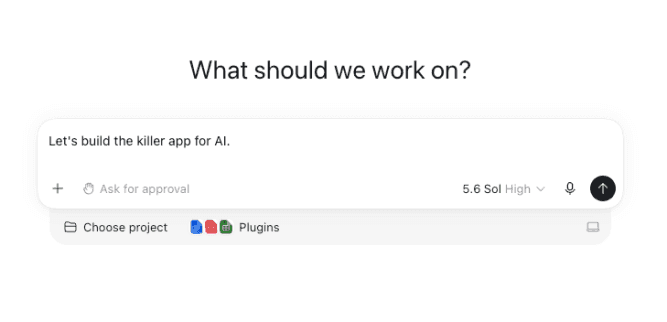
OpenAI is building AI agents for everything. Will everyone use them?
How much control are you willing to give an LLM over your digital life? Getting the most value from a model means giving it the keys. For a control freak or the AI-hesitant, it seems like a lot. For Andrew Ambrosino, the lead engineer for OpenAI’s desktop app, it’s the only way to test the future, which is why that app now has access to, and control over, his inbox, his Slack account, his phone, apps like Notion and Figma, and more. “If I’m asking it to write a document, is there a possibility that it’s going to pull from a private DM on that subject and not know that it’s not supposed to share some info? Yes,” Ambrosino told TechCrunch. “I’ll do it for the job. I will take the personal hit here and there if I have to. And I haven’t had to.” Ambrosino works on OpenAI’s biggest bet, ChatGPT Work, which was released last month and is available on the company’s lowest subscription tier, for $20 a month. The product is intended to allow white-collar workers to field AI agents — hooking LLMs up to the digital workflows used by accountants, investors, doctors, and everyone else whose day-to-day is dominated by their computer. OpenAI’smarketing copyputs the goal succinctly: A world where “where [artificial] intelligence goes beyond answering questions to helping everyone turn their biggest ideas into reality.” For software developers, that shift is already happening, but it’s been slow to spread to other departments. ChatGPT Work is a modified version of the company’s Codex coding tool. It’s meant to give non-engineers a version of the same functionality that software engineers already get from agents: an AI tool that doesn’t just answer questions, but completes multistep projects on its own. “In this new factor, ChatGPT can actually do entire, very complicated tasks for you all autonomously in a way that is delightful and safe,” Thibault Sottiaux, who leads OpenAI’s core product work, including Work, told TechCrunch. “It’s the very mission of OpenAI — to bring everyone along.” Commercially, that matters a lot. Agents that work for longer stretches burn through more tokens, which makes them more lucrative for OpenAI on a per-user basis. Reaching new professions is crucial — not just for OpenAI, but for the industry at large. If coding has proven lucrative territory for AI labs, it’s still a tiny subset of the professional work AI tools need to enable if these companies are to justify their massive investment in training and computation. While labs have been focused on software engineers, vertical-specific competitors like Harvey (for law) and Clay (for sales) have been chasing those customers with a model-agnostic approach, meaning they’ll plug in whichever AI works best at the time. Industry analysts see this as one of the major challenges facing OpenAI and its competitors. “If the labs cannot rapidly get ahold of the key complementary assets needed to scale AI in the market, value will accrue elsewhere,” Christian Cataliniwroteon a16z’s “It’s time to build” blog. Making the AI apps work for people who aren’t software engineers requires more hand-holding. OpenAI’s non-engineering workforce, like the communications and finance teams, started using Codex “at a time that it was actively hostile to them—asking them about code and showing them, ‘oh, you have an empty diff for this thing,’” Ambrosino said, referring to a technical readout meant for software changes. “So, we started to make it more general purpose between February and now.” An OpenAI-backed study found that in June, 98% of OpenAI employees were using Codex, but just 17% of organizational subscribers and less than 1% of individual subscribers were using the agentic coding tool. That difference between near total adoption inside the company and negligible adoption outside it is the challenge and opportunity for the company.“The more value and the more utility that we generate for users, the more they will be willing to also pay for some part of that utility, and that’s how we’ve always seen ChatGPT as well,” Sottiaux said. “You sit there and you’re like, ’of course I want to pay $20 bucks a month for this,’ because the value that you get is so much more.” To understand that disconnect, it helps to understand what OpenAI’s engineers are building. Every LLM requires what engineers call a “harness” — the software wrapped around a model that decides what information it sees, which tools it can use, and how it presents its answers back to you. If you want that model to do stuff — to become an agent — the harness gives it tools and instructions for using them on long-term tasks. For developers, a command-line interface (CLI) that enabled LLMs to code was enough to change the way software was built and deployed. But most people aren’t using CLIs; there’s a reason Windows replaced DOS. An agentic product that goes beyond software engineering is “going to be something that plays with the messy world of your life and your tools and websites that were built in 1995 and never updated,” Ambrosino told TechCrunch, explaining that the experiences his team is building are vital to expanding access to useful AI. Consider apps like Claude Code and Codex: They unleashed “vibe coding” by abstracting away all the actual software writing, and letting users just tell the model what they want in a program. Now, OpenAI wants to make functionality found in tools like OpenClaw, which coders use to put LLMs to work, as easy as prompting. “Without these products in front of the model, experts would know how to get the same results, but you wouldn’t get to a billion people using the thing,” Ambrosino said. That trade-off between what power users need and what mainstream adoption requires plays out in internal debates at OpenAI, where some employees argue that a button is unnecessary if users can just ask the model directly. “We push back on [that] — because it’s very early,” Ambrosino said. “Discoverability matters in this phase, and at some point we won’t have the button.” Work has a few more buttons for selecting projects and plug-ins, but it aims for the same magic box interface as other OpenAI products. He compares it to skeuomorphism, the fading practice of making digital tools look like the physical objects they replaced, like a calculator app made to look like a pocket calculator. “That stuff wasn’t just cringe design. That actually helped get people into this [and] make the transition,” Ambrosino said. OpenAI wouldn’t say how many people used Work versus Codex, but the joint app is used by just 20 million people, compared to more than a billion users the company says are prompting ChatGPT online. For now, OpenAI is pitching this tool as best suited for routine, data-intensive coordination tasks. Its employees are setting upweekly metrics reports, for example, and making spreadsheets intoplanning tools. I’ve spoken to VCs using agents to assemble relevant communications and analysis about companies into investment memos, and ops teams spinning up bespoke dashboards and data visualizations. Sam Altman is using it toplan his vacations. One OpenAI engineer described asking the program to look at a Slack conversation about an engineering problem and “make some charts,” then receiving back a series of insightful plots. “There is a deluge of information for the average worker or employee of any of these companies, including myself,” Akshay Nathan, who leads the product engineering team at OpenAI, said. “We’re actually quite limited by our ability to parse everything that’s available to us, and then take action on it. That information lives in all these system records tools [like, Salesforce]…the value of ChatGPT is you already have access to this, but now youtrulyhave access to it.” This, then, could be the digital personal assistant that AI evangelists dream about. As with Claude Cowork or Perplexity AI browsing agent, ChatGPT Work links agents to your existing workspace — email, web browser, a slew of SaaS platforms — and puts that context to work for you. When the system works, it can be impressive: I asked ChatGPT Work to get my son’s weirdly-formatted preschool calendar out of my email and put it into my Google Calendar, and it did, saving me a lot of repetitive data entry. Hopefully now I won’t forget the school potluck or fail to arrange vacation childcare. I didn’t trust OpenAI with access to my inbox, source interviews, or story drafts (fear not, AI haters) and wouldn’t let it have access to my bank account, but I believe it would be more useful had I the faith. I tasked it to do financial analysis on publicly traded companies that I cover, and it delivered an auto-updating dashboard of metrics for me; it made a queryable database of space launches, a task I’d previously had to accomplish by writing Python scripts. It also sends me a weekly email about new AI research posted at academic clearinghouses. I’ll keep experimenting with it. While asking the model for something is intuitive, giving it what it needs to take action isn’t as simple. Setting up the permissions for agents to access, say, a cloud drive was confusing and circular — I tried multiple times to give it just “read” access and received error messages. The model itself wasn’t too helpful, but eventually on the mobile app, a dialog box popped up to tell me that only complete access would make it work. Many important settings are only available on the web app, so I frequently found myself working in both at the same time. Sometimes ChatGPT Work’s limitations are baffling — link it to your Google calendar and it can create events, but not new calendars. And don’t bother trying to do anything unless the effort level is high, otherwise you’ve got the worst intern you’ve ever worked with. That’s common advice from AI early adopters, who fear that frustrated newbies will give up. Joe Gershenson, the engineering lead for OpenAI’s harness, admitted that effort settings aren’t intuitive for new users yet — ”there are things that we can do better to help them get the right level of reasoning…” he said, adding, “Watch this space.” OpenAI faces another important challenge breaking into normie white-collar work: Most workflows aren’t as measurable — or evaluable — as code. Software either works or it doesn’t, and even that distinction reduces the nuance about what makes code good or bad. A good presentation, business strategy, or sales pitch isn’t as easy to evaluate or trace. “One of the unique challenges with a product like this is just that it can really do anything,” Ambrosino said. When I asked which specific problems the team designs around, and which workflows it targets, the engineers I spoke with demurred, saying that was a question for OpenAI’s research team. OpenAI later provided an answer, telling TechCrunch that it uses its benchmarkGDPval, drawn from 44 occupations and hundreds of knowledge work tests, and supplements that with user feedback. A less official answer is that it comes from OpenAI employees themselves. Said Ambrosino, “We have to always parse out … are we doing the workflow that everybody else will be doing, or are we weird?” The early adopters of the app itself will create valuable traces with their actual usage — much of the success of coding tools is built on similar data collection — assuming they don’t opt out of making it available for training. (I did). Despite all the attention on the model interface, OpenAI’s engineers were reluctant to answer a fairly simple question: What sets Codex and ChatGPT Work apart from Claude Cowork, or other competing agentic harnesses intended for a mass user base?“It’s going to be a really disappointing answer for you, and I’m sorry, but the honest answer is that I really don’t look at the harnesses that they’re building,” Gershenson said in a typical answer. “The Mad Men‘I don’t think about you at all’meme comes to mind here.” Frankly, I don’t believe them, if only based on the extreme similarities between the products’ user interfaces, the need for competitive intelligence at any business, and because the first thing ChatGPT Work asked me to do when I started it up was port over my Claude Cowork data. It’s understandable if Claude Code is a sensitive topic around the OpenAI offices. Their corporate rival defined the market for AI coding and launched a revolution in how software engineers do their jobs. It’s additionally frustrating because OpenAI had the idea first, but didn’t quite harness it correctly. When OpenAI first developed Codex as a web app, the engineers got a bit over their skis — or, as Ambrosino puts it, “a bit more AGI-pilled.” In short, they bet on the model being smart enough to handle a task entirely on its own, with minimal user input. Built shortly afterward, Claude Code was oriented around a back-and-forth conversation with the user. If you gave it a problem, it would survey the possibilities and give you three or four options for proceeding. Once you chose, it would go a little further and then check back again, giving continual updates and leaving less room for the model and harness to make mistakes. Anthropic’s approach proved more effective, even if it demanded more work from users. “[Our] product was a little ahead of where the model and harness was at the time,” Ambrosino says now. OpenAI eventually followed suit by adding more opportunities for users to interact with the model. That became the Codex we know today, with desktop and mobile apps. Using download statistics as a proxy for interest in the programs, Claude Code was more in demand until April of this year, but now Codex has taken a slight lead;surveysof enterprise use also suggest OpenAI is catching up. Part of that lead is getting the product-market fit right, and part comes from complaints about safety restrictions on Anthropic’s models and compute shortages. OpenAI’s steps toward more human-centric harness continue with ChatGPT Work, but the engineers I spoke to insisted the key differentiator is the strength of OpenAI’s latest powerful and cost-effective models. “The frustrating answer is that a lot of times it is the model, and one thing that we have tried to do really well with this app is fully leverage the model,” Ambrosino said. That explanation returns to the “bitter lesson” learned by AI researchers that a better general model is more important than specific domain experience. For true believers, the harness is a temporary crutch, not the moat. “You could get good results in the short term by adding a whole bunch of extras — if and thens and tools — but like, come on, the next model is going to come out in a couple of months and make that obsolete,” Gershenson told TechCrunch. His team focuses on the simplest ways to expose the model to the tools and context it needs — and no more. “The goal of good harness engineering is to… be more precise about what information the model really needs to solve your problem, because the models are getting better and better at doing that if you simply let them do their thing,” Gershenson said. There is an open question, though, if most people or models are ready for that. Ethan Mollick, the Wharton School of Business professor who studies AI tools in the workplace, still sees Claude as more user-friendly,writingthat “ChatGPT tends to want to do magic & just do it for you, while Claude does comparisons & shows them, repeatedly asking for input & feedback and doing A & B tests.” Sottiaux, and perhaps OpenAI at large, disagree, arguing that the conversational nature of the app is better than learning how to use an application. “We definitely see that the world seems to be ready,” he says of the app. ”This is why we’ve had incredible adoption.” Still, it’s not clear that a model-specific harness is even the right bet for maximizing a model. Comparisons run by companies likeComposioandDatabricksshow that different harness and model combinations deliver different performance on coding benchmarks. Databricks found that Pi, an open source harness published by the software company Earendil, outperformed Codex while using the same GPT 5.5 model. Pi has been used to build projects like OpenClaw and Cloudflare OS. Pi’s creator, Mario Zechner, says his intentionally minimalist harness is evidence that an AGI-pilled approach can work, at least for software engineers and coding tasks. What it lacks in explicit features, he says, is made up for by its ability to modify itself and build its own interfaces. He sympathizes with the challenge that OpenAI’s engineers face in expanding their user base beyond engineers. “Everything is coding agent shaped…the reason is that they only have training data for coding agent tasks,” he told TechCrunch. “Say I’m in management, I make a decision today, and the outcome happens months later. You cannot capture that in a simple trace of a user and agent back and forth, so all of these kinds of tasks and anything that you don’t digitize is inaccessible to a model to learn.” Like other open source providers, he sees the big lab’s effort to push their harnesses as a way to lock-in users; ”They need to own the entire stack; otherwise, they just become a model provider and then need to compete with Chinese models.” He and other engineers TechCrunch spoke to felt that the insight into token spend and agent behavior in frontier labs’ harnesses is too limited. In a sense, that’s less meaningful to non-technical workers, but as with the coding tools, uptake at the scale OpenAI hopes for will eventually force harder conversations about cost. For example, messing around on a $20-a-month subscription, I used more than 80 million tokens in four days, which cost $65, according to the model’s analysis (there’s no dashboard in the app). That’s a subsidy of more than 3x the subscription price for four days of casual use alone. “We are working every day to push the frontier on efficiency,” Sottiaux said, pointing to a recent 80% price cut for users of OpenAI’s Luna model. “If you wake up six months from now, you should be able to do all of the same [tasks] with less spend.” The other relevant question is whether these apps create a lock-in effect on customers through data retention, or the sheer pain of configuring access to all the plug-ins and their permissions. Inside OpenAI’s wood-paneled, plant-filled headquarters, which I visited in July, the atmosphere was calm but slightly tense; these are people with a lot to do. The engineers I spoke with were constantly monitoring their laptops as we talked, and rushing from meeting room to meeting room. Nathan, the head of the product engineering team, said the focus remains on “the promise of the magic box, but I still think there’s too much complexity…I’m very optimistic that we can solve it, with the model and in a truly AI-native way.”
View

Valor, Point72 back General Intuition at $6B valuation as AI startup pushes into robotics
New York-based General Intuition, the startup building a foundation model that trains generalized AI agents to move through space and time, is in talks to raise funding at a $6 billion pre-money valuation from new investors including Valor Equity Partners, Point72 Ventures, and Seven Seven Six, according to sources familiar with the matter. Existing investors including Khosla Ventures and General Catalyst are also participating in the round. The fresh funds would come just weeks after General Intuition raised$320 million at a $2.3 billion valuation. The news confirmsearlier reportingon the deal for what is becoming one of the hottest startups tackling physical AI. CEO Pim de Wittespun out General Intuition last Octoberfrom his video game clip-sharing platform Medal, using its hundreds of millions of hours of gameplay and “action labels” — records of what buttons a player pressed and when — as an initial dataset. First sneak peak in the WSJ on how GI’s large action models work!https://t.co/6fuOcu9fkb Investor Vinod Khoslarecently told TechCrunchthat he believes those action labels will be a key part of the “emergence of intuition,” or the ability for a model to truly generalize across tasks that it wasn’t explicitly trained on. General Intuition is still finalizing the round, and a source close to the deal said that it is oversubscribed as the startup continues to field interest from investors. The company intends to use the funds to focus to improve its general model with a focus on robotic embodiments. That means spending more on compute infrastructure (the company has a partnership with neolab CoreWeave) and hiring more talent. Valor Equity Partners is known for backing SpaceX. TechCrunch has reached out to confirm its investment in General Intuition, which would be the first AI lab the fund has invested in since SpaceX.This story is developing. Please check back in for updates.
View

Anthropic Asks Job Candidates Whether AI Safety Comes Before Stock Value: Report
The question was a part of Anthropic’s culture interview, which all candidates go through with an employee selected to conduct it.
View

India's Airlines Have a Data Problem. This Dehradun Startup's Fix is an AI Layer
RayMach is betting that the next aviation software opportunity is not another standalone system, but an AI layer that can connect the fragmented data already sitting across airlines.
View

WazirX Launches India’s First AI Co-Pilot for Crypto Trading
Alongside WazirX AI, the company is launching a Paper Trading Sandbox that gives every user a simulated $100,000 balance.
View
Enviar tu herramienta


PoweredByAI.app es un directorio de herramientas de IA que ayuda a personas, empresas y creadores a descubrir las mejores herramientas de IA para escritura, programación, diseño, productividad y más.
© 2026 , Producto de011BQ. Todos los derechos reservados.