🚀 Zaprep: Deine Socials auf Steroiden. Kostenlos starten — automatisiere 1.000 DMs/Monat und verwandle Engagement in Leads. mit 1.000 automatisierten DMs/Monat.


Ist das dein KI-Tool? Beanspruche es noch heute.
Bestätige die Inhaberschaft, verwalte dein Profil und schalte Wachstumsfunktionen frei.
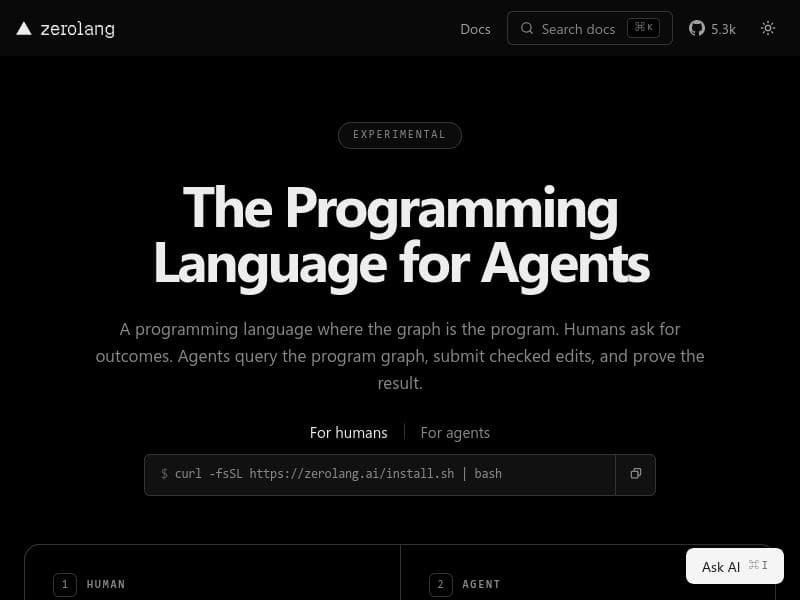
Zero is an experimental graph-first programming language that empowers agents to work directly with semantic program structures, enabling humans to specify outcomes while agents handle code edits and correctness proofs. Ideal for developers and researchers exploring AI-driven programming, Zero offers a novel, agent-first approach that redefines how software is created and verified.

Beschreibung
Zero is Vercel's experimental programming language designed for a world where AI agents write the code. Instead of editing source text, agents query and patch a semantic program graph while the compiler checks every change. Humans simply ask for outcomes, then review readable code projections when needed. Built from the ground up for agentic coding, with token efficiency, fast builds, low memory, and zero dependencies.
Ausführliche Beschreibung
Zero, also known as zerolang, is an experimental programming language designed with a revolutionary graph-first approach that redefines how programming is conducted. Unlike traditional programming languages that rely on raw source text, Zero enables agents to interact directly with the semantic structure of the program represented as a graph. This fundamental shift allows humans to specify desired outcomes rather than writing explicit code, while intelligent agents query the program graph, submit verified edits, and provide proofs of correctness for the resulting program. This novel paradigm facilitates a more collaborative and error-resistant programming process, where the focus is on what the program should achieve rather than how to write it line-by-line. At its core, Zero's standout feature is its graph-first programming language design. The program is represented as a semantic graph, which agents manipulate to implement changes. This contrasts with conventional text-based code editing, enabling a more structured and semantically rich interaction. Agents working within Zero do not merely parse text but understand the program's meaning and structure, allowing them to perform sophisticated queries and edits. Humans interact by specifying outcomes or goals, which the agents interpret and translate into precise modifications on the program graph. Each edit submitted by an agent is checked for correctness, and the system proves the validity of the changes, ensuring that the program maintains integrity and behaves as expected. This agent-first approach opens new possibilities for automation, collaboration, and correctness assurance in software development. Zero is particularly suited for developers, researchers, and organizations interested in exploring cutting-edge programming methodologies that leverage AI and semantic understanding. It is ideal for those who want to experiment with agent-assisted programming or require a higher level of program correctness and proof guarantees. Use cases include complex software projects where correctness is critical, educational environments exploring new programming paradigms, and AI research focused on program synthesis and verification. By abstracting away from raw code and focusing on outcomes, Zero can potentially reduce human error and accelerate development cycles. Regarding pricing and plans, Zero is currently in an experimental phase and primarily accessible through its open-source repository and community channels. There is no explicit pricing model detailed at this stage, as the project is focused on research and development. Interested users can explore the language and contribute via its GitHub repository, which has a growing community of over 5,000 stars, indicating active interest and ongoing development. When compared to traditional programming languages and environments, Zero stands out due to its semantic graph-based approach and agent-first interaction model. While conventional languages require manual coding and debugging, Zero leverages intelligent agents to automate code modifications and correctness proofs. This makes it fundamentally different from text-based languages like Python, Java, or JavaScript, and even from other AI-assisted coding tools that still operate on source text. However, as an experimental language, Zero is less mature and may lack the extensive libraries, tooling, and ecosystem support that established languages enjoy. Notable limitations include its experimental status, which means it may not yet be suitable for production use or large-scale projects. The learning curve can be steep for developers accustomed to traditional coding, as it requires understanding a new programming paradigm centered on semantic graphs and agent collaboration. Additionally, the reliance on agents for code edits and proofs means the system's effectiveness depends heavily on the quality and capabilities of these agents. Integration with existing development workflows and tools may also be limited at this stage. In summary, Zero is a pioneering programming language that reimagines coding as a collaborative, agent-driven process working on semantic program graphs. It offers unique capabilities for outcome-driven development and correctness proofs, making it an exciting option for innovators and researchers in programming languages and AI-assisted development.
Tool-Funktionen
- Graph-first programming language design
- Agents work with semantic program structure
- Humans specify desired outcomes
- Agents query program graph and submit checked edits
- Proof of result correctness
- Experimental and agent-first approach
Beschreibung
Zero is an experimental graph-first programming language that empowers agents to work directly with semantic program structures, enabling humans to specify outcomes while agents handle code edits and correctness proofs. Ideal for developers and researchers exploring AI-driven programming, Zero offers a novel, agent-first approach that redefines how software is created and verified.
Zero is Vercel's experimental programming language designed for a world where AI agents write the code. Instead of editing source text, agents query and patch a semantic program graph while the compiler checks every change. Humans simply ask for outcomes, then review readable code projections when needed. Built from the ground up for agentic coding, with token efficiency, fast builds, low memory, and zero dependencies.
Ausführliche Beschreibung
Zero, also known as zerolang, is an experimental programming language designed with a revolutionary graph-first approach that redefines how programming is conducted. Unlike traditional programming languages that rely on raw source text, Zero enables agents to interact directly with the semantic structure of the program represented as a graph. This fundamental shift allows humans to specify desired outcomes rather than writing explicit code, while intelligent agents query the program graph, submit verified edits, and provide proofs of correctness for the resulting program. This novel paradigm facilitates a more collaborative and error-resistant programming process, where the focus is on what the program should achieve rather than how to write it line-by-line. At its core, Zero's standout feature is its graph-first programming language design. The program is represented as a semantic graph, which agents manipulate to implement changes. This contrasts with conventional text-based code editing, enabling a more structured and semantically rich interaction. Agents working within Zero do not merely parse text but understand the program's meaning and structure, allowing them to perform sophisticated queries and edits. Humans interact by specifying outcomes or goals, which the agents interpret and translate into precise modifications on the program graph. Each edit submitted by an agent is checked for correctness, and the system proves the validity of the changes, ensuring that the program maintains integrity and behaves as expected. This agent-first approach opens new possibilities for automation, collaboration, and correctness assurance in software development. Zero is particularly suited for developers, researchers, and organizations interested in exploring cutting-edge programming methodologies that leverage AI and semantic understanding. It is ideal for those who want to experiment with agent-assisted programming or require a higher level of program correctness and proof guarantees. Use cases include complex software projects where correctness is critical, educational environments exploring new programming paradigms, and AI research focused on program synthesis and verification. By abstracting away from raw code and focusing on outcomes, Zero can potentially reduce human error and accelerate development cycles. Regarding pricing and plans, Zero is currently in an experimental phase and primarily accessible through its open-source repository and community channels. There is no explicit pricing model detailed at this stage, as the project is focused on research and development. Interested users can explore the language and contribute via its GitHub repository, which has a growing community of over 5,000 stars, indicating active interest and ongoing development. When compared to traditional programming languages and environments, Zero stands out due to its semantic graph-based approach and agent-first interaction model. While conventional languages require manual coding and debugging, Zero leverages intelligent agents to automate code modifications and correctness proofs. This makes it fundamentally different from text-based languages like Python, Java, or JavaScript, and even from other AI-assisted coding tools that still operate on source text. However, as an experimental language, Zero is less mature and may lack the extensive libraries, tooling, and ecosystem support that established languages enjoy. Notable limitations include its experimental status, which means it may not yet be suitable for production use or large-scale projects. The learning curve can be steep for developers accustomed to traditional coding, as it requires understanding a new programming paradigm centered on semantic graphs and agent collaboration. Additionally, the reliance on agents for code edits and proofs means the system's effectiveness depends heavily on the quality and capabilities of these agents. Integration with existing development workflows and tools may also be limited at this stage. In summary, Zero is a pioneering programming language that reimagines coding as a collaborative, agent-driven process working on semantic program graphs. It offers unique capabilities for outcome-driven development and correctness proofs, making it an exciting option for innovators and researchers in programming languages and AI-assisted development.
Häufig gestellte Fragen
What is Zero?
Zero is an experimental programming language that uses a graph-first approach where agents interact with the semantic structure of programs instead of raw source code. It allows humans to specify desired outcomes, with agents querying the program graph, submitting verified edits, and proving the correctness of results.
How much does Zero cost?
Zero is currently in an experimental phase and is primarily available as an open-source project. There is no formal pricing or subscription model at this time.
Who is Zero best for?
Zero is best suited for developers, researchers, and organizations interested in exploring innovative programming paradigms, agent-assisted coding, and formal correctness proofs. It is ideal for experimental projects, AI research, and educational purposes.
What are the main features of Zero?
Key features include a graph-first programming language design, agents working with semantic program structures, humans specifying desired outcomes, agents submitting checked edits, and proof of result correctness. It emphasizes an agent-first, outcome-driven programming model.
Does Zero offer a free trial?
As an open-source experimental language, Zero is freely accessible for exploration and use. There is no paid tier or trial since it is not a commercial product at this stage.
What integrations does Zero support?
Currently, Zero is an experimental project with limited integration options. It is primarily accessed via its GitHub repository and community tools. Integration with mainstream development environments is expected to evolve as the project matures.
How does Zero work?
Zero works by representing programs as semantic graphs rather than text. Humans specify the desired outcomes, and intelligent agents query and manipulate the program graph, submitting verified edits and proving the correctness of the resulting program, enabling a collaborative and error-resistant programming process.
Bewertungen
Noch keine Bewertungen. Teile als Erste:r deine Erfahrung.
Gesponserte Tools






















Empfohlene Tools
Bleib auf dem Laufenden zu den neuesten KI-Tools
Hol dir die neuesten Insights – abonniere unseren Newsletter
Gelesen und geschätzt von 50,000+ Leser:innen
Tritt der größten KI-Community bei
Unsere Community und unser Team sind für dich da!
Dein Feedback hilft Alice AI, in zukünftigen Versionen besser zu werden.







Tool einreichen


PoweredByAI.app ist ein KI-Tools-Verzeichnis, das Menschen, Unternehmen und Creators hilft, die besten KI-Tools für Schreiben, Programmieren, Design, Produktivität und mehr zu entdecken.
© 2026 , Ein Produkt von011BQ. Alle Rechte vorbehalten.