🚀 Zaprep: Deine Socials auf Steroiden. Kostenlos starten — automatisiere 1.000 DMs/Monat und verwandle Engagement in Leads. mit 1.000 automatisierten DMs/Monat.


Ist das dein KI-Tool? Beanspruche es noch heute.
Bestätige die Inhaberschaft, verwalte dein Profil und schalte Wachstumsfunktionen frei.
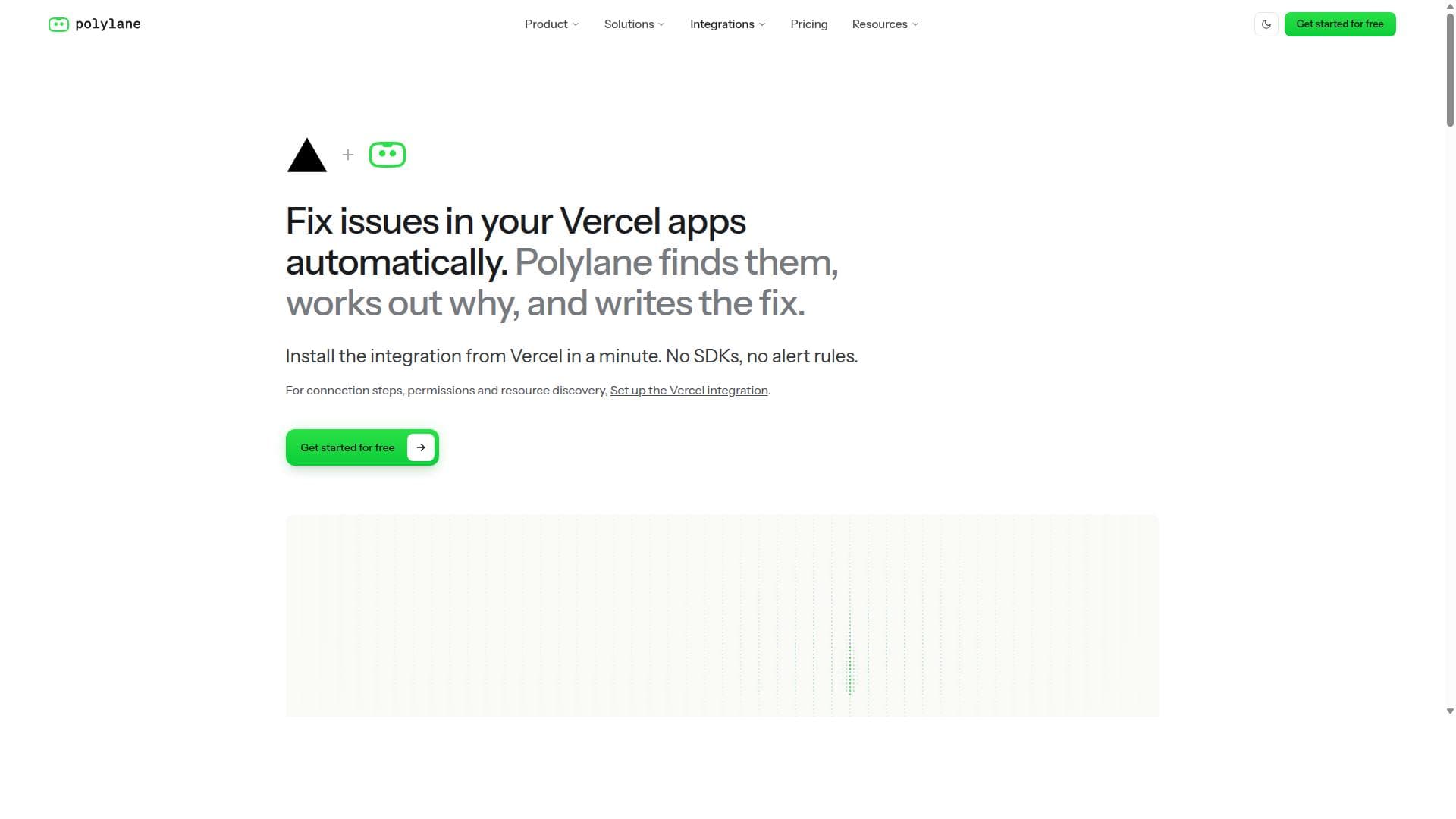
Polylane for Vercel is an AI-powered monitoring and incident response tool that not only detects issues in Vercel projects but also automatically generates pull requests with fixes, streamlining debugging and resolution. Ideal for development teams on Vercel, it learns normal project behavior to detect anomalies without manual alert rules and integrates with major observability providers, ensuring efficient and controlled incident management.

Beschreibung
Keep shipping while Polylane watches your Vercel apps. Connect through the Vercel Marketplace to bring projects, deployments, domains and logs into one live graph. Agents catch regressions, investigate the root cause with evidence, and open a pull request with the permanent fix for your review.
Ausführliche Beschreibung
Polylane for Vercel is an advanced AI-powered monitoring and incident response tool specifically designed to optimize the development and maintenance workflows of projects hosted on the Vercel platform. Its core purpose is to automate the detection, diagnosis, and resolution of issues that arise in production environments, thereby reducing downtime and accelerating the debugging process. By analyzing request logs and performance metrics, Polylane intelligently identifies the root causes of problems and proactively generates pull requests containing fixes, which developers can review and approve. This seamless integration with Vercel projects streamlines incident management and enhances operational efficiency for development teams. One of the standout features of Polylane for Vercel is its ability to automatically detect and remediate issues without requiring manual alert rule configuration. The tool learns the normal behavior patterns of each project, enabling it to spot anomalies and potential faults through continuous monitoring of logs and metrics. When an issue is detected, Polylane not only diagnoses the root cause but also crafts a code fix and opens a pull request in the relevant repository, allowing developers to review changes before deployment. This closed-loop approach to incident response reduces the time and effort traditionally needed to identify and fix bugs. Polylane supports integration with all major observability providers, allowing it to ingest data from existing monitoring tools seamlessly. Additionally, it offers a flexible integration mechanism through its Monitoring Connectivity Protocol (MCP), enabling connections to custom or less common observability systems. Importantly, Polylane requires explicit user approval before applying any changes to projects, ensuring that developers retain full control over their codebase and deployment process. This tool is best suited for development teams and DevOps engineers working on Vercel-hosted web applications who want to automate incident detection and resolution while maintaining control over code changes. It is particularly valuable for teams looking to reduce manual monitoring overhead, accelerate debugging cycles, and improve overall site reliability. Use cases include real-time error detection in production, automated bug fixing workflows, anomaly detection without complex alert rules, and streamlined collaboration between monitoring and development teams. Regarding pricing, Polylane offers a free plan to help teams get started with its capabilities. Detailed information about all plans, pricing tiers, and usage limits is available on the official website. This flexible pricing model allows teams of various sizes and needs to adopt Polylane incrementally and scale as their requirements grow. Compared to traditional monitoring and incident response tools, Polylane stands out by combining AI-driven root cause analysis with automated fix generation and pull request creation. While many monitoring solutions alert developers to issues, Polylane goes a step further by proposing actionable code changes, thus closing the loop between detection and resolution. Its learning-based anomaly detection eliminates the need for manual alert rule setup, which is a common pain point in other platforms. However, users should consider that Polylane’s automated fixes require developer review and approval, which means it is not a fully autonomous remediation system but rather a collaborative assistant. Notable limitations include the dependency on Vercel projects and repositories for full functionality, which means it is not a universal tool for all deployment environments. Additionally, while Polylane supports major observability providers, integration with niche or proprietary systems may require custom configuration via MCP. Finally, as with any AI-driven tool, the quality of automated fixes depends on the complexity of the issues and the accuracy of the underlying models, so human oversight remains essential to ensure code quality and stability. Overall, Polylane for Vercel offers a powerful, AI-enhanced approach to monitoring and incident response that significantly reduces the time and effort required to maintain healthy production environments, making it an excellent choice for Vercel users seeking to modernize their operational workflows.
Tool-Funktionen
- Automatically detects and fixes issues in Vercel projects
- Reads request logs and metrics to diagnose root causes
- Opens pull requests with fixes for developer review
- Supports integration with major observability providers
- Learns normal project behavior to detect anomalies without alert rules
- Requires user approval before making changes to projects
Beschreibung
Polylane for Vercel is an AI-powered monitoring and incident response tool that not only detects issues in Vercel projects but also automatically generates pull requests with fixes, streamlining debugging and resolution. Ideal for development teams on Vercel, it learns normal project behavior to detect anomalies without manual alert rules and integrates with major observability providers, ensuring efficient and controlled incident management.
Keep shipping while Polylane watches your Vercel apps. Connect through the Vercel Marketplace to bring projects, deployments, domains and logs into one live graph. Agents catch regressions, investigate the root cause with evidence, and open a pull request with the permanent fix for your review.
Ausführliche Beschreibung
Polylane for Vercel is an advanced AI-powered monitoring and incident response tool specifically designed to optimize the development and maintenance workflows of projects hosted on the Vercel platform. Its core purpose is to automate the detection, diagnosis, and resolution of issues that arise in production environments, thereby reducing downtime and accelerating the debugging process. By analyzing request logs and performance metrics, Polylane intelligently identifies the root causes of problems and proactively generates pull requests containing fixes, which developers can review and approve. This seamless integration with Vercel projects streamlines incident management and enhances operational efficiency for development teams. One of the standout features of Polylane for Vercel is its ability to automatically detect and remediate issues without requiring manual alert rule configuration. The tool learns the normal behavior patterns of each project, enabling it to spot anomalies and potential faults through continuous monitoring of logs and metrics. When an issue is detected, Polylane not only diagnoses the root cause but also crafts a code fix and opens a pull request in the relevant repository, allowing developers to review changes before deployment. This closed-loop approach to incident response reduces the time and effort traditionally needed to identify and fix bugs. Polylane supports integration with all major observability providers, allowing it to ingest data from existing monitoring tools seamlessly. Additionally, it offers a flexible integration mechanism through its Monitoring Connectivity Protocol (MCP), enabling connections to custom or less common observability systems. Importantly, Polylane requires explicit user approval before applying any changes to projects, ensuring that developers retain full control over their codebase and deployment process. This tool is best suited for development teams and DevOps engineers working on Vercel-hosted web applications who want to automate incident detection and resolution while maintaining control over code changes. It is particularly valuable for teams looking to reduce manual monitoring overhead, accelerate debugging cycles, and improve overall site reliability. Use cases include real-time error detection in production, automated bug fixing workflows, anomaly detection without complex alert rules, and streamlined collaboration between monitoring and development teams. Regarding pricing, Polylane offers a free plan to help teams get started with its capabilities. Detailed information about all plans, pricing tiers, and usage limits is available on the official website. This flexible pricing model allows teams of various sizes and needs to adopt Polylane incrementally and scale as their requirements grow. Compared to traditional monitoring and incident response tools, Polylane stands out by combining AI-driven root cause analysis with automated fix generation and pull request creation. While many monitoring solutions alert developers to issues, Polylane goes a step further by proposing actionable code changes, thus closing the loop between detection and resolution. Its learning-based anomaly detection eliminates the need for manual alert rule setup, which is a common pain point in other platforms. However, users should consider that Polylane’s automated fixes require developer review and approval, which means it is not a fully autonomous remediation system but rather a collaborative assistant. Notable limitations include the dependency on Vercel projects and repositories for full functionality, which means it is not a universal tool for all deployment environments. Additionally, while Polylane supports major observability providers, integration with niche or proprietary systems may require custom configuration via MCP. Finally, as with any AI-driven tool, the quality of automated fixes depends on the complexity of the issues and the accuracy of the underlying models, so human oversight remains essential to ensure code quality and stability. Overall, Polylane for Vercel offers a powerful, AI-enhanced approach to monitoring and incident response that significantly reduces the time and effort required to maintain healthy production environments, making it an excellent choice for Vercel users seeking to modernize their operational workflows.
Häufig gestellte Fragen
What is Polylane for Vercel?
Polylane for Vercel is an AI-driven monitoring and incident response tool tailored for projects hosted on the Vercel platform. It analyzes request logs and metrics to identify root causes of issues and automatically opens pull requests with fixes, helping developers quickly resolve production problems.
How much does Polylane for Vercel cost?
Polylane offers a free plan to get started, with additional paid plans that vary based on usage and features. Detailed pricing information, including all plans and limits, is available on the Polylane website.
Who is Polylane for Vercel best for?
Polylane is best suited for development teams, DevOps engineers, and site reliability engineers working on Vercel-hosted web applications who want to automate issue detection and resolution while maintaining control over code changes.
What are the main features of Polylane for Vercel?
Key features include automatic detection and fixing of issues in Vercel projects, root cause analysis through request logs and metrics, automatic pull request creation with fixes for developer review, integration with major observability providers, anomaly detection without manual alert rules, and requiring user approval before applying changes.
Does Polylane for Vercel offer a free trial?
Yes, Polylane provides a free plan that allows users to try out its core features and get started with AI-powered monitoring and incident response.
What integrations does Polylane for Vercel support?
Polylane supports integration with all major observability providers and allows connections to other systems through its Monitoring Connectivity Protocol (MCP), enabling flexible data ingestion from various monitoring tools.
How does Polylane for Vercel work?
Polylane continuously monitors request logs and metrics from Vercel projects, learns normal behavior patterns, and detects anomalies without requiring manual alert rules. When issues occur, it diagnoses the root cause and automatically generates pull requests with proposed fixes, which developers can review and approve before deployment.
Social Media
Tool nutzenBewertungen
Noch keine Bewertungen. Teile als Erste:r deine Erfahrung.
Gesponserte Tools






























Empfohlene Tools
Bleib auf dem Laufenden zu den neuesten KI-Tools
Hol dir die neuesten Insights – abonniere unseren Newsletter
Gelesen und geschätzt von 50,000+ Leser:innen
Tritt der größten KI-Community bei
Unsere Community und unser Team sind für dich da!
Dein Feedback hilft Alice AI, in zukünftigen Versionen besser zu werden.








Tool einreichen


PoweredByAI.app ist ein KI-Tools-Verzeichnis, das Menschen, Unternehmen und Creators hilft, die besten KI-Tools für Schreiben, Programmieren, Design, Produktivität und mehr zu entdecken.
© 2026 , Ein Produkt von011BQ. Alle Rechte vorbehalten.