Microsoft Maia 300


Ist das dein KI-Tool? Beanspruche es noch heute.
Bestätige die Inhaberschaft, verwalte dein Profil und schalte Wachstumsfunktionen frei.
Azure Maia is Microsoft’s groundbreaking scalable AI inference system, engineered to power multi-gigawatt AI workloads and support the next era of Super Intelligence. Ideal for enterprises and developers requiring high-throughput, multigenerational AI capabilities, it serves as the backbone for Microsoft’s AI-powered products and services starting in 2027.

Beschreibung
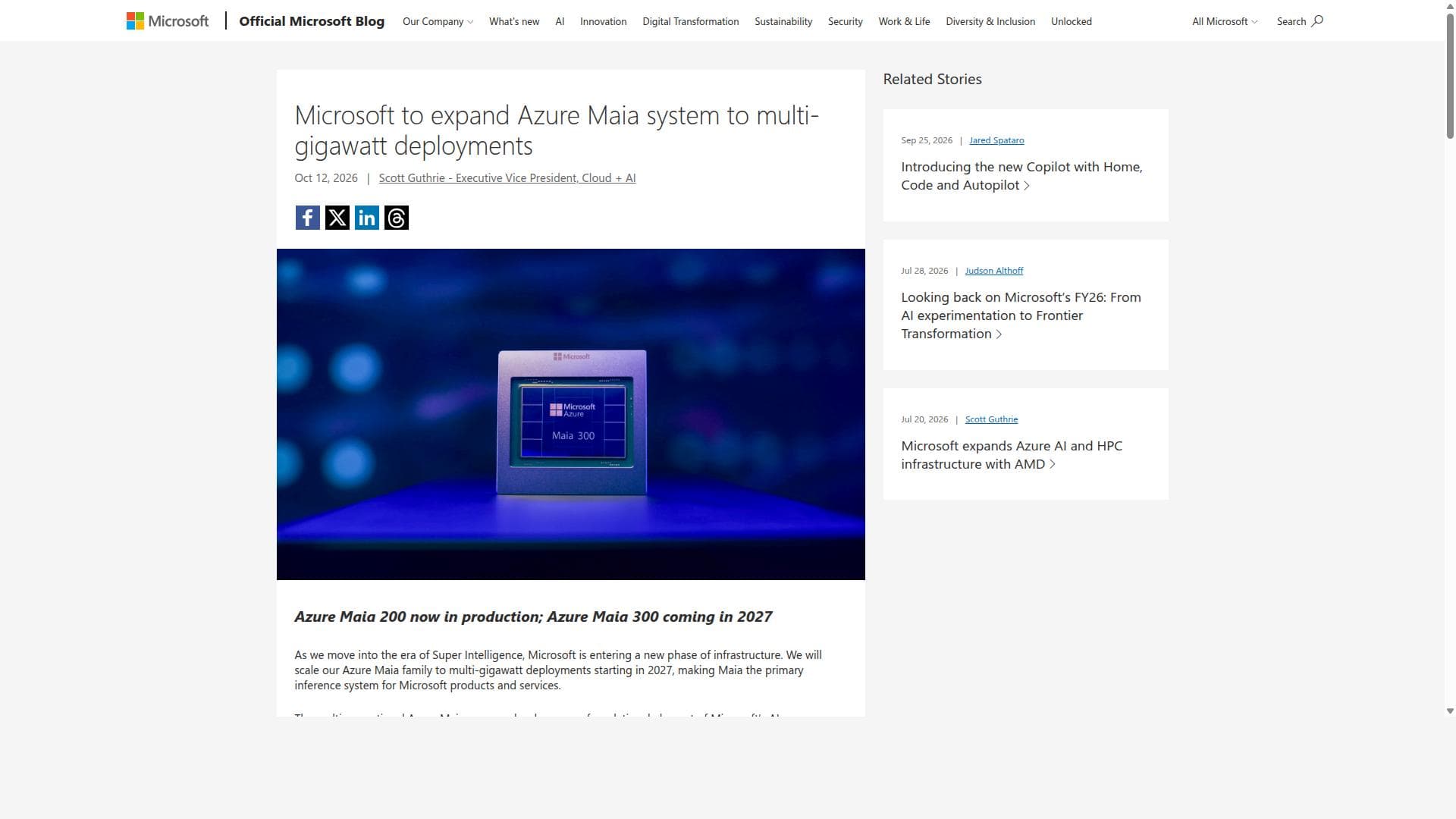
Maia 300 is Microsoft’s next-generation AI inference platform, announced Oct 12, 2026. Per Microsoft, it’s built for long-context reasoning, low-latency conversation, and agents, with 8 HBM4 stacks, TSMC N2P compute chiplets, and 96-accelerator racks. Microsoft claims 40% more tokens per megawatt. Production starts in 2027, and Azure Maia scales to multi-gigawatt deployments, becoming the main inference system for Microsoft’s products.
Ausführliche Beschreibung
Azure Maia is an advanced, scalable inference system developed by Microsoft, designed to meet the demands of next-generation artificial intelligence workloads. Set to support multi-gigawatt deployments starting in 2027, Azure Maia represents a significant leap in AI infrastructure, serving as the primary inference backbone for Microsoft's extensive suite of products and services. Its core purpose is to enable the era of Super Intelligence by providing robust, high-capacity computational resources capable of supporting multigenerational AI models that evolve and improve over time. This system is engineered to handle the exponential growth in AI inference requirements, ensuring seamless performance and scalability for complex AI applications. Key features of Azure Maia include its scalability to multi-gigawatt power levels, which allows it to support massive AI workloads that traditional systems cannot handle. This scalability ensures that as AI models grow in complexity and size, Azure Maia can expand accordingly without compromising performance. It acts as the primary inference system for Microsoft’s ecosystem, powering AI-driven functionalities across products such as Azure Cognitive Services, Microsoft 365, and other cloud-based AI solutions. Additionally, Azure Maia supports multigenerational AI capabilities, meaning it can efficiently manage and deploy AI models that continuously evolve, learn, and adapt, fostering more intelligent and context-aware applications. The system is purpose-built for the era of Super Intelligence, positioning Microsoft at the forefront of AI infrastructure innovation. Azure Maia is best suited for enterprises, AI researchers, and developers who require cutting-edge AI inference infrastructure capable of handling large-scale, complex AI models. Organizations leveraging Microsoft's cloud ecosystem will find Azure Maia particularly beneficial due to its seamless integration with Azure services and Microsoft’s AI product portfolio. Use cases include large-scale natural language processing, real-time AI-driven analytics, advanced computer vision applications, and any scenario demanding high-throughput, low-latency AI inference at scale. It is also ideal for companies preparing for the future of AI, where multigenerational models and superintelligent systems become standard. While specific pricing and plans for Azure Maia have not been publicly detailed, it is expected to follow Microsoft's Azure pricing models, potentially involving usage-based billing aligned with power consumption and inference throughput. Given its enterprise-grade capabilities and scale, pricing will likely be tailored for large organizations and high-demand AI workloads. Interested users should consult Microsoft Azure sales and support channels for detailed pricing information and deployment options. Compared to alternative AI inference systems, Azure Maia stands out due to its unparalleled scalability to multi-gigawatt deployments and its role as the foundational inference infrastructure for Microsoft’s vast AI ecosystem. Many existing AI inference platforms focus on smaller-scale or specialized workloads, whereas Azure Maia is designed for broad, high-capacity use across diverse applications. Its integration with Microsoft’s cloud services and AI tools provides a cohesive environment that competitors may lack. However, alternatives may offer more flexibility or lower entry costs for smaller-scale projects, making Azure Maia more suitable for organizations with substantial AI infrastructure needs. Notable considerations for Azure Maia include its anticipated launch timeline in 2027, meaning it is currently in development or early production phases with Azure Maia 200 already in production. Organizations should plan accordingly for adoption and integration timelines. Additionally, the system’s scale and power requirements may necessitate significant infrastructure investment and expertise to optimize deployment. As with any cutting-edge AI infrastructure, potential users should evaluate their specific workload needs and readiness to adopt multigenerational AI capabilities to fully leverage Azure Maia’s benefits.
Tool-Funktionen
- Scalable to multi-gigawatt deployments
- Primary inference system for Microsoft products and services
- Supports multigenerational AI capabilities
- Designed for the era of Super Intelligence
Beschreibung
Azure Maia is Microsoft’s groundbreaking scalable AI inference system, engineered to power multi-gigawatt AI workloads and support the next era of Super Intelligence. Ideal for enterprises and developers requiring high-throughput, multigenerational AI capabilities, it serves as the backbone for Microsoft’s AI-powered products and services starting in 2027.
Maia 300 is Microsoft’s next-generation AI inference platform, announced Oct 12, 2026. Per Microsoft, it’s built for long-context reasoning, low-latency conversation, and agents, with 8 HBM4 stacks, TSMC N2P compute chiplets, and 96-accelerator racks. Microsoft claims 40% more tokens per megawatt. Production starts in 2027, and Azure Maia scales to multi-gigawatt deployments, becoming the main inference system for Microsoft’s products.
Ausführliche Beschreibung
Azure Maia is an advanced, scalable inference system developed by Microsoft, designed to meet the demands of next-generation artificial intelligence workloads. Set to support multi-gigawatt deployments starting in 2027, Azure Maia represents a significant leap in AI infrastructure, serving as the primary inference backbone for Microsoft's extensive suite of products and services. Its core purpose is to enable the era of Super Intelligence by providing robust, high-capacity computational resources capable of supporting multigenerational AI models that evolve and improve over time. This system is engineered to handle the exponential growth in AI inference requirements, ensuring seamless performance and scalability for complex AI applications. Key features of Azure Maia include its scalability to multi-gigawatt power levels, which allows it to support massive AI workloads that traditional systems cannot handle. This scalability ensures that as AI models grow in complexity and size, Azure Maia can expand accordingly without compromising performance. It acts as the primary inference system for Microsoft’s ecosystem, powering AI-driven functionalities across products such as Azure Cognitive Services, Microsoft 365, and other cloud-based AI solutions. Additionally, Azure Maia supports multigenerational AI capabilities, meaning it can efficiently manage and deploy AI models that continuously evolve, learn, and adapt, fostering more intelligent and context-aware applications. The system is purpose-built for the era of Super Intelligence, positioning Microsoft at the forefront of AI infrastructure innovation. Azure Maia is best suited for enterprises, AI researchers, and developers who require cutting-edge AI inference infrastructure capable of handling large-scale, complex AI models. Organizations leveraging Microsoft's cloud ecosystem will find Azure Maia particularly beneficial due to its seamless integration with Azure services and Microsoft’s AI product portfolio. Use cases include large-scale natural language processing, real-time AI-driven analytics, advanced computer vision applications, and any scenario demanding high-throughput, low-latency AI inference at scale. It is also ideal for companies preparing for the future of AI, where multigenerational models and superintelligent systems become standard. While specific pricing and plans for Azure Maia have not been publicly detailed, it is expected to follow Microsoft's Azure pricing models, potentially involving usage-based billing aligned with power consumption and inference throughput. Given its enterprise-grade capabilities and scale, pricing will likely be tailored for large organizations and high-demand AI workloads. Interested users should consult Microsoft Azure sales and support channels for detailed pricing information and deployment options. Compared to alternative AI inference systems, Azure Maia stands out due to its unparalleled scalability to multi-gigawatt deployments and its role as the foundational inference infrastructure for Microsoft’s vast AI ecosystem. Many existing AI inference platforms focus on smaller-scale or specialized workloads, whereas Azure Maia is designed for broad, high-capacity use across diverse applications. Its integration with Microsoft’s cloud services and AI tools provides a cohesive environment that competitors may lack. However, alternatives may offer more flexibility or lower entry costs for smaller-scale projects, making Azure Maia more suitable for organizations with substantial AI infrastructure needs. Notable considerations for Azure Maia include its anticipated launch timeline in 2027, meaning it is currently in development or early production phases with Azure Maia 200 already in production. Organizations should plan accordingly for adoption and integration timelines. Additionally, the system’s scale and power requirements may necessitate significant infrastructure investment and expertise to optimize deployment. As with any cutting-edge AI infrastructure, potential users should evaluate their specific workload needs and readiness to adopt multigenerational AI capabilities to fully leverage Azure Maia’s benefits.
Häufig gestellte Fragen
What is Azure Maia?
Azure Maia is a scalable AI inference system developed by Microsoft designed to support multi-gigawatt deployments starting in 2027. It serves as the primary inference infrastructure for Microsoft products and services, enabling advanced multigenerational AI capabilities.
How much does Azure Maia cost?
Microsoft has not publicly disclosed specific pricing details for Azure Maia. Pricing is expected to follow Azure’s usage-based billing models and will likely be tailored for large-scale enterprise deployments. Interested users should contact Microsoft Azure sales for detailed pricing information.
Who is Azure Maia best for?
Azure Maia is best suited for enterprises, AI researchers, and developers who require high-capacity AI inference infrastructure to support complex, large-scale AI models. It is particularly beneficial for organizations leveraging Microsoft’s cloud ecosystem and preparing for advanced AI workloads.
What are the main features of Azure Maia?
Key features include scalability to multi-gigawatt deployments, serving as the primary inference system for Microsoft’s AI products, support for multigenerational AI models, and design optimized for the era of Super Intelligence.
Does Azure Maia offer a free trial?
As of now, there is no public information regarding a free trial for Azure Maia. Prospective users should check Microsoft Azure’s official channels for any announcements about trials or pilot programs.
What integrations does Azure Maia support?
Azure Maia integrates seamlessly with Microsoft’s Azure cloud services and AI product portfolio, including Azure Cognitive Services and Microsoft 365, enabling broad AI inference capabilities across Microsoft’s ecosystem.
How does Azure Maia work?
Azure Maia operates as a scalable inference system that processes AI model computations at multi-gigawatt power levels. It supports deploying and managing multigenerational AI models, providing the computational backbone for Microsoft’s AI-driven products and services.
Social Media
Tool nutzenBewertungen
Noch keine Bewertungen. Teile als Erste:r deine Erfahrung.