

Ist das dein KI-Tool? Beanspruche es noch heute.
Bestätige die Inhaberschaft, verwalte dein Profil und schalte Wachstumsfunktionen frei.
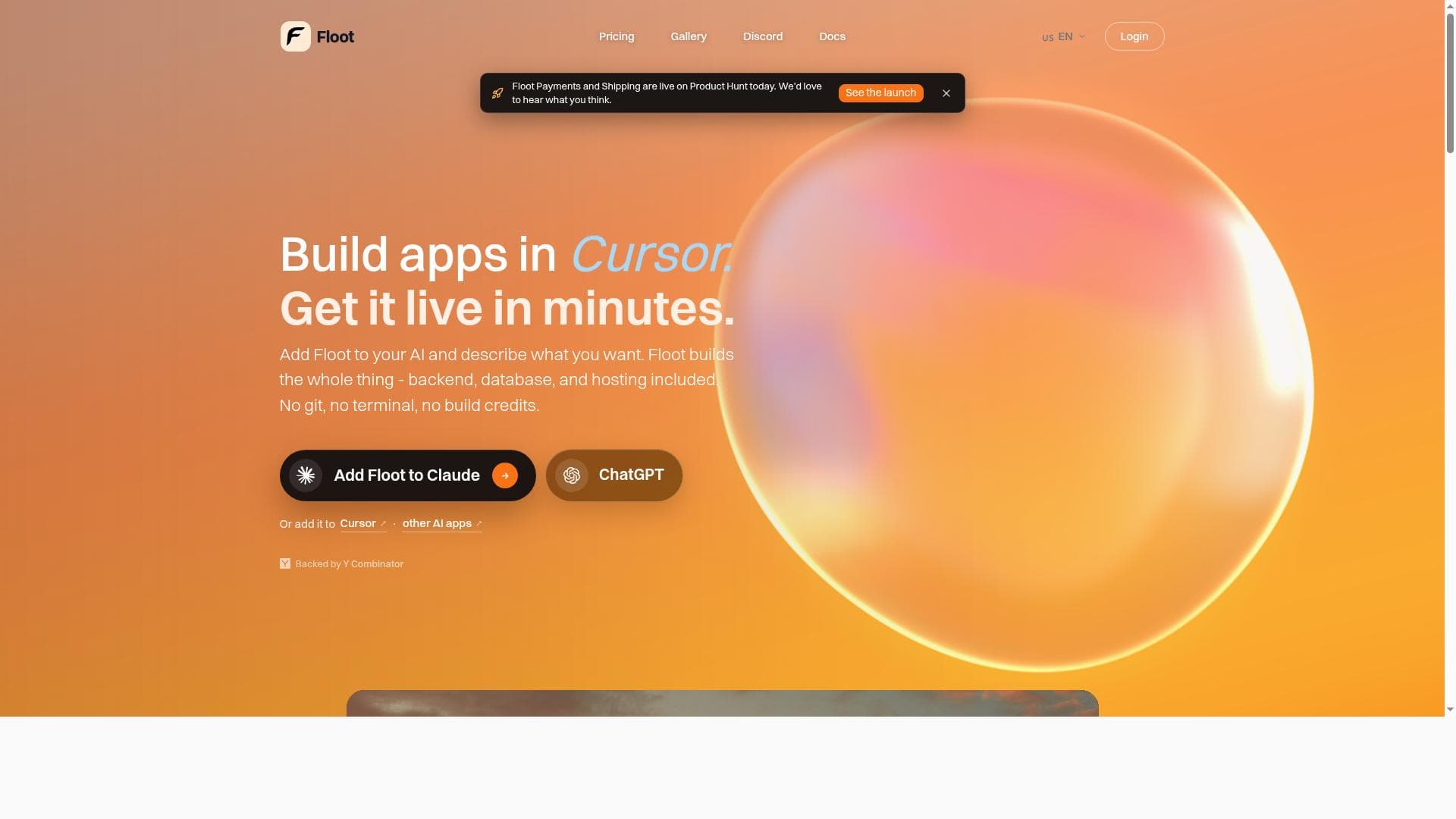
Floot revolutionizes app development by enabling users to build full-stack web and mobile applications from simple plain-language descriptions, no coding required. Ideal for non-technical founders and developers alike, it combines managed backend services, AI assistant integration, and one-click publishing to streamline the entire app creation process.

Beschreibung
Floot apps can now take real money. Ask your AI in ChatGPT, Claude or Cursor for "a $9/month plan", "a checkout for this course" or "shipping labels for my orders", and Floot sets it up: subscriptions with a billing page, one-time payments, tickets and deposits, coupons and refunds, plus shipping with live rates, labels and tracking. Runs on Stripe, no API keys or webhooks. Test free in preview, go live when you publish.
Ausführliche Beschreibung
Floot is an innovative no-code platform designed to empower users to build and host full-stack web and mobile applications using plain-language descriptions. Its core purpose is to simplify the app development process by eliminating the need for traditional coding skills. By leveraging natural language inputs, Floot translates user ideas into fully functional applications, supporting modern technologies such as React and TypeScript for frontends, serverless backend endpoints, and managed Postgres databases. This approach allows entrepreneurs, product managers, and developers to rapidly prototype and deploy apps without the overhead of manual coding and infrastructure management. Key features of Floot include the ability to create full-stack applications by simply describing the desired functionality in everyday language. The platform manages essential backend components such as authentication, file storage, email integration, and a Postgres database, providing a comprehensive environment for app development. Users can publish their applications with a single click to a live URL and even connect custom domains for professional branding. Additionally, Floot supports publishing mobile apps directly to the iOS App Store and Google Play, streamlining the distribution process. A standout capability is its integration with AI assistants like Claude and ChatGPT via the Model Context Protocol (MCP), enabling users to build and enhance apps through conversational AI interactions or automated coding assistance. Floot is best suited for non-technical founders, startups, small businesses, and teams looking to quickly validate ideas or build MVPs without investing heavily in engineering resources. It also appeals to developers seeking to accelerate app creation by automating routine backend setup and deployment tasks. Use cases range from building customer portals, internal tools, marketplaces, and SaaS products to mobile apps requiring authentication, database management, and email workflows. The platform’s support for serverless endpoints and managed infrastructure reduces operational complexity and maintenance overhead, making it ideal for rapid iteration and scaling. Regarding pricing, Floot offers a freemium model that allows users to start building apps at no cost, making it accessible for experimentation and early-stage projects. Paid plans unlock additional features, higher usage limits, and advanced capabilities such as custom domains, app store publishing, and integration with AI assistants. Detailed pricing information is available on their website, enabling users to choose plans that fit their project size and requirements. Compared to traditional app development frameworks and no-code tools, Floot stands out by combining natural language app creation with a full-stack environment that includes frontend, backend, database, and deployment in one platform. Unlike many no-code tools that focus primarily on frontend design or require manual backend configuration, Floot automates the entire stack and integrates AI assistance for enhanced productivity. This makes it a unique solution for users who want both simplicity and technical depth without writing code. However, there are some considerations to keep in mind. While Floot abstracts much of the complexity, users may encounter limitations in highly customized or complex app logic that exceeds the capabilities of plain-language descriptions or serverless endpoints. Additionally, reliance on AI assistants for code generation may require users to verify and refine outputs to ensure correctness and security. As with any emerging platform, integration with third-party services beyond the built-in features may require additional workarounds or custom development. In summary, Floot offers a powerful, user-friendly platform for building and deploying full-stack web and mobile applications without coding. Its combination of plain-language app creation, managed backend services, AI assistant integration, and seamless publishing options makes it an attractive choice for a wide range of users aiming to bring ideas to life quickly and efficiently.
Tool-Funktionen
- Build full-stack apps by describing them in plain language
- Managed Postgres database, authentication, file storage, and email
- One-click publishing to a live URL with custom domains
- Publish to the iOS App Store and Google Play
- Remote MCP server for building from Claude and ChatGPT/Codex
Beschreibung
Floot revolutionizes app development by enabling users to build full-stack web and mobile applications from simple plain-language descriptions, no coding required. Ideal for non-technical founders and developers alike, it combines managed backend services, AI assistant integration, and one-click publishing to streamline the entire app creation process.
Floot apps can now take real money. Ask your AI in ChatGPT, Claude or Cursor for "a $9/month plan", "a checkout for this course" or "shipping labels for my orders", and Floot sets it up: subscriptions with a billing page, one-time payments, tickets and deposits, coupons and refunds, plus shipping with live rates, labels and tracking. Runs on Stripe, no API keys or webhooks. Test free in preview, go live when you publish.
Ausführliche Beschreibung
Floot is an innovative no-code platform designed to empower users to build and host full-stack web and mobile applications using plain-language descriptions. Its core purpose is to simplify the app development process by eliminating the need for traditional coding skills. By leveraging natural language inputs, Floot translates user ideas into fully functional applications, supporting modern technologies such as React and TypeScript for frontends, serverless backend endpoints, and managed Postgres databases. This approach allows entrepreneurs, product managers, and developers to rapidly prototype and deploy apps without the overhead of manual coding and infrastructure management. Key features of Floot include the ability to create full-stack applications by simply describing the desired functionality in everyday language. The platform manages essential backend components such as authentication, file storage, email integration, and a Postgres database, providing a comprehensive environment for app development. Users can publish their applications with a single click to a live URL and even connect custom domains for professional branding. Additionally, Floot supports publishing mobile apps directly to the iOS App Store and Google Play, streamlining the distribution process. A standout capability is its integration with AI assistants like Claude and ChatGPT via the Model Context Protocol (MCP), enabling users to build and enhance apps through conversational AI interactions or automated coding assistance. Floot is best suited for non-technical founders, startups, small businesses, and teams looking to quickly validate ideas or build MVPs without investing heavily in engineering resources. It also appeals to developers seeking to accelerate app creation by automating routine backend setup and deployment tasks. Use cases range from building customer portals, internal tools, marketplaces, and SaaS products to mobile apps requiring authentication, database management, and email workflows. The platform’s support for serverless endpoints and managed infrastructure reduces operational complexity and maintenance overhead, making it ideal for rapid iteration and scaling. Regarding pricing, Floot offers a freemium model that allows users to start building apps at no cost, making it accessible for experimentation and early-stage projects. Paid plans unlock additional features, higher usage limits, and advanced capabilities such as custom domains, app store publishing, and integration with AI assistants. Detailed pricing information is available on their website, enabling users to choose plans that fit their project size and requirements. Compared to traditional app development frameworks and no-code tools, Floot stands out by combining natural language app creation with a full-stack environment that includes frontend, backend, database, and deployment in one platform. Unlike many no-code tools that focus primarily on frontend design or require manual backend configuration, Floot automates the entire stack and integrates AI assistance for enhanced productivity. This makes it a unique solution for users who want both simplicity and technical depth without writing code. However, there are some considerations to keep in mind. While Floot abstracts much of the complexity, users may encounter limitations in highly customized or complex app logic that exceeds the capabilities of plain-language descriptions or serverless endpoints. Additionally, reliance on AI assistants for code generation may require users to verify and refine outputs to ensure correctness and security. As with any emerging platform, integration with third-party services beyond the built-in features may require additional workarounds or custom development. In summary, Floot offers a powerful, user-friendly platform for building and deploying full-stack web and mobile applications without coding. Its combination of plain-language app creation, managed backend services, AI assistant integration, and seamless publishing options makes it an attractive choice for a wide range of users aiming to bring ideas to life quickly and efficiently.
Häufig gestellte Fragen
What is Floot?
Floot is a no-code platform that allows users to build and host full-stack web and mobile applications by describing their app ideas in plain language. It supports React and TypeScript frontends, serverless backend endpoints, managed Postgres databases, authentication, storage, and email integration.
How much does Floot cost?
Floot offers a freemium pricing model where users can start building apps for free. Paid plans provide additional features, higher usage limits, custom domains, app store publishing, and AI assistant integrations. Detailed pricing is available on Floot's website.
Who is Floot best for?
Floot is ideal for non-technical founders, startups, small businesses, and developers who want to rapidly create and deploy full-stack web and mobile applications without coding. It's especially useful for building MVPs, internal tools, and customer-facing apps.
What are the main features of Floot?
Key features include building full-stack apps from plain-language descriptions, managed Postgres databases, authentication, file storage, email integration, one-click publishing to live URLs with custom domains, publishing to iOS and Android app stores, and integration with AI assistants like Claude and ChatGPT via the Model Context Protocol.
Does Floot offer a free trial?
Yes, Floot provides a freemium plan that allows users to try the platform and build apps at no cost before upgrading to paid plans for additional features and capacity.
What integrations does Floot support?
Floot integrates with AI assistants such as Claude and ChatGPT through the Model Context Protocol, and it includes built-in support for authentication, file storage, email services, and managed Postgres databases. It also supports publishing apps to the iOS App Store and Google Play.
How does Floot work?
Users describe their desired application in plain language within Floot's editor or via connected AI assistants. Floot then automatically generates the full-stack application, including frontend, backend endpoints, database schema, authentication, and other services. The app can be published instantly to a live URL or mobile app stores.
Bewertungen
Noch keine Bewertungen. Teile als Erste:r deine Erfahrung.
Gesponserte Tools























Empfohlene Tools
Bleib auf dem Laufenden zu den neuesten KI-Tools
Hol dir die neuesten Insights – abonniere unseren Newsletter
Gelesen und geschätzt von 50,000+ Leser:innen
Tritt der größten KI-Community bei
Unsere Community und unser Team sind für dich da!
Dein Feedback hilft Alice AI, in zukünftigen Versionen besser zu werden.