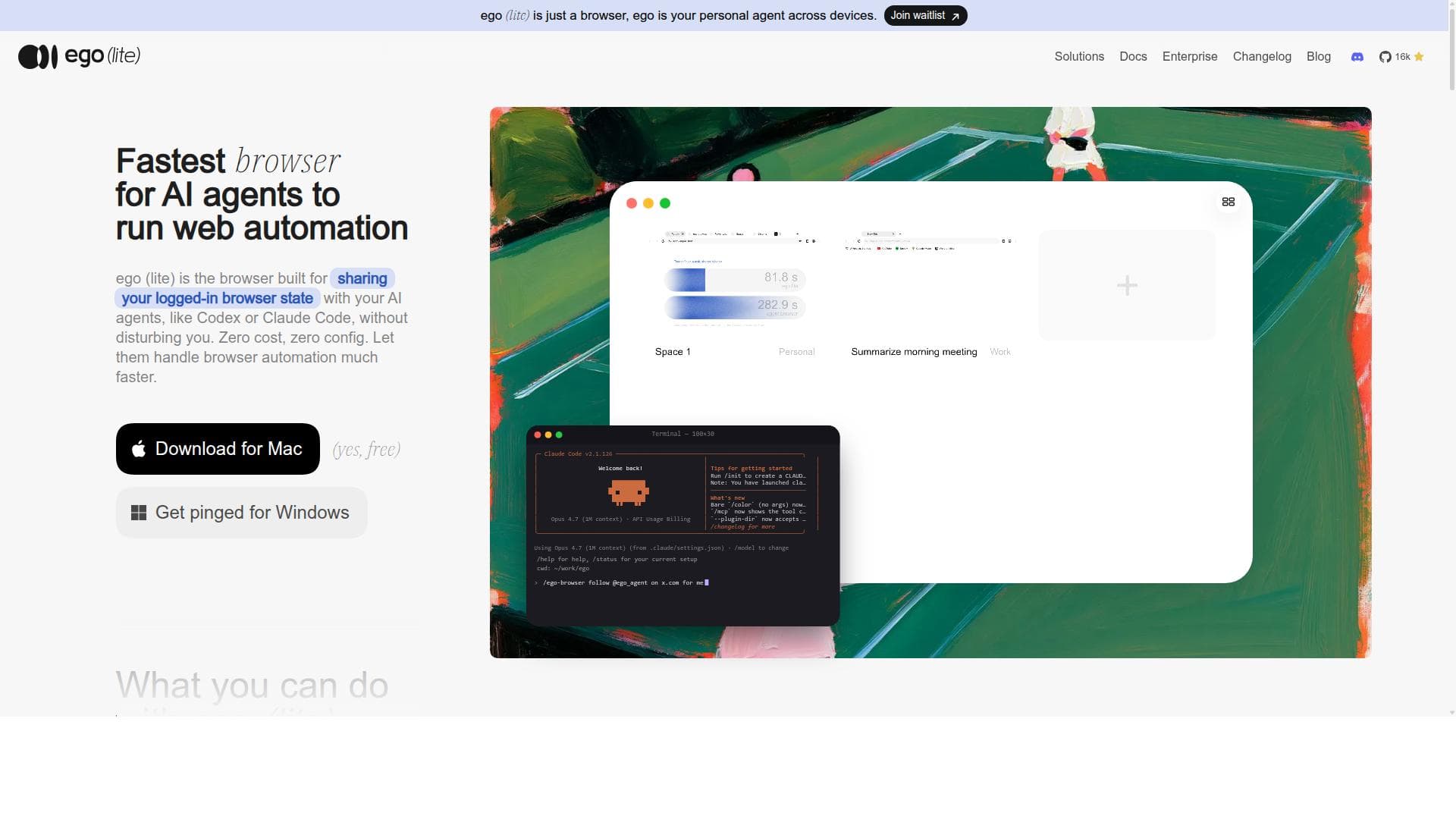

ego (lite) is the fastest AI-native browser designed to run over 100 simultaneous web automation tasks effortlessly, leveraging powerful AI models like Claude Code and Codex. Ideal for developers and enterprises needing scalable, secure, and efficient AI-driven browser automation, it uniquely combines Chrome data inheritance with isolated workspaces for seamless, high-speed automation.
Beschreibung
ego (lite) is the fastest browser designed specifically for AI agents to run web automation tasks. It supports running over 100 browser automation tasks simultaneously using Claude Code or Codex. The browser is always free with no setup required and features an open Real-World Benchmark for performance.
Ausführliche Beschreibung
ego (lite) is a highly specialized, ultra-fast browser designed specifically for AI agents to execute web automation tasks efficiently and at scale. Its core purpose is to enable AI-driven automation workflows by providing a browser environment optimized for running multiple concurrent tasks without the typical setup complexities. Leveraging advanced AI models such as Claude Code or Codex, ego (lite) can simultaneously run over 100 browser automation tasks, making it an indispensable tool for developers, researchers, and businesses that rely on automated web interactions. This agent-native browser is built on Chromium technology, inheriting Chrome’s data, bookmarks, and login credentials, which ensures seamless integration with users’ existing browsing environments and credentials, thereby reducing friction and enhancing productivity. One of the standout features of ego (lite) is its support for isolated workspaces called Spaces. These Spaces allow AI agents to operate in segregated environments, preventing data leakage and ensuring task-specific contexts remain intact. This isolation is critical for complex automation scenarios where multiple agents might be performing diverse tasks simultaneously. Additionally, ego (lite) incorporates compressed semantic input through an accessibility tree, which optimizes the way AI agents interpret and interact with web page elements. This feature not only improves accessibility but also enhances the precision and speed of automation tasks. Furthermore, ego (lite) can be externally controlled via the ego-browser interface, allowing developers to orchestrate and manage AI agents remotely, facilitating scalable and flexible automation pipelines. ego (lite) is best suited for AI developers, automation engineers, and enterprises that require robust, scalable browser automation solutions. Use cases include automated testing, data scraping, digital marketing automation, customer support bots, and any scenario where multiple web-based tasks need to be executed in parallel with high reliability and speed. Its ability to handle over 100 simultaneous tasks without setup makes it ideal for high-demand environments where time and resource efficiency are paramount. Regarding pricing, ego (lite) is offered as a free-to-use tool with no setup required, making it accessible for individuals and organizations looking to experiment or deploy AI-driven browser automation quickly. While the base version is free, users interested in advanced features or enterprise-grade support may need to consult the provider for customized plans or additional services, although such details are not explicitly stated on the public website. Compared to alternatives, ego (lite) distinguishes itself by focusing exclusively on AI agent-driven browser automation with native support for AI models like Claude Code and Codex. While traditional browser automation tools such as Selenium or Puppeteer require significant setup and scripting, ego (lite) offers a streamlined experience with native AI integration and parallel task execution at scale. Its inheritance of Chrome data and isolated Spaces also provide a more secure and user-friendly environment compared to generic headless browsers. However, unlike some commercial automation platforms, ego (lite) may have limitations in terms of user interface customization or integration with non-AI workflows. Notable considerations include the reliance on specific AI models (Claude Code or Codex) which may affect compatibility with other AI frameworks. Additionally, while the tool excels at parallel task execution, users should evaluate their specific automation needs to ensure that ego (lite)’s isolated Spaces and semantic input features align with their workflow requirements. Since ego (lite) is a relatively new and specialized tool, community support and third-party integrations might be less extensive than more established automation platforms. Overall, ego (lite) offers a cutting-edge, AI-native browser automation experience that significantly reduces setup time and enhances parallel processing capabilities for AI-driven web tasks.
Tool-Funktionen
- Inherits Chrome data, bookmarks and logins
- Spaces — isolated workspace for AI agents
- Compressed semantic input (accessibility tree)
- Controllable by external agents via ego-browser
Beschreibung
ego (lite) is the fastest AI-native browser designed to run over 100 simultaneous web automation tasks effortlessly, leveraging powerful AI models like Claude Code and Codex. Ideal for developers and enterprises needing scalable, secure, and efficient AI-driven browser automation, it uniquely combines Chrome data inheritance with isolated workspaces for seamless, high-speed automation.
ego (lite) is the fastest browser designed specifically for AI agents to run web automation tasks. It supports running over 100 browser automation tasks simultaneously using Claude Code or Codex. The browser is always free with no setup required and features an open Real-World Benchmark for performance.
Ausführliche Beschreibung
ego (lite) is a highly specialized, ultra-fast browser designed specifically for AI agents to execute web automation tasks efficiently and at scale. Its core purpose is to enable AI-driven automation workflows by providing a browser environment optimized for running multiple concurrent tasks without the typical setup complexities. Leveraging advanced AI models such as Claude Code or Codex, ego (lite) can simultaneously run over 100 browser automation tasks, making it an indispensable tool for developers, researchers, and businesses that rely on automated web interactions. This agent-native browser is built on Chromium technology, inheriting Chrome’s data, bookmarks, and login credentials, which ensures seamless integration with users’ existing browsing environments and credentials, thereby reducing friction and enhancing productivity. One of the standout features of ego (lite) is its support for isolated workspaces called Spaces. These Spaces allow AI agents to operate in segregated environments, preventing data leakage and ensuring task-specific contexts remain intact. This isolation is critical for complex automation scenarios where multiple agents might be performing diverse tasks simultaneously. Additionally, ego (lite) incorporates compressed semantic input through an accessibility tree, which optimizes the way AI agents interpret and interact with web page elements. This feature not only improves accessibility but also enhances the precision and speed of automation tasks. Furthermore, ego (lite) can be externally controlled via the ego-browser interface, allowing developers to orchestrate and manage AI agents remotely, facilitating scalable and flexible automation pipelines. ego (lite) is best suited for AI developers, automation engineers, and enterprises that require robust, scalable browser automation solutions. Use cases include automated testing, data scraping, digital marketing automation, customer support bots, and any scenario where multiple web-based tasks need to be executed in parallel with high reliability and speed. Its ability to handle over 100 simultaneous tasks without setup makes it ideal for high-demand environments where time and resource efficiency are paramount. Regarding pricing, ego (lite) is offered as a free-to-use tool with no setup required, making it accessible for individuals and organizations looking to experiment or deploy AI-driven browser automation quickly. While the base version is free, users interested in advanced features or enterprise-grade support may need to consult the provider for customized plans or additional services, although such details are not explicitly stated on the public website. Compared to alternatives, ego (lite) distinguishes itself by focusing exclusively on AI agent-driven browser automation with native support for AI models like Claude Code and Codex. While traditional browser automation tools such as Selenium or Puppeteer require significant setup and scripting, ego (lite) offers a streamlined experience with native AI integration and parallel task execution at scale. Its inheritance of Chrome data and isolated Spaces also provide a more secure and user-friendly environment compared to generic headless browsers. However, unlike some commercial automation platforms, ego (lite) may have limitations in terms of user interface customization or integration with non-AI workflows. Notable considerations include the reliance on specific AI models (Claude Code or Codex) which may affect compatibility with other AI frameworks. Additionally, while the tool excels at parallel task execution, users should evaluate their specific automation needs to ensure that ego (lite)’s isolated Spaces and semantic input features align with their workflow requirements. Since ego (lite) is a relatively new and specialized tool, community support and third-party integrations might be less extensive than more established automation platforms. Overall, ego (lite) offers a cutting-edge, AI-native browser automation experience that significantly reduces setup time and enhances parallel processing capabilities for AI-driven web tasks.
Häufig gestellte Fragen
What is ego (lite)?
ego (lite) is a specialized browser built for AI agents to perform web automation tasks at scale. It supports running over 100 automation tasks simultaneously without setup, leveraging AI models like Claude Code and Codex, and offers isolated workspaces called Spaces for secure and efficient task management.
How much does ego (lite) cost?
ego (lite) is available for free with no setup required, allowing users to run AI-driven browser automation tasks without upfront costs. For advanced features or enterprise solutions, users may need to contact the provider for customized pricing.
Who is ego (lite) best for?
ego (lite) is best suited for AI developers, automation engineers, and businesses that require fast, scalable browser automation. It is ideal for use cases like automated testing, data scraping, digital marketing automation, and managing multiple AI-driven web tasks concurrently.
What are the main features of ego (lite)?
Key features include inheritance of Chrome data, bookmarks, and logins; isolated workspaces called Spaces for AI agents; compressed semantic input via an accessibility tree for improved AI interaction; and external control through the ego-browser interface for managing AI agents remotely.
Does ego (lite) offer a free trial?
ego (lite) is offered as a free tool with no setup required, effectively providing immediate access without the need for a trial period.
What integrations does ego (lite) support?
ego (lite) integrates natively with AI models such as Claude Code and Codex for running automation tasks. It also inherits Chrome data for seamless user experience, and can be controlled externally via the ego-browser interface, though detailed third-party integrations are not explicitly listed.
How does ego (lite) work?
ego (lite) operates as an AI-native Chromium-based browser that runs multiple web automation tasks in parallel using AI models like Claude Code or Codex. It creates isolated workspaces called Spaces for each AI agent to securely execute tasks, uses compressed semantic input to optimize AI interaction with web pages, and allows external control through the ego-browser interface.
Social Media
Tool nutzenBewertungen
Noch keine Bewertungen. Teile als Erste:r deine Erfahrung.