🚀 Zaprep: Deine Socials auf Steroiden. Kostenlos starten — automatisiere 1.000 DMs/Monat und verwandle Engagement in Leads. mit 1.000 automatisierten DMs/Monat.


Ist das dein KI-Tool? Beanspruche es noch heute.
Bestätige die Inhaberschaft, verwalte dein Profil und schalte Wachstumsfunktionen frei.
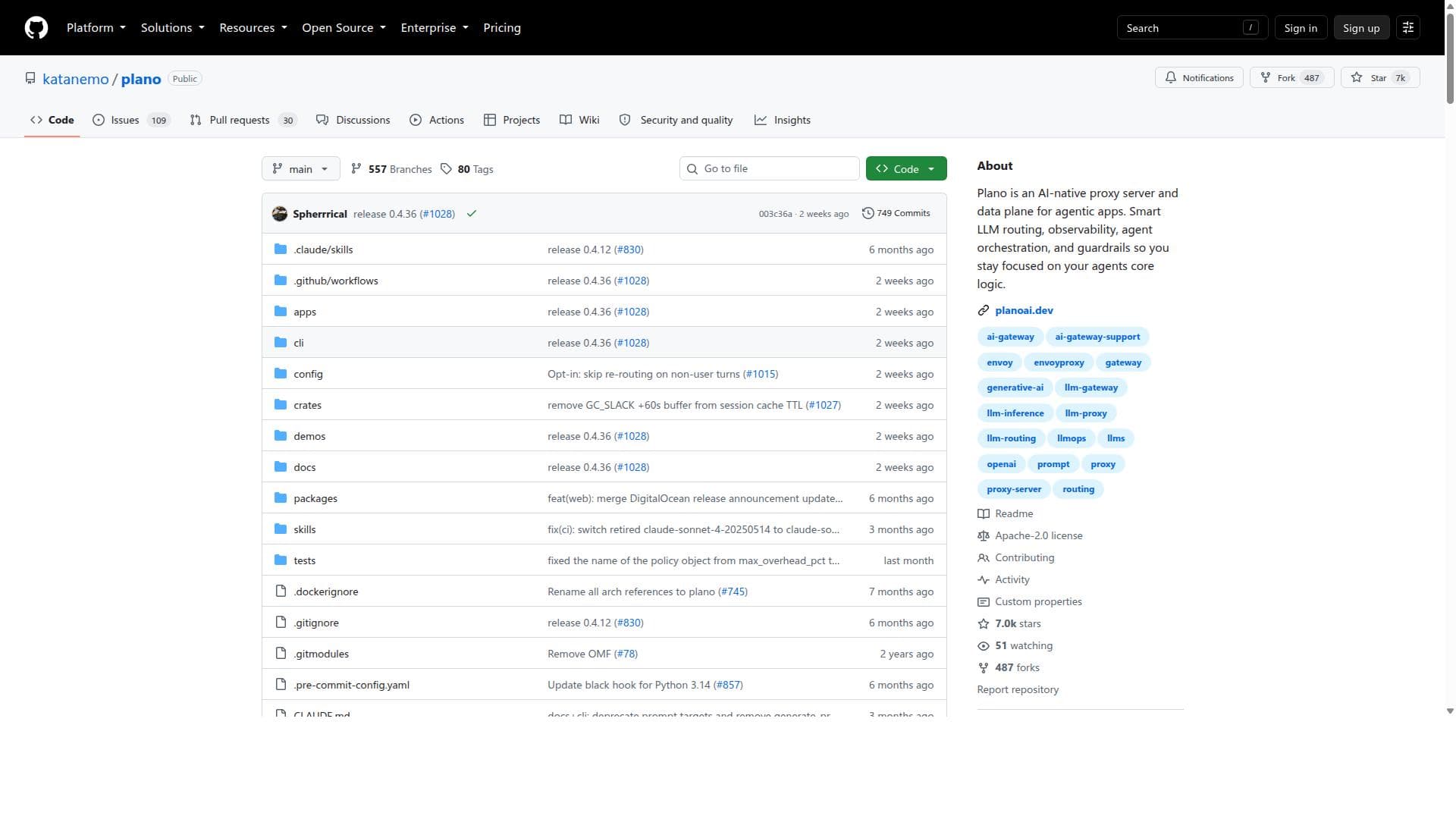
Plano is a cutting-edge AI-native proxy server designed to streamline the management of agentic AI applications by offering smart LLM routing, observability, orchestration, and guardrails. It uniquely empowers developers to focus on their agents’ core logic while efficiently handling complex AI workflows, making it ideal for teams building scalable, multi-agent AI systems.

Beschreibung
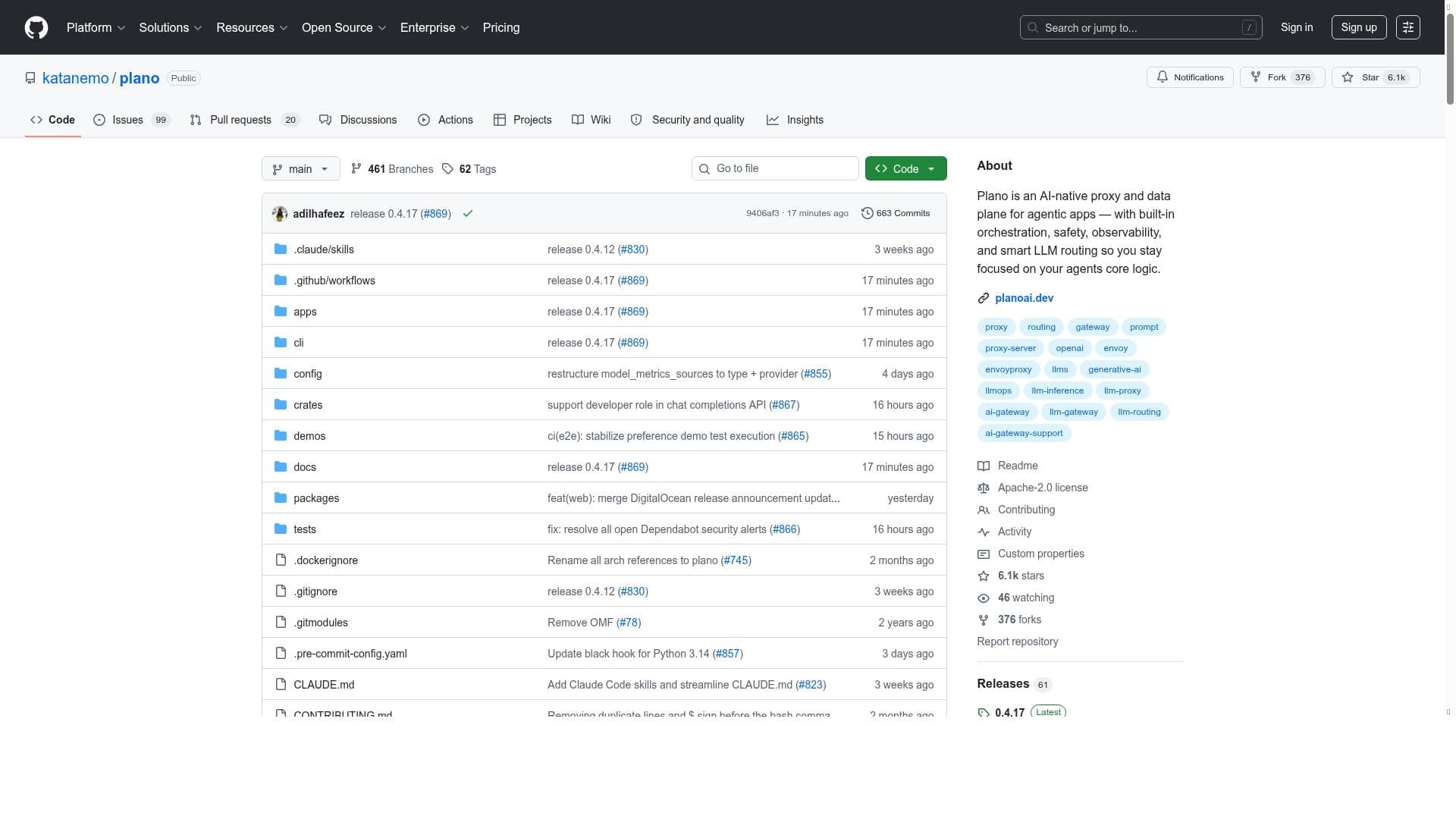
Arch is an intelligent infrastructure primitive to help developers build fast, personalized agents in mins. Arch is a gateway engineered with LLMs to seamlessly integrate prompts with APIs, and to transparently add safety and tracing features outside app logic
Ausführliche Beschreibung
Plano is an advanced AI-native proxy server and data plane specifically engineered for agentic applications, which are applications that leverage autonomous AI agents to perform complex tasks. Its core purpose is to simplify and optimize the management of AI workflows by providing a robust infrastructure layer that handles the intricacies of large language model (LLM) routing, observability, agent orchestration, and operational guardrails. By abstracting these complexities, Plano enables developers to focus on building the core logic of their AI agents without worrying about the underlying infrastructure challenges that come with scaling and coordinating multiple AI models and agents. At the heart of Plano’s capabilities is its AI-native proxy server functionality. Unlike traditional proxy servers, Plano is designed from the ground up to understand and route requests intelligently between various large language models. This smart LLM routing ensures that queries are directed to the most appropriate model based on context, performance, or cost considerations, thereby optimizing response quality and efficiency. Moreover, Plano provides comprehensive observability features, allowing developers and operators to monitor AI agents’ behavior, performance metrics, and interactions in real time. This visibility is crucial for debugging, improving agent workflows, and ensuring reliability. Agent orchestration is another key feature of Plano. It supports the coordination of multiple AI agents working together, managing their interactions, dependencies, and task handoffs seamlessly. This orchestration layer is essential for building sophisticated AI systems that require multiple specialized agents collaborating to achieve complex goals. Additionally, Plano incorporates guardrails that help maintain agent focus and prevent undesired behaviors or deviations from intended workflows. These guardrails act as safety nets, ensuring that AI agents operate within defined boundaries and adhere to best practices. Plano is best suited for developers, AI researchers, and organizations building agentic applications that require scalable, reliable, and efficient AI infrastructure. Use cases include AI-powered automation platforms, conversational AI systems with multi-agent setups, AI research environments experimenting with different LLMs, and enterprises deploying AI agents for customer service, data analysis, or decision support. Its ability to handle complex AI workflows and provide observability makes it particularly valuable for teams looking to deploy production-grade AI agents at scale. Regarding pricing, Plano is an open-source project hosted on GitHub, which means it is freely available for use and modification. Users can deploy and customize Plano according to their needs without licensing fees. However, costs related to infrastructure, cloud hosting, and API usage of third-party LLM providers would still apply depending on the deployment scenario. This open-source nature encourages community contributions and transparency but may require technical expertise to set up and maintain. When compared to alternatives, Plano stands out due to its AI-native design tailored specifically for agentic applications, whereas many proxy or orchestration tools are more general-purpose or focused on single-model management. Its integrated approach combining smart LLM routing, observability, orchestration, and guardrails in one platform reduces the need for piecing together multiple tools. However, unlike some commercial platforms, Plano may lack a polished user interface or turnkey cloud service experience, which could be a consideration for teams without dedicated DevOps or AI infrastructure resources. Notable limitations include the requirement for technical proficiency to deploy and configure Plano effectively, as it is primarily targeted at developers comfortable with AI infrastructure. Also, as an open-source project, ongoing support and feature updates depend on community engagement and contributions. Users should also consider the complexity of managing multiple LLM providers and the associated costs outside of Plano itself. Finally, while Plano provides guardrails, ensuring comprehensive safety and ethical compliance in AI agent behavior still requires careful design and oversight by developers. In summary, Plano is a powerful, open-source AI-native proxy and orchestration platform that empowers developers to build and manage sophisticated agentic AI applications with enhanced routing, monitoring, and control capabilities. It is ideal for teams seeking to streamline complex AI workflows and scale multi-agent systems efficiently, provided they have the technical expertise to leverage its full potential.
Tool-Funktionen
- AI-native proxy server for agentic apps
- Smart LLM routing
- Observability for AI agents
- Agent orchestration
- Guardrails to maintain agent focus
Beschreibung
Plano is a cutting-edge AI-native proxy server designed to streamline the management of agentic AI applications by offering smart LLM routing, observability, orchestration, and guardrails. It uniquely empowers developers to focus on their agents’ core logic while efficiently handling complex AI workflows, making it ideal for teams building scalable, multi-agent AI systems.
Arch is an intelligent infrastructure primitive to help developers build fast, personalized agents in mins. Arch is a gateway engineered with LLMs to seamlessly integrate prompts with APIs, and to transparently add safety and tracing features outside app logic
Ausführliche Beschreibung
Plano is an advanced AI-native proxy server and data plane specifically engineered for agentic applications, which are applications that leverage autonomous AI agents to perform complex tasks. Its core purpose is to simplify and optimize the management of AI workflows by providing a robust infrastructure layer that handles the intricacies of large language model (LLM) routing, observability, agent orchestration, and operational guardrails. By abstracting these complexities, Plano enables developers to focus on building the core logic of their AI agents without worrying about the underlying infrastructure challenges that come with scaling and coordinating multiple AI models and agents. At the heart of Plano’s capabilities is its AI-native proxy server functionality. Unlike traditional proxy servers, Plano is designed from the ground up to understand and route requests intelligently between various large language models. This smart LLM routing ensures that queries are directed to the most appropriate model based on context, performance, or cost considerations, thereby optimizing response quality and efficiency. Moreover, Plano provides comprehensive observability features, allowing developers and operators to monitor AI agents’ behavior, performance metrics, and interactions in real time. This visibility is crucial for debugging, improving agent workflows, and ensuring reliability. Agent orchestration is another key feature of Plano. It supports the coordination of multiple AI agents working together, managing their interactions, dependencies, and task handoffs seamlessly. This orchestration layer is essential for building sophisticated AI systems that require multiple specialized agents collaborating to achieve complex goals. Additionally, Plano incorporates guardrails that help maintain agent focus and prevent undesired behaviors or deviations from intended workflows. These guardrails act as safety nets, ensuring that AI agents operate within defined boundaries and adhere to best practices. Plano is best suited for developers, AI researchers, and organizations building agentic applications that require scalable, reliable, and efficient AI infrastructure. Use cases include AI-powered automation platforms, conversational AI systems with multi-agent setups, AI research environments experimenting with different LLMs, and enterprises deploying AI agents for customer service, data analysis, or decision support. Its ability to handle complex AI workflows and provide observability makes it particularly valuable for teams looking to deploy production-grade AI agents at scale. Regarding pricing, Plano is an open-source project hosted on GitHub, which means it is freely available for use and modification. Users can deploy and customize Plano according to their needs without licensing fees. However, costs related to infrastructure, cloud hosting, and API usage of third-party LLM providers would still apply depending on the deployment scenario. This open-source nature encourages community contributions and transparency but may require technical expertise to set up and maintain. When compared to alternatives, Plano stands out due to its AI-native design tailored specifically for agentic applications, whereas many proxy or orchestration tools are more general-purpose or focused on single-model management. Its integrated approach combining smart LLM routing, observability, orchestration, and guardrails in one platform reduces the need for piecing together multiple tools. However, unlike some commercial platforms, Plano may lack a polished user interface or turnkey cloud service experience, which could be a consideration for teams without dedicated DevOps or AI infrastructure resources. Notable limitations include the requirement for technical proficiency to deploy and configure Plano effectively, as it is primarily targeted at developers comfortable with AI infrastructure. Also, as an open-source project, ongoing support and feature updates depend on community engagement and contributions. Users should also consider the complexity of managing multiple LLM providers and the associated costs outside of Plano itself. Finally, while Plano provides guardrails, ensuring comprehensive safety and ethical compliance in AI agent behavior still requires careful design and oversight by developers. In summary, Plano is a powerful, open-source AI-native proxy and orchestration platform that empowers developers to build and manage sophisticated agentic AI applications with enhanced routing, monitoring, and control capabilities. It is ideal for teams seeking to streamline complex AI workflows and scale multi-agent systems efficiently, provided they have the technical expertise to leverage its full potential.
Häufig gestellte Fragen
What is Plano?
Plano is an AI-native proxy server and data plane designed for agentic applications. It provides smart routing of large language model requests, observability into AI agent behavior, orchestration of multiple agents, and guardrails to maintain agent focus, helping developers manage complex AI workflows efficiently.
How much does Plano cost?
Plano is an open-source tool available for free on GitHub. While there is no licensing cost for using Plano itself, users should consider infrastructure expenses and any fees associated with third-party large language model providers they integrate with.
Who is Plano best for?
Plano is best suited for developers, AI researchers, and organizations building agentic AI applications that require scalable and reliable orchestration of multiple AI agents. It is ideal for teams needing advanced LLM routing, observability, and workflow management in AI-powered automation, conversational AI, and research.
What are the main features of Plano?
Key features of Plano include an AI-native proxy server for intelligent LLM routing, real-time observability into AI agent performance, orchestration capabilities for coordinating multiple agents, and guardrails to ensure agents stay focused and operate within defined parameters.
Does Plano offer a free trial?
Since Plano is an open-source project, it is freely available to use without a trial period. Users can download, deploy, and modify the software at no cost.
What integrations does Plano support?
Plano supports integration with various large language model providers through its smart routing capabilities. While specific integrations depend on configuration, it is designed to work with multiple LLM APIs and can be extended to support additional AI services as needed.
How does Plano work?
Plano operates as a proxy server that intelligently routes requests to the most suitable large language model based on context and performance. It monitors AI agent activity through observability tools, orchestrates interactions among multiple agents, and enforces guardrails to maintain agent focus and workflow integrity.
Social Media
Tool nutzenBewertungen
Noch keine Bewertungen. Teile als Erste:r deine Erfahrung.
Gesponserte Tools





























Empfohlene Tools
Bleib auf dem Laufenden zu den neuesten KI-Tools
Hol dir die neuesten Insights – abonniere unseren Newsletter
Gelesen und geschätzt von 50,000+ Leser:innen
Tritt der größten KI-Community bei
Unsere Community und unser Team sind für dich da!
Dein Feedback hilft Alice AI, in zukünftigen Versionen besser zu werden.







Tool einreichen


PoweredByAI.app ist ein KI-Tools-Verzeichnis, das Menschen, Unternehmen und Creators hilft, die besten KI-Tools für Schreiben, Programmieren, Design, Produktivität und mehr zu entdecken.
© 2026 , Ein Produkt von011BQ. Alle Rechte vorbehalten.