🚀 Zaprep: Deine Socials auf Steroiden. Kostenlos starten — automatisiere 1.000 DMs/Monat und verwandle Engagement in Leads. mit 1.000 automatisierten DMs/Monat.
BlogBest Continuous Testing Tools for Agile and DevOps Teams
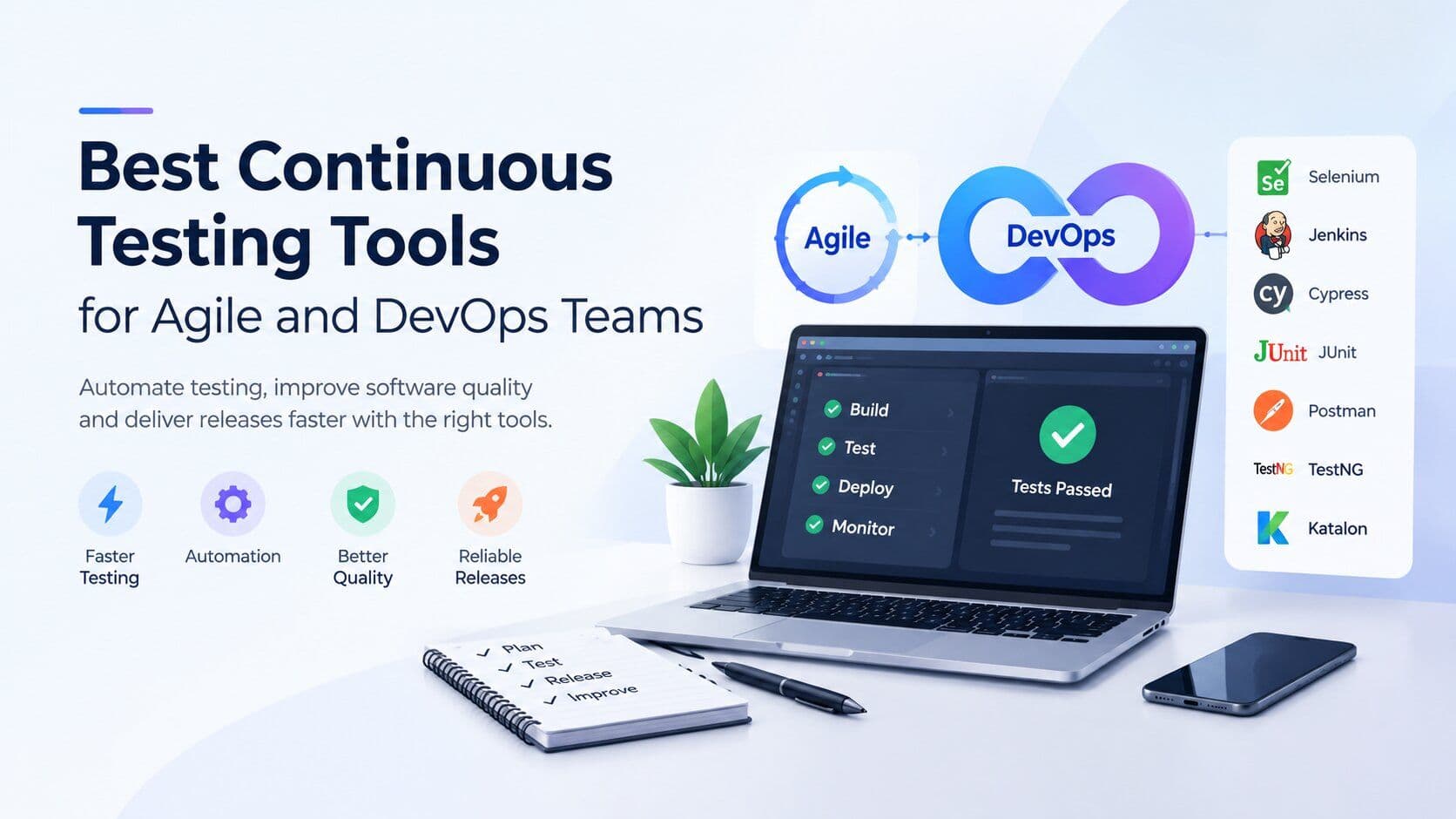
Best Continuous Testing Tools for Agile and DevOps Teams
 Shashank Jain
30. Sept. 2026
10 Min. Lesezeit
Best Continuous Testing Tools for Agile and DevOps Teams
Continuous testing tools have become the dividing line between teams that ship confidently and teams that ship nervously. The real problem isn't finding tools that run tests; it's finding ones that hold up when your codebase changes constantly, flaky tests keep breaking your CI/CD pipeline, and coverage gaps quietly let bugs reach production. After reviewing dozens of platforms across real enterprise use cases, the pattern becomes clear: the tool you pick shapes your defect escape rate, your pipeline feedback loop time, and your team's sanity. This guide breaks down the five platforms worth your time.
How the picks were chosen
Each option was assessed using publicly available information gathered from official product pages, user review platforms, analyst reports, and published case studies. Only platforms with a documented track record in continuous testing environments made the cut.
→ See the full research breakdown
- Functionize - Best for enterprise QA automation and continuous testing
- mabl - Best for enterprise test automation and DevOps-driven QA teams
- Selenium Testing - Best for cross-browser web automation testing
- Virtuoso QA - Best for enterprise test automation and AI-powered QA
- Tricentis Tosca - Best for enterprise software testing automation
The Stakes Behind Choosing the Best Continuous Testing Tools
Picking the wrong continuous testing tool doesn't just slow your team down; it actively erodes trust in your pipeline. When tests are fragile and break for no clear reason, engineers stop believing in the results. Bugs get missed, release confidence drops, and the whole point of continuous testing falls apart.
Keeping a test suite stable while a codebase changes fast is genuinely hard. UI changes, API updates, and shifting dependencies all create drift between what your tests expect and what your app actually does.
A well-chosen platform closes that gap with self-healing capabilities, stable element recognition, and tight CI/CD connectivity. The payoff shows up where it matters most: a lower mean time to detect defects, a healthier test pass rate with fewer flaky tests dragging it down, and faster feedback from build to results.
5 Continuous Testing Tools Compared
Note: All data in this table is sourced from review platforms and the official websites of the listed companies.
Company Name | Years Operating | Team Size | Headquartered In |
Functionize | Est. 2014 | 157 | Walnut Creek, California |
mabl | Est. 2016 | 112 | Boston, MA |
Selenium Testing | Est. 2004 | Community-driven | Open Source |
Virtuoso QA | Est. 2017 | 112 | London |
Tricentis Tosca | Est. 2007 | 400+ | Austin, Texas |
1. Functionize - Best for Enterprise QA Automation and Continuous Testing
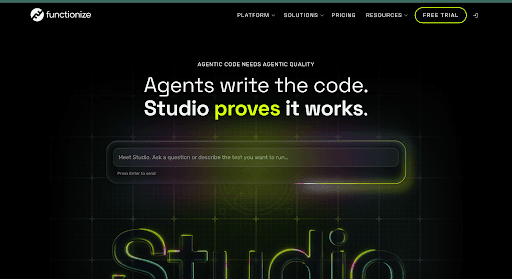
How Does Functionize Operate?
Functionize builds AI-native testing agents that automate user workflows and adapt when applications change, without requiring a script rewrite every time. The platform hits 99.97% element recognition accuracy, which directly cuts down on flaky tests and the maintenance burden that kills team momentum. Non-technical team members can create and deploy tests up to 90% faster than traditional scripted approaches, so QA doesn't become a bottleneck waiting on engineers with Selenium expertise.
Why Pick Functionize for Continuous Testing Tools?
Teams stuck spending more time fixing broken tests than writing new ones will find Functionize directly targets that problem. Its self-healing agents adapt to application changes in real time, and that kind of autonomous healing combined with near-perfect element recognition accuracy is genuinely rare at enterprise scale.
What the Reviews Show:
Functionize earned recognition as a Strong Performer in the Forrester Q4 2025 Wave Report on Autonomous Testing Platforms, which is a meaningful signal for enterprise buyers. Clients like McAfee and GE Healthcare report dramatic results, with GE Healthcare cutting 40 hours of testing down to 4 hours. A 90% labor saving is the kind of number that gets executive attention fast.
1. Mabl - Best for Enterprise Test Automation and DevOps-Driven QA Teams
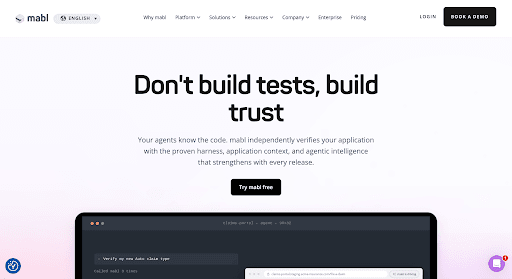
How Does Mabl Operate?
Mabl covers web, mobile, and API testing through a single unified platform, which matters because most teams are tired of stitching together five different tools to get full coverage. Their adaptive auto-healing technology uses multi-model AI and GenAI to keep tests running even as applications shift, reducing test maintenance by up to 85%. The platform connects cleanly to CI/CD pipelines and DevOps toolchains, so it fits into existing workflows rather than forcing a rebuild.
Why Pick Mabl for Continuous Testing Tools?
Teams that want one platform to handle UI, API, and performance testing without juggling separate vendors will find mabl's unified approach genuinely cuts operational overhead. The auto-healing capabilities mean your pipeline feedback loop stays tight even during rapid UI changes, which is where most test suites start breaking down.
What the Reviews Show:
Mabel holds a G2 Leader position in Test Automation and has won the "Best AI-Based Solution for Engineering" at the AI Breakthrough Awards three years running (that kind of repeat recognition doesn't happen by accident). Clients including Microsoft, Charles Schwab, and JetBlue are on the platform, which shows it scales to complex enterprise environments. Customers consistently point to auto-healing and CI/CD integration as the features that make the biggest daily difference.
3. Selenium Testing - Best for Cross-Browser Web Automation Testing
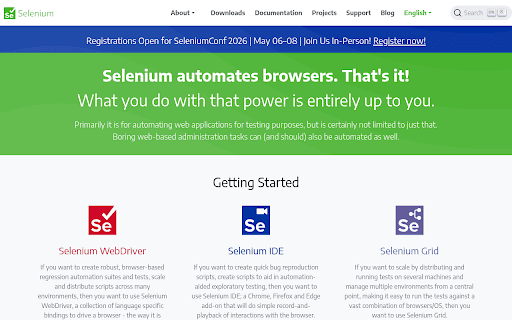
How Does Selenium Testing Operate?
Selenium is the open-source browser automation framework that most modern testing stacks are built on top of, whether teams realize it or not. The project ships three tools: WebDriver for writing automation scripts, IDE for record-and-playback, and Grid for running tests in parallel across multiple machines. Governed by the Software Freedom Conservancy and licensed under Apache 2.0, it's free to use and backed by contributions from major browser vendors and the global QA community.
Why Pick Selenium Testing for Continuous Testing Tools?
Teams that need powerful, flexible browser automation without a licensing cost will find Selenium's two-decade track record hard to argue against, especially when their existing engineers already know the framework. The tradeoff worth knowing is that self-healing and low-code authoring aren't built in, so maintenance overhead falls on the team, unlike platforms like mabl or Functionize that handle that automatically.
What the Reviews Show:
Selenium's reputation rests on stability and ubiquity more than flashy feature releases. The testing community has built an enormous ecosystem of libraries, integrations, and documentation around it, which makes getting started relatively straightforward for teams with scripting experience. The main friction points are flaky test management and the setup time required for Grid-based parallel execution.
4. Virtuoso QA - Best for Enterprise Test Automation and AI-Powered QA
How Does Virtuoso QA Operate?
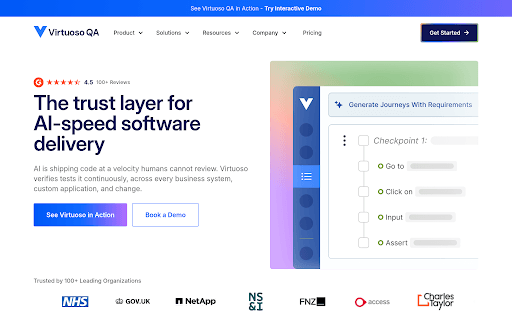
Virtuoso QA is built AI-native from the ground up, covering web testing, API testing, and low-code test authoring in natural language. That natural language approach is what separates it from tools that require engineering skill to create tests; business users and QA teams can collaborate on test authoring without needing to write code. The self-healing tests and cloud architecture mean it's aimed squarely at enterprise teams running complex application portfolios.
Why Pick Virtuoso QA for Continuous Testing Tools?
QA teams carrying heavy test maintenance costs will find Virtuoso QA's claim of up to 85% lower maintenance overhead worth a serious look, particularly because the AI foundation wasn't added later. The natural language authoring also opens test creation to non-technical team members, which directly expands test coverage without adding headcount.
What the Reviews Show:
Virtuoso QA holds a Strong Performer position in Forrester's Continuous Automation Testing Platforms evaluation, putting it in similar analyst territory as Functionize. Case studies from clients including Toolstation and coaching.com point to QA cost savings in the 30-40% range overall. The combination of analyst recognition and real client cost data gives it more credibility than platforms that only show curated testimonials.
5. Tricentis Tosca - Best for Enterprise Software Testing Automation
How Does Tricentis Tosca Operate?
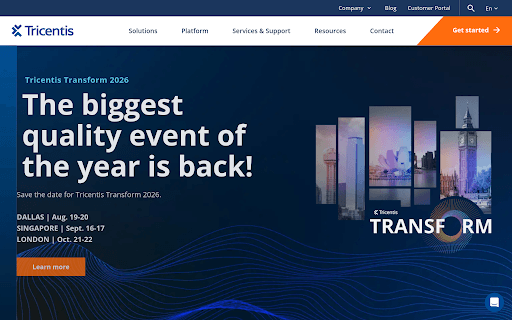
Tricentis Tosca uses a model-based testing approach that separates test logic from technical details, which makes tests easier to maintain when the underlying application changes. Their patented Vision AI technology handles UI testing with self-healing capabilities, and the platform supports over 160 technologies including SAP, Salesforce, and legacy enterprise systems. With 26 global offices and more than 2,500 enterprise customers (think Fortune 500 scale), they're one of the most established names in this space.
Why Pick Tricentis Tosca for Continuous Testing Tools?
Organizations running complex enterprise application ecosystems, especially those mixing modern web apps with legacy systems, will find Tricentis's 160+ technology support covers ground that most competitors don't. Their risk-based testing approach also helps teams prioritize where testing effort matters most, which directly improves defect escape rate without requiring unlimited test execution budget.
What the Reviews Show:
Tricentis consistently earns recognition from Forrester, Gartner, and IDC, and the 2025 TrustRadius Top Rated awards for both Tosca and NeoLoad confirm that their reputation holds across multiple product lines. Enterprise clients value the model-based approach for reducing test maintenance, though smaller teams sometimes note that the initial setup and learning curve is steeper compared to low-code alternatives like mabl or Virtuoso QA.
Selection Framework: How Each Pick Was Evaluated
Putting this list together required more than a surface-level feature comparison. The research process started broad, then narrowed systematically based on evidence rather than marketing claims.
The Data Collection Phase
The initial pool of candidates was built by pulling from multiple independent sources: software review platforms, analyst directories, published case studies, and product documentation. The goal was to capture a wide range of tools across different maturity levels, from open-source frameworks to fully managed enterprise platforms. Sources were prioritized based on recency and specificity to continuous testing environments rather than general software testing.
Narrowing Down the Candidate Pool
Once the longlist was assembled, options without a verifiable track record in production CI/CD environments were removed. Review patterns were analyzed for consistency across multiple platforms rather than relying on a single source. Tools with an unusually high number of unverified or templated reviews were flagged and given lower weight. Platforms that couldn't show real-world usage at meaningful scale were also deprioritized, since continuous testing demands more than proof-of-concept results.
Claims Subjected to Rigorous Testing
Every performance claim found on a vendor's official site was cross-checked against third-party reviews and published case studies. When a vendor stated an 80% reduction in test maintenance, that figure was traced back to named clients or independent reports rather than accepted at face value. Discrepancies between marketing language and actual user feedback were noted and factored into the final assessment.
The Authority Layer
Each platform was evaluated for external recognition signals beyond self-reported achievements. Analyst reports from Forrester and Gartner, award recognition from independent bodies, and mentions in industry publications all contributed to the authority assessment. Platforms that only appeared in their own press releases without third-party confirmation received less weight than those with consistent external validation across multiple years.
Continuous Testing Tools Case Files
Dedicated continuous testing service pages, feature documentation, and integration listings were reviewed for each platform to confirm that CI/CD testing isn't just an afterthought in their product plans. Verified user reviews specific to CI/CD pipeline integration, test stability, and maintenance reduction were prioritized over general testing feedback. Case studies featuring named enterprise clients with measurable outcomes, such as reduced testing hours or improved defect detection rates, carried the most weight in the final selection.
Finding the Right Continuous Testing Tools for Your Needs
Picking a continuous testing tool comes down to knowing what problem you're actually trying to solve first. If the answer is "all of them," that usually means you need a platform, not just a tool. Here are the main factors worth evaluating before committing.
- Industry/Domain Experience: Look for platforms that have deployed in environments similar to yours, whether that's heavily regulated industries with FDA validation constraints or fast-moving SaaS products with weekly releases. Experience in your context matters more than a general feature list.
- Features and Services: Check whether the platform covers web, API, and mobile testing natively or requires add-ons. Self-healing, parallel execution, and low-code authoring are now table stakes for most enterprise teams.
- Pricing Structure: Enterprise platforms in this space typically don't publish flat pricing (not cheap, by any measure), so factor in test execution volume, seat counts, and integration requirements when requesting quotes.
- Results Measurement: Any credible platform should give you clear visibility into test pass rates, flaky test percentages, and pipeline feedback loop time. If a vendor can't show you those metrics clearly, that's worth noting.
- Industry Knowledge and Compliance: For teams operating in regulated environments, confirm that the platform supports SOC 2 compliance and relevant testing standards adherence. The gap between a tool that technically works and one that satisfies audit requirements can be significant.
Final Words
Choosing a continuous testing tool shapes every release cycle that follows. Platforms like Functionize and mabl lead on AI-driven self-healing and low maintenance overhead, while Selenium remains the foundational choice for teams with scripting depth. Tricentis Tosca and Virtuoso QA fill the enterprise complexity gap well. The right pick comes down to your team's skill set, your pipeline maturity, and how much test maintenance overhead you can realistically absorb as release velocity keeps increasing.
Verwandte Tags
AI ToolsVerwandte Kategorien
KI-ToolsLass dein KI-Tool in Artikeln wie diesem vorstellen
Erreiche Nutzer, die aktiv KI-Tools auf PoweredbyAI entdecken, und baue SEO-Backlinks auf, die deine Sichtbarkeit bei Google verbessern.
Vertraut von 25,000+ KI-Tools und wachsenden Startups
Lass dein KI-Tool in reichweitenstarken Blogs & Artikeln vorstellen
Werde auf PoweredByAI vorgestellt und erreiche Nutzer, die aktiv Tools wie deins entdecken. Baue starke SEO-Backlinks auf, die dir beim Google-Ranking helfen und stetigen organischen Traffic bringen.
Gesponserte Blog-Features mit gezielter Reichweite
Gastartikel mit Do-Follow-Backlinks
Kontextuelle Linkplatzierungen für SEO-Boost
Vertraut von 25,000+ KI-Tools und wachsenden Startups
Enjoyed this? Talk AI tools with other founders and builders.
Join our Slack communityAktuelle Blogs



Tool einreichen


PoweredByAI.app ist ein KI-Tools-Verzeichnis, das Menschen, Unternehmen und Creators hilft, die besten KI-Tools für Schreiben, Programmieren, Design, Produktivität und mehr zu entdecken.
© 2026 , Ein Produkt von011BQ. Alle Rechte vorbehalten.