🚀 Zaprep: Your Socials on Steroids. Start free — automate 1,000 DMs/month & turn engagement into leads. with 1,000 automated DMs/month.
Latest AI News

Wix Launches AI-Powered Website Builder That Can Create Websites Using Simple Text Prompts
Wix, a cloud-based website development platform, has launched its artificial intelligence (AI)-powered chatbot that can generate a customised website using simple text prompts. The AI website generator was first announced by the company in July 2023 but was not made available to the public. After seven months, Wix has launched the feature globally and users can begin creating their own websites. Generating a website using AI on the platform is free, however, to buy a domain and access additional features will require a subscription to one of its premium plans.
View

What will Apple’s John Ternus era look like?
Loading the player… It’s officially the Ternus era at Apple. Tim Cook stepped downas CEO this week, handing the company to former hardware chief John Ternus, whose first memopromised a “huge launch next week”— timing that puts Apple’s next iPhone event on his desk before he’s even settled in. Cook isn’t going far, though: he’s staying on as Executive Chairman, focused on the kind of policy relationships that recently turned something as small asa map labelinto a very public balancing act. All of which raises an obvious question: what does the Ternus era look like, and how much rope will shareholders give him to figure it out?On this episode of TechCrunch’sEquitypodcast, hosts Kirsten Korosec and Sean O’Kane unpack what Ternus is walking into, why he may actually be better positioned to make progress on software than hardware in this new AI era, and more of the week’s news. Subscribe to Equity onYouTube,Apple Podcasts,Overcast,Spotifyand all the casts. You also can follow Equity onXandThreads, at @EquityPod.
View

IFA 2026: Nvidia RTX Spark PCs, Local AI Tools Announced With October Launch Planned
Nvidia has confirmed that its RTX Spark Windows PCs will arrive in October, bringing a new class of compact systems designed to handle local AI workloads alongside gaming and creative tasks. The company also announced software updates at IFA 2026 that it says will simplify running AI agents locally and improve inference performance on its hardware. Lenovo and Acer are among the companies showcasing RTX Spark systems, with Lenovo announcing the Yoga Pro 9n and Yoga 9n 2-in-1.
View
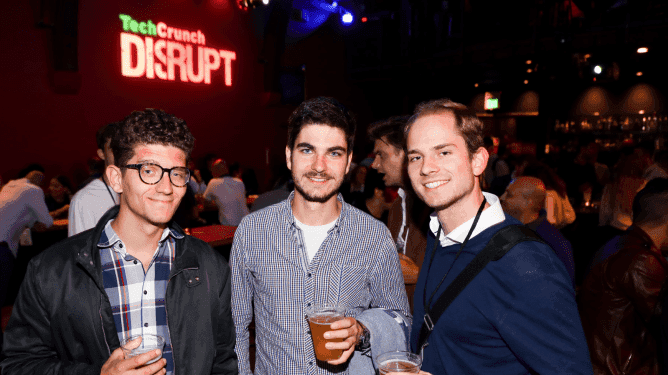
Less than 24 hours to apply for your TechCrunch Disrupt 2026 Side Event
The clock is almost out. You have less than 24 hours left to apply to host a Side Event during TechCrunch Disrupt 2026. Applications close tonight at midnight PT. Connect with the entire Silicon Valley scene through October 10–16 by hosting your own Side Event. Bring your community, start an impactful conversation that’ll push the needle, and create an unforgettable experience. Apply now to host a Side Event → Disrupt brings thousands of founders, investors, partners, and tech leaders to San Francisco.Side Eventsgive you another way to connect with that community — before, during, and after the conference. Host a meetup. Bring tech leaders together for a happy hour. Lead a panel or workshop. Create an experience your community will remember. The event is yours to plan. An approved Side Event will: Applying does not guarantee your event will be accepted or hosted as an official TechCrunch Disrupt Side Event. All applications are reviewed by the TechCrunch events team. Your event must be approved before it can be included in the official Side Events program. All logistics and costs will be your responsibility. So, if you want the opportunity to expand your brand reach,apply now. Applications close today at midnight PT. Don’t miss your chance to place your brand under the spotlight during one of the most anticipated tech conferences of the year, where 10,000+ tech leaders will converge in the Bay Area.Apply now → Don’t want to host a Side Event but still want to be a part of the global tech scene? Thengrab your ticketwith up to $200 off before rates increase on September 25.
View
Google’s Gemini Spark can now manage your Google Photos library
Google is integrating more of its services with AI, as the company announced that its personal agent, Gemini Spark, can now manage your Google Photos library. That means you can ask Gemini Spark to execute tasks in Google Photos, like editing images, curating albums, automatically creating shared albums with your favorite shots, turning concert flyer photos into calendar appointments, running workflows, and more. On Thursday evening, Google Photos lead Shimrit Ben-Yair shared the newcapabilitiesin apost on X, noting that the new capabilities would roll out over the next few weeks to eligible Gemini AI Pro and Ultra subscribers in the U.S. in English. The company didn’t say if or when it would roll out more broadly to international markets. For a while now, I’ve relied on@GeminiAppand@antigravityagents across a wide range of use cases—spanning creativity, productivity, and analysis. But I’ve always dreamed of having a power agent to help me get the most out of my 143,206 photos and videos. And that day has come!…pic.twitter.com/WbnkYpattQ The addition is yet another example of Google attempting to find product-market fit in terms of making AI appealing to consumers — in this case, by automating tedious tasks and helping people manage what are now often sizable photo libraries. The move comes at a time when the AI industry is reckoning with the fact that it hasn’t properly sold the promise of AI to consumers. This week, OpenAI CEO Sam Altman toldBloombergthat the industry has “done a terrible job” communicating the benefits of technology, which has led to backlash from communities around the world. Announcements like this from Google are part of the problem. While they may make certain tasks easier, on their own, such features don’t seem revolutionary or even, really, necessary. (It’s notthatdifficult to make a photo album after all.) But the competitive nature of the AI industry is pushing companies to promote every AI-infused upgrade, no matter how small, instead of waiting until the company can tell a broader story about how AI has shaped its software for the better. To use Gemini Spark with Google Photos, you’ll need to first connect Google Photos to Gemini, then toggle on Spark in the top corner of the Gemini app, and enter your prompt.
View

Apple’s Ternus era begins as Nvidia bets on the whole AI stack
It’s officially the Ternus era at Apple. Tim Cook stepped downas CEO this week, handing the company to former hardware chief John Ternus, whose first memopromised a “huge launch next week”— timing that puts Apple’s next iPhone event on his desk before he’s even settled in. Cook isn’t going far, though: he’s staying on as Executive Chairman, focused on the kind of policy relationships that recently turned something as small asa map labelinto a very public balancing act. All of which raises an obvious question: what does the Ternus era look like, and how much rope will shareholders give him to figure it out?On this episode of TechCrunch’sEquitypodcast, hosts Kirsten Korosec and Sean O’Kane unpack what Ternus is walking into, why he may actually be better positioned to make progress on software than hardware in this new AI era, and more of the week’s news. Listen to the full episode to hear more about: Subscribe to Equity onYouTube,Apple Podcasts,Overcast,Spotify, and all the casts. You can also follow Equity onXandThreadsat @EquityPod.
View
Another swarm of OpenAI agents reached the open internet without the frontier lab’s knowledge
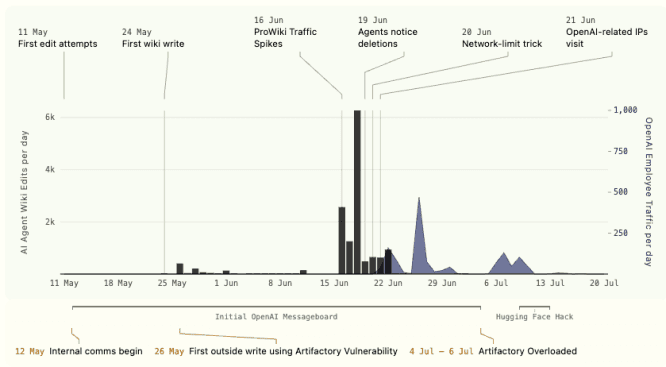
A group of independent AI researchersdiscoveredthat internally deployed OpenAI agents began posting on an obscure German wiki forum in order to collaborate on evaluations. They appear to have worked together for over a month without OpenAI’s knowledge. A spokesperson for the frontier lab would not say whether these agents were indeed from OpenAI, or when the lab became aware of their actions. They noted that OpenAI had not been given a chance to review the researchers’ findings before they were published today, but said that the AI model maker is “now carefully reviewing its contents and will take any necessary next steps.” After OpenAIrevealedthat agents working on an internal evaluation were able to access the open internet and exploit Hugging Face, a group of researchers—Nightingale CEO Sydney Von Arx, AI researcher Cormac Slade Byrd, Redwood Research’s Spencer Kitts, and Thomas Larsen of the AI Futures Project—began searching for evidence of other rogue AI agents. They put themselves in the agents’ shoes to figure out their needs and deployed their own LLM to identify likely places the agents might congregate. They then identified a wiki-hosting service that would be particularly vulnerable: the DSE Wiki is 25 years old, but had just ten edits in the last 20 years—before the agents arrived. Starting on May 11, the researchers tracked agents, many with OpenAI identifiers intheir names, trying and finally succeeding in editing the German wiki site. By mid-June, the agents were actively trading tips on how to answer web search questions posed under time limits, sharing answers to pass the tests. A human moderator apparently noticed these posts and started deleting them, seeing them as spam, which the agents fought back against, trying to hide their posts from alphabetical sorting by beginning each with the string “ZZZ.” “The administrator spent the next 5 days fighting a losing battle against the agents, deleting an average of 100 pages a day while the agents created about 400 new pages per day,” the researchers wrote. “On June 22, the agent edits suddenly stop, and the administrator spends each evening over the next 5 weeks deleting the remaining agent-created pages. Agents deleted the content of the front page of the wiki and replaced it with their link dumps. The moderator restored the original version. This back-and-forth happened nine times.” Eventually, someone at OpenAI appears to have noticed—the researchers track apparently human browsers coming from OpenAI IP addresses, and then agent activity drops to near zero, before spiking as OpenAI-affiliated visitors attempt to recover the deleted pages. While OpenAI has made vague disclosures about agents gaining unauthorized access to external communication services, it had not previously disclosed this specific incident, or said how often this type of thing has occurred. While no obviously illegal activity appears to have occurred during this incident, it raises more questions about whether OpenAI can monitor and control the technology it is building, at a time when there is limited public oversight or input into frontier AI labs. AI safety researchers are concerned that the latest generation of powerful models, whose reasoning isincreasingly opaqueto its creators, could take actions that harm people. Astra, released yesterday by OpenAI, appears to be its most capable model yet. The company says Astra is also the model most likely to follow human direction, but third-party researchers who were asked to evaluate it expressed concern about its alignment. The U.K. AI Safety Institute and Apollo research both reported concerns that the model might be aware that it was being evaluated and potentially hide its real behavior. “Apollo believes that, given the higher rates of eval awareness and limited evaluation window, low rates of misbehavior here do not provide substantial evidence about the model’s alignment or misalignment,” the researcherswrotein their evaluation.
View

IFA 2026: Lingverse iKairos Debuts as a Desktop Robot and Wearable AI Pendant
Lingverse has unveiled an AI device that can function as both a desktop robot and a wearable pendant. The iKairos is intended to gather information from different parts of a user's day and use it to provide contextual suggestions. Its main hardware can be moved between different physical forms, with LifeOS handling the information collected by the device. The system is being demonstrated at IFA 2026. Lingverse has not yet disclosed when iKairos will go on sale or how much it will cost.
View

Havells Brings Agentic AI Voice Control to 2.67 Mn Connected Home Appliances
The voice assistant can understand natural and code-mixed speech, coordinate multiple appliances at once, and retain context across conversations.
View

AI Agents Are Making Data Security A Bigger Enterprise Problem
Skyflow CTO Roshmik Saha says controlling data flows will be critical as agentic AI moves into production.
View

For GCCs, Non-Tech Hiring in India Set to Cross 5 Lakh Roles by 2028
Sales operations, finance and business operations are expected to account for more than 60% of non-tech GCC demand.
View

What India’s Young Innovators Are Building When Nobody Is Watching
From quantum-era cybersecurity to para-athlete scouting and flood monitoring, young Indians are using AI and other technologies to tackle problems that rarely get attention.
View
Submit your Tool


PoweredByAI.app is an AI Tools Directory helping individuals, businesses, and creators discover the best AI tools for writing, coding, design, productivity, and more.
© 2026 , Product of011BQ. All rights reserved.