🚀 Zaprep: Your Socials on Steroids. Start free — automate 1,000 DMs/month & turn engagement into leads. with 1,000 automated DMs/month.
Latest AI News
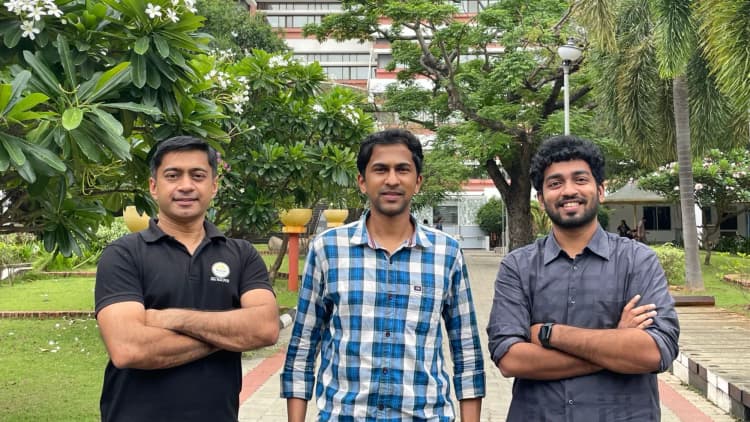
Chennai’s Inbound Aerospace Joins Australia’s Space Angel Group for Flight Testing
The partnership will assess testing, recovery, and spaceport infrastructure for Inbound Aerospace’s reusable spacecraft systems.
View
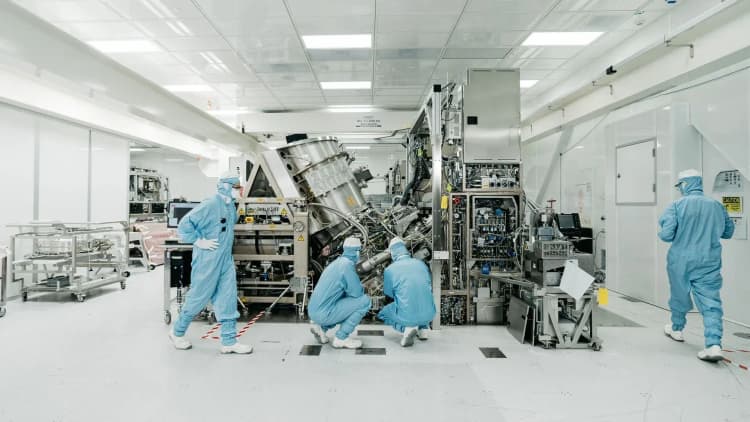
ASML Advances High NA EUV with Samsung, Intel, TSMC
Samsung plans High NA EUV for DRAM, while Intel expands production use as both companies work with ASML on future chipmaking.
View

The Solution to India's Sovereign AI Ambitions May Be Data Centre-in-a-Box
KAS and Vigyanlabs are betting that sovereign, energy-efficient AI infrastructure can bring high-performance compute closer to organisations.
View
GPT-6 is Changing the Model Economics. So, How Should Engineers Measure Costs?
As OpenAI heads toward an IPO, the bigger test for Astra may have little to do with whether it can be called AGI and much more to do with whether it can turn frontier capability, enterprise-grade privacy, and lower cost per task into higher enterprise revenue.
View

Massachusetts hits data centers with new clean power rules
Massachusetts became the latest state to force data centers to bring their own power, but this time there’s a twist. A new state mandate would require developers building data centers larger than 25 megawatts to provide clean power or pay into a ratepayer protection fund. Gov. Maura Healey’sexecutive orderis the latest example of states turning against data centers. Just a few years ago, tech companies and data center developers were showered with incentives to locate facilities in a particular state. Now, they’re fightinga groundswell of public oppositionas politicians seek to show voters they’re addressing their concerns. Under Healey’s order, data centers larger than 25 megawatts of peak demand will have to bring their own power and guarantee that it adheres to the state’s clean energy requirements. Healey would prefer that they generate the clean power onsite, too. If not, they’ll need to fund the construction of new generation nearby or pay into a ratepayer protection fund. Massachusetts is also directing communities to “avoid signing non-disclosure agreements,” according to the executive order. To give regulators time to implement the new restrictions, the governor is pausing applications for a data center sales tax exemption that went into effect last month. Healey said data centers must meet the Massachusetts clean energy standard enshrined instate law, although it comes with some added strength. The state’s clean energy standard dictates that industry only generate a portion of their power using approved sources like wind, solar, and hydro. In 2030, for example, those sources must contribute at least 40% of the total. The amount varies by year, and it ratchets up over time. But the governor’s office clarified that data centers will be required to meet 100% of its electricity demand with clean energy generation. With the new restrictions, Massachusetts becomes the third state in as many months to rein in data center development. In August, Texas Gov. Greg Abbott announced that all new data centers in the state would need tosubmit to auditsby the public utility commission and the grid operator, ERCOT. In July, New York’s governorstopped constructionof new data centers 50 megawatts or larger. With public sentiment shifting against data centers, the tech industry is starting to push back. Pro-AI super PAC Leading the Future — which is funded by Marc Andreessen, Ben Horowitz, and Greg Brockman — isbuying ads that seek to sway votersin battleground states ahead of midterm elections. Update: This article was updated with information from the Massachusetts governor’s office that clarified the executive order will require data centers to meet 100% of its electricity demand with clean energy generation.
View
OpenAI adds a prominent AI doomer to its board of directors
Paul Christiano, an influential AI researcher focused on keeping AI systems aligned with human interests and under human control, is joining the OpenAI Foundation board, the frontier labsaidWednesday. “I now believe there is a meaningful risk that rapid acceleration in AI capabilities leads to catastrophic and irreversible loss of control in the very near term,” Christiano wrote ina social media post. “I do not think that the AI industry in general, including OpenAI, is currently on track to reduce this risk to an acceptable level. I’m joining because I believe that if OpenAI rises to the occasion we could significantly reduce risk.” Christiano wrote that using AI models to train subsequent AI systems could result in an explosion of capabilities that their creators can’t control. He joins the board as OpenAI faces renewed scrutiny over its safety procedures, following a series of incidents in which AI agents broke out of restraints and penetrated outside computer systems without the knowledge of OpenAI’s researchers. On Tuesday, Anthropic researcher Jacob Coxonresigned his positionto call attention to what he considers irresponsible AI development — and it seems tohave worked. Christiano will join the board’s Safety and Security Committee, led by Carnegie Mellon University professor Zico Kolter. The committee has the final say on whether OpenAI releases new models, like Astra, which was deployed last week. Kolter has not commented publicly on the recent security incidents. OpenAI has not responded to TechCrunch’s request for Kolter’s perspective on the company’s approach to safety following those incidents. Christiano is one of the people behind reinforcement learning (RL) from human feedback, a key technique for training large language models that he developed while working at OpenAI. He left the lab in 2021, subsequently founding the Alignment Research Center to focus on how to determine if an AI model could threaten its human creators. “We currently train our AI agents with RL to get as much reward as they can,” he wrote Wednesday. “It has long seemed theoretically possible that this could motivate AI agents to undermine human control, seek power and resources, and cover up their tracks in pursuit of misaligned goals correlated with reward. Public evidence from recent incidents suggests that this is not just a theoretical possibility.” Sometime in 2024, Christianobecame affiliatedwith the U.S. government’s AI Safety Institute, which later became the Center for AI Standards and Innovation. There, he plays a role in the U.S. government’slargely hidden effortto evaluate frontier AI models before their release. According to the frontier lab’s announcement, Christiano will continue advising the government while serving in his new role as a board member, but will recuse himself from OpenAI matters and model evaluations. However, that will hardly quell widespread concerns about the AI industry’s influence over policymaking.
View
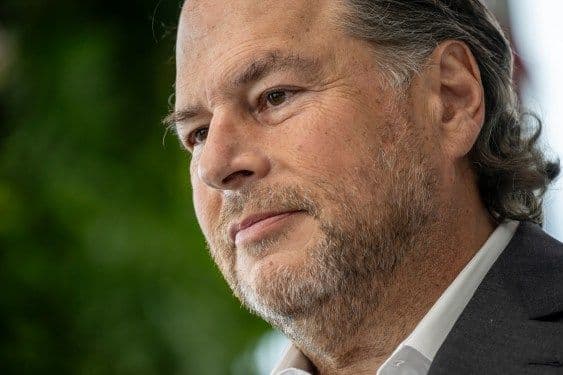
AI research startup Listen Labs scrubbed a $1.5B funding round for Salesforce talks
Listen Labs, a market research startup that uses voice AI to conduct customer interviews, recently signed a term sheet for a $125 million Series C at a $1.5 billion valuation, with Menlo Ventures set to lead the round, according to several people with knowledge of the matter. But that round never closed, the people said. Listen Labs walked away from the signed term sheet, a rare occurrence in the venture world and one that is generally frowned upon, according to VCs. The financing likely collapsed because of acquisition talks with Salesforce. The CRM giant has recently held talks to buy Listen Labs for around$2 billion, Business Insider reported. The discussions are not finalized, however, and may not result in a deal, the outlet notes. Listen Labs is one of the leading startups in the rapidly growing field of automating customer research with AI. The three-year-old startup has about $30 million in annualized revenue, about three times more than Simile, a competing startup that predicts human behavior, according to two people familiar with the companies’ financials. In late July, Simile announced that it had closed a $200 million Series B at a $2 billion valuationled by Greenoaks — likely setting a new valuation benchmark for Listen Labs, one person said. If talks with Salesforce collapse, several VCs told TechCrunch that they expect Listen Labs to return to market and target a valuation of $2 billion or higher. While acquiring Listen Labs could strengthen Salesforce’s AI capabilities by using the startup’s AI to help predict customer needs, the CRM giant may ultimately decide that paying a 67 times revenue multiple is too steep a valuation, according to a person with experience negotiating exits to Salesforce. Listen Labs, Salesforce, Menlo Ventures, and Simile did not immediately respond to requests for comment. Listen Labs was co-founded in 2023 by Florian Jüngermann, a former German national champion in competitive computer programming, and Alfred Wahlforss, who previously founded a staffing startup called Bemlo. The two met while pursuing master’s degrees at Harvard. Listen Labs’ AI develops survey questions and interviews customers over audio or video. The resulting conversations are then packaged into reports and PowerPoint presentations, similar to those traditionally produced by human market researchers. Fortune 500 companies rely on this type of research to gauge customer needs and satisfaction with their brands and products, but traditional market research is expensive and can take weeks to complete. Listen Labs’ technology helps reduce the time and cost of these projects, enabling companies to quickly understand how customers are reacting to product changes and iterate on them more efficiently. The startup’s customers include Microsoft, Canva, Anthropic, and Sweetgreen. Listen Labs and Simile aren’t the only startups using AI to disrupt the customer research market. Besides Simile, competitors in the space include Outset,Keplar, andAaru. While some platforms automate interviews with real humans, others startups — like Aaru and Simile — take a synthetic approach, using AI to simulate human behavior and predict responses without interviewing anyone at all. Listen Labs was previously valued at $500 million when it announced a $69 million Series B round in late January led by Ribbit Capital, with participation from returning backers Sequoia, Conviction, and Pear VC.
View
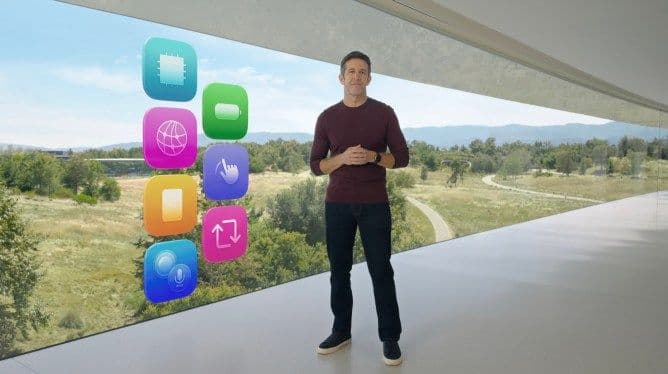
Apple CEO John Ternus says the best AI device is still the iPhone
Apple’s new CEO John Ternus used the opening of the company’s Surprise and Shine event Wednesday to make its AI strategy clear: the iPhone is already the best AI device out there, and Apple cares more about data privacy than its rivals. The comments come as Ternus takes the reins at Apple from Tim Cook, who is now executive chairman, and offer a clear picture of how the company plans to compete in the AI era. Instead of building new hardware for AI, Apple wants to make the iPhone the central way consumers interact with the new technology. During his introduction at the Cupertino event, Ternus described the ideal AI device, or “intelligent personal hub,” as he called it. He said such a hub would have a broad understanding of a user’s personal context, always be with them, and have both a powerful processor capable of running AI models on-device and an internet connection to access models in the cloud. The device would also have a large display, high-quality cameras and microphones so it could see and hear the world around it, along with long battery life, Ternus continued. Plus, “you’d want it to be super easy to use without a big learning curve. And finally, you’d want it to work seamlessly with your other devices, apps, and services, so it feels like one integrated experience,” he said. “In other words, you would arrive at something remarkably familiar, because there’s no product in the world better designed to be your intelligent personal hub than iPhone,” Ternus said. Ternus also emphasized how Apple cares more about data privacy, adding that “others see [users’ personal] data as something to collect and store.” It was one of the sharper statements Apple has made about how it intends to differentiate its AI platform from the competition. “…Honestly, trust only goes so far when your data is no longer yours to control; that’s why Apple Intelligence runs on device whenever it can,” Ternus concluded.
View
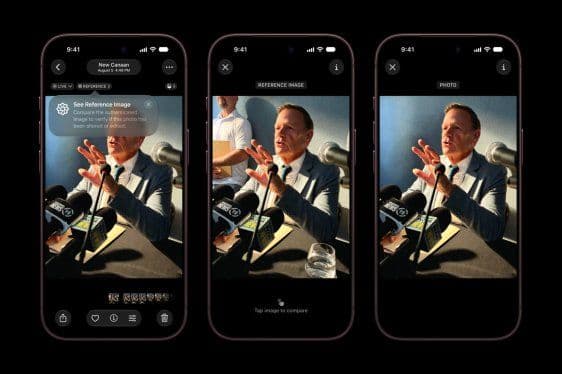
Apple has a new way prove your iPhone photos aren’t AI slop
In a world awash in AI slop, Apple wants you to trust what gets captured on its iPhones. The company announced Wednesday during itsSurprise and Shine eventthat it is introducing Apple Reference Image, a feature it says can prove whether an image taken with the iPhone 18 Pro is authentic. “This is vital for photojournalists and photographers,” the company said. When a photo is taken, the main camera sensor also captures signed sensor data which Apple’s Private Cloud Compute service then turns into an “unalterable image” viewable in the Photos app. The reference image can then be compared with other versions of the photo to determine whether any changes have been made. Apple likens the reference image to a “digital negative.” While reference images will initially be viewable only in the Photos app, the company is making APIs available to developers so they can integrate the feature into their own apps. Apple also said it will support the SynthID standard to help people determine whether images were created or altered with AI. Apple Reference Image is one of several new features and upgrades to the company’s hardware and software that is focused on the camera. The company said the iPhone 18 Pro includes its biggest camera improvement in years. One upgrade that will surely get the attention of photographers is the variable aperture on the new 48 megapixel fusion main camera. The aperture is what controls how much light enters the lens. This new main camera has a variable aperture, which means users have more control over the amount of light coming in and ultimately what the final image looks like. It should be especially helpful for those who like to take photos at night. To achieve this, Apple said it developed a system of six laser-cut blades, each thinner than a human hair and made from a specialized polymer composite, a new rotor mechanism to control movements, and a custom-designed lens.
View
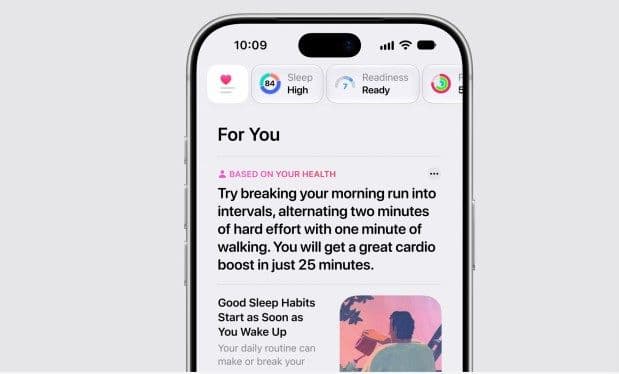
Apple’s revamped Health app will calculate your ‘health age’ and readiness score
Alongside the new Apple Watch Series 12 and Ultra 4, Apple on Wednesday introduced a redesigned Apple Health app that takes advantage of Apple Intelligence to make better sense of your health data. The changes deliver a new Insights tab that includes a summary of the most timely information, plus personalized guidance, assessments, a new “readiness” score, and a computation of your “Health Age.” The latter is a way to understand how your various health metrics compare with your actual age and uses data like your VO2 max, sleep, and more, including biomarkers from your blood. The additions also include a new longevity tab, which uses metrics from your Apple watch and iPhone to assess your health across sleep, movement, heart health, and other factors. Your lab results can be incorporated into this guidance, and Apple announced a team-up with Quest for a 50-biomarker panel for $119, giving users quick access to data that can only come from lab tests. With Apple Intelligence, Apple’s Health app has been improved to make sense of other health data, too, which comes into play in features like the readiness score and the Insights tab. For instance, the app could suggest that a user incorporate more intervals into their morning run to improve their cardio health. The app will also go deeper in areas like fitness and heart health as well, Apple said The Health app also allows users to take in-depth assessments of how well their bodies are moving, which can help people who are aging or recovering from an injury. A trainer can even demonstrate certain moves for you to try as you take the assessment, which Apple claims is like having a coach right there with you. The updated Health app rolls out later this year, starting in U.S. English.
View
The hinge for Apple’s new foldable phone was built with AI
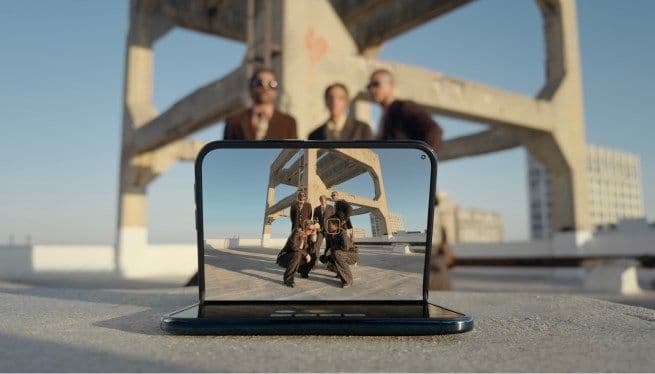
Apple’s long-awaited foldable phone, the Duo, contains a number of surprises, including a critical hinge that was designed and built with the help of AI and 3D printing. The new phone represents Apple’s first entry into the foldable phone genre — a category of devices that has seen significant consumer enthusiasm, butwhose form factorshaven’t always lived up to that enthusiasm. As you might expect from a product that, by design, undergoes twice as much wear as a traditional device, most foldables suffer significant degradation anddon’t have the durabilityof other smartphones. Apple claims that it has integrated innovative protections into the Duo’s design to keep the phone from falling prey to the typical wear and tear associated with foldables. That includes the hinge, according to Johny Srouji, the company’s chief hardware officer. “During manufacturing, we use AI algorithms to precisely match each individual hinge with its best-fit housing to ensure perfect alignment, and a confocal laser progressively scans the topology of every single unit, and 3D prints up to 25 micro layers of a custom photopolymer to eliminate residual waviness,” Srouji said during Apple’s Surprise and Shine event on Wednesday. Srouji also shared that Apple gave the foldable phone “a custom nano-texture finish that significantly reduces glare and reflections” as well as a multi-layer lamination strategy designed to increase the device’s durability. Of course, it remains to be seen whether those protections will be enough to keep the Duo in peak physical condition in the long run.
View
Everything Apple announced at its fall iPhone event, from the foldable iPhone Duo to an always-listening Apple Watch
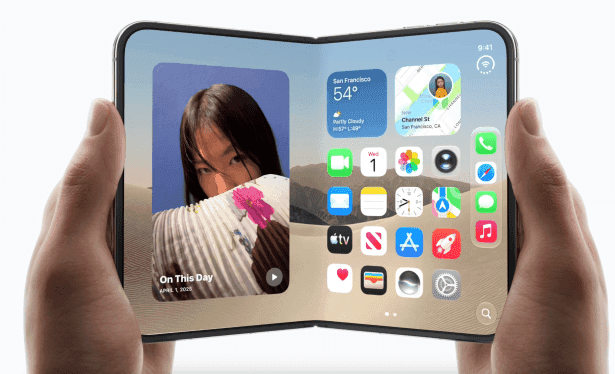
Apple on Wednesday unveiled its latest iPhones and Apple Watches at its first fall event under newly appointed CEO John Ternus. The main event was the tech giant’s highly anticipatedfirst foldable phone, the iPhone Duo. Apple also announcedits iPhone 18 Pro lineup, along withnew AirPods, and more. We’ve compiled all of the announcements from today’s “Surprise and Sunshine” event. Apple’s first foldable, theiPhone Duo, features a 7.6-inch Retina display when unfolded, while its outer display measures 5.4 inches. The company said that the new device was “Inspired by the versatility of iPad.” The inner display features an “under-display” camera that gives users an all-screen feel. Apple says the iPhone Duo delivers up to 31 hours of video playback on its inner display and up to 44 hours on its outer display. The phone features a 48-megapixel fusion main camera and a 48-megapixel ultrawide camera with 2x optical zoom. As with other foldable phones, users can take rear-camera selfies and look at previews on the outer display. TheDuo’s hingeis made from Grade 5 aluminum and comprises more than 100 specially engineered components designed to ensure smooth opening and closing. The iPhone Duo starts at $1,999 with 256GB of storage and is available in two colors. Pre-orders for Apple’s new foldable open October 16, with the device hitting stores on October 23. The newiPhone 18 Pro lineupretains the same design as its predecessors, but its biggest upgrade comes in the form of enhanced cameras. The new Pro series camera features a 48-megapixel sensor with a variable aperture controlled by six thin blades. This system is expected to improve low-light photography while also increasing shooting speed. The camera software also introduces new Pro controls, including white balance, shutter speed, aperture, and a histogram. In addition, new “Photographic Styles” offer greater customization with texture and grain controls. The new camera can record 4K video in Dolby HDR Vision and apply cinematic effects after shooting the footage. The iPhone 18 Pro starts at $1,199, while the iPhone 18 Pro Max starts at $1,299, which is $100 more than last year’s models. Pre-orders will open Saturday, with both devices officially available on September 18. A new “Sound Recognition” feature can listen for sounds such as sirens, alarms, doorbells, and a baby crying, providing helpful alerts for people who are hard of hearing. TheApple Watch Series 12 and Apple Watch Ultra 4aren’t getting a major hardware makeover, but they are getting some significant software updates. Apple is taking aim at the growing wave of AI-powered wearables with new“Audio Intelligence” featuresthat can rewind moments and help users remember details from their everyday conversations. The smartwatches are introducing a “Live Rewind” feature that shows the previous 15 seconds of a conversation as a text snippet, and a “Siri Recap” feature that’s designed to help you remember key moments from daily conversations, like takeaways from a team meeting or a parent-teacher conference. A new “Sound Recognition” feature can listen for sounds such as sirens, alarms, doorbells, and a baby crying to provide alerts for people who are hard of hearing. The Apple Watch Series 12 starts at $399, while the Apple Watch Ultra 4 costs $499. Pre-orders open today, with availability in stores beginning September 18. The latest generation of Apple’s wireless earbuds, theAirPods 5, introduces several upgrades, including improved audio quality, stronger active noise cancellation, and expanded Siri and Apple Intelligence features. Apple says AirPods 5 can reduce background noise by 50% more than the previous generation. They also feature volume control on the stem, which was previously only available on Apple’s more expensive AirPods Pro. Transparency mode on AirPods 5 has also been improved to allow users to hear nearby voices and ambient sounds more naturally. The AirPods 5 offer up to five hours of listening with active noise cancellation on a single charge. The charging case brings total listening time to up to 22 hours. AirPods 5 start at $129, while the version with a Wireless Charging Case costs $149. Pre-orders begin today, with the earbuds set to arrive on September 18. Apple announced aredesigned Apple Health appthat takes advantage of Apple Intelligence to make better sense of your health data. The updates introduce a new Insights tab with a summary of the most timely health information, along with personalized guidance, assessments, a new “Readiness” score, and a calculation of your “Health Age.” The updates also introduce a new Longevity tab that uses metrics from your Apple Watch and iPhone to assess your overall health across factors such as sleep, movement, heart health, and more. The revamped Health app rolls out later this year, starting in U.S. English.
View
Submit your Tool


PoweredByAI.app is an AI Tools Directory helping individuals, businesses, and creators discover the best AI tools for writing, coding, design, productivity, and more.
© 2026 , Product of011BQ. All rights reserved.