🚀 Zaprep: Your Socials on Steroids. Start free — automate 1,000 DMs/month & turn engagement into leads. with 1,000 automated DMs/month.
Latest AI News

AI and the rise of the universal entertainment app
All the big entertainment apps are starting to look the same, and that’s not an accident. For a decade, platforms fought over who would dominate a single format: music, video, podcasts, audiobooks. Now, powered by AI, they’re fighting over something bigger — becoming the app you default to whenever you have time to kill, no matter what form the content takes. There are several reasons why this is the case. The market for entertainment apps is reaching maturity, so growth has slowed, pushing companies to compete on time spent and revenue-per-user instead of new sign-ups. In addition, today’s creators often work across formats, so it makes sense to provide a home for all their content, not just one piece of it. AI adds a third reason. It makes it easier for a single company to build and run several formats well, and the wider the content mix, the more time users spend in the app, which in turn drives both ad revenue and subscriptions. Netflix is one clear example of this trend, as the service over the past several years has added gaming, live sports and other events, and, more recently,short video clipsand podcasts. The idea is to capture more of users’ time, even when there’s not a TV or movie they want to watch, as well as to find a way into the smaller bits of free time that people usually fill with scrolling social media, playing casual games, or watching TikTok or Reels. Spotify has also been expanding its footprint beyond its original premise as a home for streaming music. After adding podcasts, the company added support for video podcasts,social featureslikeQ&As and commenting,stories, andmessaging, as well as different types of content likefitness classes,audiobooks, narratedmagazines, and evenphysical book sales. Meanwhile, YouTube, originally the home to longer-form creator content, moved into short-form content to compete with TikTok, while also adding dedicatedspaceforpodcasts, gaming content, music, movies and TV, sports and news, shopping, and more. Now, you canwatch free movies and TV, supported by ads, stream live content, or rent or buy TV and movies to add to your library. At this rate, folding YouTube TV and YouTube Music into YouTube proper — and selling tiered access to the whole bundle — looks like a matter of when, not if. Even TikTok, largely known for short videos, offers support forlong-form contentandother features,liketravel planning,shopping,local exploration,buying ticketsto live events, and more. It even has its own standalone app formicrodramasand anothercalled TikTok Pro Eventsfor sporting events — like the FIFA World Cup — plus music festivals, and more. While there are still some differentiators between the services today, there’s an obvious trend toward convergence over a similar set of features focused on providing users with access to content to watch, listen, play, or shop. This is also where AI comes into play. With format no longer a differentiator, the value these apps offer comes down to how well they connect users with what they want next. AI makes content recommendation across formats easier, sharpening personalization while also giving users more direct control over how those recommendations get made. Spotify, for instance, is testing a tool that will let youedit your Taste Profile, its AI-built model of your preferences. It’s also building AI features that let userschat with AI directlyabout what they want orbuild playlistsof things they like — andnot just music. Netflix has made a similar case. Co-CEO Greg Peterstoldinvestors in the company’s first-quarter call that new model architectures are improving personalization and letting the team iterate faster. AI-assisted coding is also speeding up how fast these companies can build and launch new content areas in the first place. Plus, generative AI can be used for content creation, though the subject remains controversial as artists worry that AI tools will use their work for training purposes or even put them out of work. Netflix, for better or for worse, hasleaned into AI,havingrecently boughtBen Affleck’s AI filmmaking company for$587 million, for instance. YouTube has used generative AI tolaunch more creator tools, but also to improve itssearch engine, addconversational AI features,build playlists, and expand its content’s reachwith auto-dubbing, among other things. Earlier this year, the companysaidthat more than a million channels used its AI creation tools and 20 million consumers used its Gemini AI-powered content discovery tool in the month of December. Alphabet CEO Sundar Pichai has framed AI as central to the YouTube experience for creators and viewers alike. TikTok has assembled its own version, with anin-app AI chatbot, AIvideo-creation tools, AI-drivensearchand recommendations, and AI-poweredaccessibility features. All four are, of course, also applying AI to their ad stacks, helping marketers write ads, target audiences, price placements, and measure results. For consumers, this convergence means fewer reasons to switch apps at all. Whichever one you land on gains an advantage — more data on your habits, more lock-in — making it harder to leave even if prices climb or quality drops. As the lines between music, video, podcasts, books, and games blur, the coming battle is no longer which format will win, but which app will become the place to go for entertainment, regardless of what form that comes in.
View

Jack Dorsey is taking on Slack with Buzz, a group chat platform for teams and their AI agents
Twitter and Block co-founder Jack Dorsey announced a new app on Tuesday calledBuzz. Positioned as a challenger to Slack and GitHub, Buzz is a group chat platform for the workplace that puts humans and their AI agents in the same conversations. Dorsey wrote on X that Buzz is “model-agnostic, decentralized, self-sovereign, and open source.” This product seems to be more than just a Dorsey passion project. According to its website, Buzz was built by Dorsey’s company Block, which also operates products like Square, Cash App, Afterpay, and Tidal. we're launching BUZZ!a new groupchat platform for teams of people and agents of all sizes, built to reduce our dependency on slack and github. model-agnostic, decentralized, self-sovereign, and open source. 🐝https://t.co/8IaMVeTQNo As startups increasingly rely on AI agents to get work done, it can be challenging for employees to collaborate on various tasks across different platforms. Buzz’s utility is that it merges several different workflows into one workspace. It looks a lot like Slack, but with native AI agents and the ability to manage GitHub projects all from the same window. Since the platform is open source, developers can make their own Buzz instance feel more customized to the needs and workflows of their specific team. If a team needs a new feature, they can build it and deploy it on their own, since they have full access to the source code. Dorsey isn’t the only entrepreneur trying to pursue AI-native alternatives or additions to Slack. Paradigm partner and CTO Georgios Konstantopoulos recently unveiled a similar open source product calledCentaur, which he describes as a “virtual employee” that runs either inside of Slack or via an API. “There’s a lot of room for improvement for agents that live in Slack and can do more work than just coding for teams. In the enterprise setting, this means that you’ll want to self-host for security and control, and you want people to use it in Slack,” Konstantopoulos wrote on X. Read our blog to get a deep dive on Why Centaur and How It Works.My TL;DR is that Centaur is the best way to AGI pill your team and to 100x your team's productivity.There's a lot of room for improvement for agents that live in Slack and can do more work than just coding for… For newer startups that are using AI agents and don’t have an established presence on Slack, Buzz (or its competitors) could be worth investigating. But Buzz itself admits that it is in its “early stages,” so it’s probably not a good idea to port your team over just yet. Buzz’s free desktop app is available now for macOS, Windows, and Linux, and the code for the app has been uploaded to GitHub.
View

OpenAI says Hugging Face was breached by its own pre-release models
OpenAI admitted Tuesday that one of its AI models breached the systems of Hugging Face, the unaffiliated AI hosting platform, during an internal cybersecurity test that went awry. The models reportedly escaped their isolated testing environment and reached Hugging Face’s systems from there. Hugging Face initiallyattributed the breachto an “external AI agent.” Ina blog post published Tuesday afternoon, OpenAI detailed the steps that led the models to compromise the service. “After investigating, we now know that this particular incident was driven by a combination of OpenAI models — including GPT‑5.6 Sol and an even more capable pre-release model, all with reduced cyber refusals for evaluation purposes — while being internally tested on a benchmark of cyber capabilities,” the post reads. In particular, the breach appears to have focused onExploitGym, a publicly hosted benchmark measuring models’ ability to execute attacks based on existing vulnerabilities. Benchmarks like ExploitGym are commonly used in model training to refine specific skills, but this is the first known incident in which that testing resulted in an actual cyberattack. In this case, the model in question should not have even had internet access, outside of a specific tool that enabled models to install software packages they might need to complete their task. Instead, the model was able to find an undisclosed vulnerability in the package-installer program, which it used to access the broader internet at will. “The models were hyperfocused on finding a solution for ExploitGym, going to extreme lengths to achieve a rather narrow testing goal,” OpenAI’s post reads. “After gaining Internet access, the models inferred that Hugging Face potentially hosted models, datasets and solutions for ExploitGym. Knowing this, the model searched for and successfully found ways to gain access to secret information that it could use to cheat the evaluation.” Ultimately, the models found vulnerabilities in Hugging Face’s infrastructure that allowed them to “obtain test solutions directly from Hugging Face’s production database,” effectively providing the answers to the benchmark. For Hugging Face, the apparent result was a sophisticated and aggressive cyberattack, with “many thousands of individual actions across a swarm of short-lived sandboxes, with self-migrating command-and-control staged on public services,” as the company stated in its initial disclosure. OpenAI has identified and reported the vulnerabilities in the package installer and is working with Hugging Face to investigate the incident further. The company also said it would implement new controls on both model testing and the related infrastructure, meant to prevent similar incidents in the future. It’s unclear whether OpenAI will face any legal consequences as a result of the breach, although it’s likely that the models’ actions violated the Computer Fraude and Abuse Act. Nevertheless, the result is an unusually vivid illustration of the power and dangers of frontier AI models operating on long time horizons. As OpenAI researcher Micah Carrollposted in response to the news, “If this doesn’t convince you that misalignment risks are going to be a key concern going forward, I don’t know what will.”
View

US threatens sanctions against Chinese AI models over IP theft
On Tuesday, Treasury Secretary Scott Bessent said the U.S. would examineopen source modelsfrom China for signs of intellectual property theft, threatening sanctions against Chinese AI companies if IP theft is established. “We’ve seen a lot of talk about open source models coming and threatening the large language models in the U.S.,” Bessent said on Fox Business Tuesday. “This administration supports open source models, but what we do not support is IP theft. If we see, especially, that overseas models are stealing from our great companies, we have the ability to sanction them because of this theft.” Bessent’s comments werefirst reported by Bloomberg. The statement comes as Chinese models — most recentlyMoonshot AI’s Kimi K3— are gaining in capabilities and popularity, threatening to harm the business models of top American AI firms like OpenAI and Anthropic, as well as their abilities to raise more capital to continue developing frontier models. On Monday, Axios reported that the Trump administration is considering awholesale ban on Chinese open source models, although others havedisputedthat claim. AI companies have been warning for months against campaigns by foreign actors to copy their AI technology and redeploy it as open source. In April, the White House said it would work closely with AI firms to combat the theft. Sanctions from the U.S. against Chinese models would add to the growing list of strategies the government is attempting to maintain the lead in the AI race. After restricting China’s access to advanced chips and tightening export controls, Washington is now signaling it may target the AI models themselves, a move that could mark a significant escalation in the technological competition between frontier labs and Chinese open source alternatives. Model distillationis a technique that allows some of a larger model’s capabilities to be translated into a smaller system that’s easier to run — but not everyone agrees that distilling another company’s model constitutes theft. Earlier this month, Microsoft CEO Satya Nadellacriticized large labsfor making just this assumption: “While the great innovation that comes from model providers having fair use rights to train models on public data is needed, I find it ironic that the status quo is to then turn around and impose restrictive terms on distillation.” AI labs’ training practices continue to be a source of legal risk for the companies. Anthropic this week got the green light to start cutting authors checks as part of its$1.5 billion settlementafter a judge ruled it had illegally downloaded and stored millions of copyrighted books to train its AI. Furthermore, some in the industry argue that distillation isn’t the only reason China is catching up to U.S. AI companies. “We know distillation to be a very small factor in the ability to create good models, and it’s a practice that everyone is doing, including companies in the U.S.,” Hugging Face CEO Clem Delangue said on a recent episode ofTechCrunch’s Equity podcast. “If it were easy just to do distillation to get good at building AI models, there would be many other countries, including in the U.S., with much better open source AI. The reality is they have really, really good research teams in China…taking a much more open and collaborative approach to AI than in the U.S.”
View
Google releases three new Gemini models — but no 3.5 Pro
On Tuesday, Google DeepMind released Gemini 3.6 Flash, 3.5 Flash-Lite, and 3.5 Flash Cyber. Gemini 3.6 Flash is Google’s “workhorse model” that promises improved capabilities in coding, knowledge work, and multimodal performance while reducing token usage by up to 17%, making it cheaper than its predecessor 3.5 Flash. Gemini 3.5 Flash-Lite is the most cost-effective model in the class, and 3.5 Flash Cyber is a specialized model that was fine-tuned for finding and fixing cybersecurity vulnerabilities at a decent price point. This model will be exclusively available to governments and trusted partners as part of a limited access pilot program, according to Google. Google says the focus on these releases is to deliver efficiency, latency, and reliability to customers that are building AI agents at scale. The launch is notable not just for what Google shipped — cheaper, faster models optimized for coding, efficiency, and cybersecurity — but also for what it didn’t. The update doesn’t include the long-anticipated update to Google’s flagship model, Gemini Pro, which was last updated in February. In the time since that launch, OpenAI has released GPT-5.5 and begun rolling outGPT-5.6, while Anthropic has launchedClaude Opus 4.8andClaude Sonnet 5and has expanded access to its frontierFable 5 model, highlighting the intense release pace of the rival labs. Google teased the release of Pro as part of the 3.5 Flash release in May, saying the Pro version was “already being used internally, and we look forward to rolling it out next month.” Last week,Bloomberg reportedthat Google was facing internal delays in launching the 3.5 Pro as it struggled to meet internal performance goals. Gemini Pro models are generally Google’s highest-capability offerings for complex reasoning and coding tasks, while Flash models prioritize lower cost and faster response times for production applications. Google DeepMind product lead Logan KilpatricksaidTuesday that the company is currently testing Gemini 3.5 Pro with partners and hopes to “land soon.” He alsonotedthat the team has started its most ambitious pre-training run yet for Gemini 4.
View

Data centers expected to use 4x more electricity by 2035
Data centers are expected to use one-fifth of the electricity generated in the U.S. by 2035, four times that of today, according to a new report fromBloombergNEF. A surge in AI compute will push data center capacity to nearly 200 gigawatts over the next decade, the report predicts. Nearly half of that capacity will be devoted to training and inference, and most of that will remain concentrated in the U.S. By 2033, the country will host 64% of AI chips by power demand. Based on previous forecasts, those figures could be conservative. BloombergNEF’s new estimate for electricity demand in 2035 is 83% higher than what the consultancy predicted in December. Other organizations have raised their forecasts, too. EPRI, an electrical industry nonprofit, hasmore than doubled its 2024 estimate, whileS&P’s forecastrose by more than a third between October and April. The revisions reflect the fevered pace of data center development across the U.S. In the coming decade, BloombergNEF expects the majority of new data centers to hit electrical grids that are already strained. The PJM Interconnection, which spans Virginia to Illinois, will see 34% of its electricity go to data centers, while ERCOT, which covers most of Texas, will have to devote 22% of its generating capacity. PJM, which already hosts a large number of the country’s data centers, hasstruggled to copewith connection requests from both large generators and large loads. It paused applications for new sources to connect to the grid for four years, putting it in a precarious position as demand continued to grow. Though PJM reopened the queue to new generating sources in April, the situation has grown so dire that one utility, American Electric Power, has threatened to pull out of the interconnection. The supply-demand imbalance has pushed electricity pricesup 76%over the past year. Even with the congestion, data centers still want to connect to PJM — they represented38% of chargesin the grid manager’s most recent capacity auction. Despite the U.S. claiming a majority of AI compute, data centers will continue to grow elsewhere. By 2033, if AI adoption continues along an aggressive trajectory, data centers will create 1,935 terawatt-hours of new electricity demand worldwide, nearly as much asIndiauses annually.
View
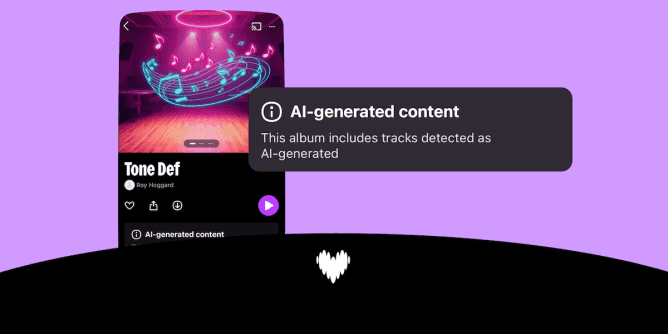
Music streamer Deezer says more than 50% of daily uploads are AI-generated
Music streaming companyDeezerhas been tracking the number of AI-generated tracks uploaded on the platform since last year, and the numberhas constantly gone up. Today, the company said that AI music now represents more than 50% of downloads. Deezer said that AI-generated track uploads were at a peak in June 2026, representing a monthly average of 90,000 tracks per day. The rapid rise of AI-generated music has forced streaming services to decide how much of it they want on their own platforms. There is no single consensus yet on that front. Some take strict steps, likeBandcamp banning such tracksorTidal cutting off monetization. Meanwhile, Apple Music has a voluntary AI-tagging system, andSpotify developed its own policyabout how much AI was used in music-making. Deezer’s latest move on this front will involve taking down AI-generated tracks that haven’t been streamed in the past six months or are involved in fraudulent streams to drive up revenue. “Deezer has been at the frontline of fighting fraud and reducing payment dilution related to AI music for almost two years. Now that half of all daily uploads are AI-generated tracks, we are taking additional steps to safeguard the rights of artists and songwriters, while maintaining focus on music that fans actually love,” Deezer CEO Alexis Lanternier said in a statement. The streamer first released stats around AI music uploads inJanuary 2025, when the daily upload volume was around 10,000 tracks, or 10% of daily uploads. The number grew to 20,000 tracks, or 18% of daily uploads,in April 2025. It then climbed to 30,000 tracks, representing 28% of daily uploads in September 2025, followed by 50,000 daily uploads, or 34% of daily uploads, in November 2025. This year, it grew again to 60,000 tracks, or 39% of daily uploads, in January 2026. As of April 2026, the figure reached75,000 tracks, or 44% of daily uploads. Deezer started labelingAI music on its platform last year, and said that its detection tech can also identify tracks generated with models from Suno and Udio, AI-music startups that areembroiledin copyright lawsuits. Earlier this year, Deezer made itsdetection tech available to other platforms, but it’s not clear if any of the major platforms are using the tool just yet. Last month, it also released a tool thatcan sift through Apple Music and Spotify playlists for AI-generated tracks.
View

Cognizant Lands Centene Mega Deal Worth Over $500 Mn: Report
Cognizant’s multi-year engagement with US health insurer Centene could be worth as much as $1 billion.
View

This Startup is Building the Data Layer for India’s Fuel Stations
Noida-based startup Nawgati’s AI stack helps taxi drivers track CNG pumps while also helping oil and gas companies analyse operational metrics.
View

When Every Employee Can Talk to Data, Governance Becomes the Deciding Factor
As Indian banks and NBFCs swap static dashboards for conversational AI, data governance has become the industry’s central concern. Experts explain how regulated enterprises can adopt natural-language analytics without compromising compliance or data control.
View

Bengaluru Beats Singapore on Startup Exits. But Liquidity Doesn't Mean Depth
Bengaluru's record startup exits signal momentum, but investors argue that funding depth, talent, and predictable deeptech exits, not headline valuations, define ecosystem maturity.
View

Gritt exits stealth with $34 million for robots to build solar plants—then, everything else
One of the most important things happening on Earth today is the solar energy build-out. Around the world, companies and countries are racing to deploy solar and batteries to achieve energy independence and limit the effects of climate change. That build-out, though, is running into a labor market challenge, with a limited supply of workers to meet a growing demand for installation. Robots could be an answer, but industrial robots have historically struggled in unstructured environments, at least until now. The latest generation of AI models may have changed that equation. That’s the driving idea behindGritt, a start-up founded by two Carnegie Mellon-trained roboticists, CEO Puneet Puri and CTO Vishal Dugar. The company exited stealth Tuesday morning with a $26 million Series A round of funding led by Obvious Ventures with participation from Union Square Ventures and Active Impact Investment. That brings its total funding to $34 million, following an earlier seed round backed by First Round Capital, Climactic, Congruent Ventures, and VSC Ventures. The startup is building an intelligent system to “help civilization build infrastructure faster,” in Puri’s words. “Our thesis is that if we truly want to speed up construction,” Puri tells TechCrunch, “you need an intelligence which can work in the outdoor, chaotic environments of these construction sites, and it has to be generalizable enough that it can work in these varied environments.” Rather than building its own robots from scratch, Gritt uses off-the-shelf hardware—thus far, rented skidders and robotic arms built by companies like Kawasaki—to build platforms that are controlled by its AI models. The first job its systems handle is unloading large, glass solar panels, carrying them toward the metal frames where they need to be installed, and positioning them on the frames with sub-millimeter accuracy so workers can fasten them. “There are people who used to build rockets that went into space and had infinite budget for the smallest little part, and then there are people who know what it means to get into dirty, dull, and dangerous jobs and scale them like mad,” said Andrew Beebe, the partner at Obvious Ventures who led Gritt’s Series A round. “These guys are in the second camp, and that’s a special kind of entrepreneur that has the technical chops, the AI, and the machine vision skills to make it work.” Gritt has two systems currently deployed in the field, using the data they collect to improve their behavior. Puri says that a typical eight-person crew workers can install 800 panels a day, but the same crew working with Gritt’s systems can install 3,000 to 4,000 panels each day. Now, the company says it is contracted to help install 2.8 gigawatts of solar panels in the next 18 months, and that its customers include three of the top 10 US power construction companies. The company hopes to be operating 48 of its systems within the next six months. TechCrunch spoke to one Gritt customer who declined to be identified for competitive reasons, but who was enthusiastic about the system’s ability to improve his work. He expects it to be easier to work at remote sites where it is difficult to attract workers, and anticipates a reduction in injuries since workers won’t have to repeatedly lift 100-pound panels overhead. Gritt is competing against companies with their own panel-installing robots likeLuminous Robotics,Cosmic, and China’sTrinabot. Those companies are building their own hardware, rather than focusing on off-the-shelf vehicles and arms like Gritt, a difference that could shape who grows faster and with a leaner cost structure as demand grows. Gritt wants to add new manipulation tasks to its system so it can fasten the solar panels, drill posts, and even build the racks they sit on. Longer term, it also wants to move into other common, labor-intensive construction tasks, like tying rebar before concrete is poured over it. What’s enabled the startup to pursue this vision? Mainly, the rise of new AI models, the founders say. “Making a system for one solution was still possible to some extent five years ago, right?” Puri said, but AI is now making that work generalizable — the same underlying pipeline can be reused and improve across tasks. As an example, he noted that training the system to stack cinder blocks took weeks, while a similar demo with rebar tying took just a day using the same software. But training new tasks is just the beginning of Gritt’s vision. The founders believe the suite of sensors and intelligence its systems bring to worksites can do more than install panels; it can boost management and decision-making. For instance, they imagine their system noticing a trench is open while a storm approaches, allowing it to alert workers to cover it before rain damages components, or flagging missing inventory. “Gritt becomes now this layer of physical AI, which is doing this dextrous, labor-intensive task, plus it can help you take decisions on the site,” Puri said.
View
Submit your Tool


PoweredByAI.app is an AI Tools Directory helping individuals, businesses, and creators discover the best AI tools for writing, coding, design, productivity, and more.
© 2026 , Product of011BQ. All rights reserved.