🚀 Zaprep: Your Socials on Steroids. Start free — automate 1,000 DMs/month & turn engagement into leads. with 1,000 automated DMs/month.
Latest AI News

Fractal’s Net Profit Declines 37% QoQ Even as Enterprise AI Demand Lifts Revenue Past ₹900 Cr
Fractal Analytics’ shares plunged nearly 6% after Q1 FY27 results despite the pure-play AI company increasing its profits YoY and expanding margins.
View

The $205 Bn AI Bet Google Can’t Afford to Lose
Record cloud growth, rising Gemini adoption and a new TPU business suggest Google’s AI investments are finally beginning to show returns.
View
How AI guardrails are impeding the work of offensive cybersecurity researchers
For months, AI giants have devised special vetted programs and strict guardrails to limit the use of their models by malicious hackers. But these limits are now hindering the work of legitimate network defenders, as well as that of offensive cybersecurity researchers. In June, the U.S. governmentslapped export control restrictionson Anthropic’s much-hyped AI models Mythos and Fable. The move was prompted at least in part by a report that claimed it was possible to bypass the models’ guardrails designed to prevent users from using them to build and execute malicious cyberattacks. Regardless of whether the incident was really motivated byfears of a jailbreak, the fact is that Anthropichas repeatedly marketedMythos assome kind of doomsday cybermachinethat can only be given to carefully vetted users, and even then with strict guardrails in place. (The export controls on Fable 5 and Mythos 5 have since been lifted. Fable 5 returned to general access on July 1; Mythos 5 has been reintroduced only to vetted U.S. organizations as part of the government’s review process.) That kind of gatekeeping isn’t unique to Mythos. Both Anthropic, with its other models, and OpenAI offer cybersecurity researchers programs they can apply to get vetted and — if approved — access models with fewer cybersecurity restrictions: OpenAI’sTrusted Access for Cyberand Anthropic’sCyber Verification Program. These guardrails have been widely criticized, particularly by researchers whose job is to find unknown vulnerabilities in systems and devise ways to exploit them before criminals do. During a recent appearance on a cybersecurity podcast, Mark Dowd, a well-known security researcher,saidthat, “it’s not really comfortable to me that these random large companies are making arbitrary decisions about what is safe in security and what’s not.” Dowd has spent decadesfinding and selling “zero days”— previously unknown software flaws and the exploits that take advantage of them — to Western governments, rather than report them to the software makers so they get patched. Governments pay a premium for vulnerabilities precisely because they stay open, which is useful for intelligence operations. Dowd admitted his work may make him biased, but he isn’t alone. Several people who work in offensive cybersecurity — they proactively probe systems for weaknesses — described to TechCrunch how they use AI tools and deal with their guardrails. Chris Anley, the chief scientist at security consulting giant NCC Group, said that asking an AI model to try to exploit a bug is a key step in confirming it’s a real vulnerability worth fixing. But if a guardrail prompts the model to refuse to answer the question outright, the guardrail hurts defenders, he said. “This is where the whole offensive versus defensive and guardrails part comes in, because ‘fix this code’ as a prompt is both an essential mechanism for defense but also a roadmap for finding critical vulnerabilities in the code base,” said Anley. “So at the same time, the same tool is both an offensive tool and a defensive tool, and the two can’t really be unpicked.” It’s “like a hammer,” he continued. “You can’t build a house without a hammer. It’s definitely a tool but it’s also irreducibly a weapon as well.” When he and his colleagues run into such a roadblock, they sometimes fall back on open-source AI models that come with no guardrails at all. Paolo Stagno, the chief technology officer at CrowdFense, a well-known company that develops, acquires, and sells unknown vulnerabilities to government agencies, agreed with Dowd, saying AI companies “essentially treat customers like children who need babysitting” with their vetted programs and guardrails. Stagno said he and his colleagues do use frontier models — but only for reverse engineering. They avoid using AI to help find vulnerabilities or build exploits, he said, because feeding that work into a cloud-based model risks leaking sensitive vulnerability data or having it absorbed into future training runs. For that step, he said, they use open source models run locally, as they do not rely on sharing data outside of the model. Giuseppe Cali, a security researcher who finds zero-days and develops exploits, said guardrails are not impeding his work. That’s because he doesn’t use AI for offensive work; instead, he uses it for initial reverse engineering, to understand the code he’s analyzing, and to build supporting tools. For that, he said, AI tools can speed up the process and allow him to focus on discovering vulnerabilities. “I still want to own the actual bug discovery and weaponization myself and that wouldn’t change if all guardrails were lifted tomorrow,” said Cali. “I am jealous of my bugs, and I like this game too much to let models play it for me.” One researcher at a smartphone-component manufacturer, who spoke on condition of anonymity because he isn’t authorized to talk to the press, said his employer isn’t part of Anthropic’s CVP program and as a result, its tools are barely useful for finding vulnerabilities because the guardrails are too strict. “If it catches wind we’re doing anything security related, it just stops and isn’t usable,” the person said. Chris Thompson — chief executive of cybersecurity firm RemoteThreat and founder of Offensive AI Con, an offensive security and AI-focused event — said that in his experience using the frontier AI models, the guardrails can be inconsistent and work differently every day. That’s true even inside the looser boundaries of Anthropic and OpenAI’s vetted programs. “I think the practical impact is you spend a lot of time negotiating with the model instead of working on the core security program,” said Thompson. “Instead of analyzing a vulnerability and reasoning through the exploitability, you’re trying to find why you’re getting inconsistent results or why are models over-sanitizing the output.” As a consequence, researchers rely on or get pushed toward Chinese open-source models like GLM — freely downloadable models that can be run locally with no vetting or usage restrictions — said Thompson. “You have these responsible researchers that are being pushed away from U.S.-governed systems to foreign-owned systems,” he said. “I think it’s more harmful than good to have these guardrails in place.” Rather than tightening restrictions further, Thompson called for the AI frontier labs to open up their programs, provide responsible access, and also hold those who abuse their tools accountable. Otherwise, he argued, defenders will lose the AI race. “There’s this big storm coming. There’s this big wave of attacks that are going to happen at speed and scale like never before,” said Thompson. “But the same security consulting firms and legit researchers that are trying to make a difference are being stifled right now.”
View

AMD takes on Nvidia with its Helios AI rack-scale system
Chipmaker AMD is taking aim at competitor Nvidia with its latest hardware release: a rack-scale system designed to power computing needs of the world’s largest AI labs. At the company’s sold-out Advancing AI conference in San Francisco on Thursday, AMD Chair and CEO Dr. Lisa Su promoted the new AI rack system known as Helios — along with its growing list of customers, including Microsoft — as the company prepares to ship it later this year. Su also pitched the company’s newest chips that are designed to feed the compute-hungry dragon that is the AI industry. Rack systems combine many processors into asingle high-powered unit. They are built for data centers, where they train and run AI models and other compute-intensive workloads. Su called Helios the tech industry’s “highest-performance AI rack,” adding that it was “built to train and run the most demanding frontier models in the world at massive scale.” The system will be deployed by leading AI companies at gigawatt-scale, the company said. Nvidia has historically dominated this market with itsVera Rubin and Grace Blackwellrack-scale systems. AMD is clearly looking to get in on the action. And Helios’ performance metrics appear to give it a real chance, beating out Vera Rubin by a number of metrics,The Register reported. Helios, which was revealed in 2025 andshown onstagein January at CES 2026, already has several well-known customers, including OpenAI, Meta, Oracle, Anthropic, and Microsoft, all of whichhave plans to deploythe system. Microsoft CEO Satya Nadellasaid Mondaythat the company would expand its Azure infrastructure with Helios. Meanwhile, Anthropic and AMDannounced a strategic partnershipWednesday to deploy up to two gigawatts of GPUs via the new rack system. AMDalso introducedThursday its Venice-X CPU, which is designed for data centers and to handle high-computing workloads. The Venice-X is expected to launch in 2027. During her remarks, Su commented on the trajectory of the chip industry, claiming that, by the year 2030, chips that power AI will become a massive part of the overall computing market. This is because the industry is “seeing a step change in compute demand” driven largely by the rise of agentic AI, she said. “When you ask the agent to do something, it actually has dozens of steps, and it has to reason, and it has to call tools, and it has to access data, and it has to keep doing it over and over until it solves the problem, and so you need lots of GPUs to do all that,” the executive said. “We’re now expecting that by 2030, the AI accelerator market is going to reach about $1.4 trillion,” Su said. “What that means is, by the end of the decade, the AI accelerator market is going to approach the size of the entire semiconductor market today.” “We do expect that GPUs are going to make up the vast majority of that market because the algorithms are still very much in their infancy, and we’re still continuing to see the workloads change, and that favors programmability in the overall silicon ecosystem,” she added.
View

Meta launched a new AI optimism ad set to a song about human extinction
Meta’snewest advertisementbegins with a black-and-white shot of an eye, showing us what someone sees as they read countless panicked headlines about how AI is going to take our jobs, isolate us, and spark a global crisis. “Some people will have you believe AI is going to make us feel less connected. That it’s going to leave us behind,” a voiceover says. “We couldn’t disagree more.” Suddenly, the video shifts to color, and shows a cycle of different people opening their eyes and smiling. Then, we see a couple dancing on a rooftop, pointing at a rainbow; a group of teens swimming in a lake; a child frolicking in a field; friends embracing after time apart. “Call us optimists. Call us dreamers. Call us whatever the hell you want. But we’re betting on people, and we like those odds,” the voiceover says. “The future is for everyone.” That’s a nice sentiment — pretty convenient for a company betting hundreds of billions of dollars that AI will revolutionize humanity. But the strangest part of the advertisement is not that we’re watching these happy moments play out via Instagram posts. It’s that the soundtrack to the ad is the David Bowie song “Five Years.” If you are not familiar with this song, I urge you togive it a listen,read the lyrics, and think about what it is trying to say. It seems clear to me, but I studied poetry in college, so as a control for this experiment, I asked my brother — a blockchain analyst who loves Claude Code and does not read for fun — if he could tell me what the song is about. “I thought climate change at first, then zombie apocalypse, then an asteroid hitting the earth,” he told me. He is correct. It is a song about the human race panicking after learning they will die in a mass-extinction event in five years. If you’re not familiar with Bowie’s music, this track might sound happy and inspiring, matching the ad’s upbeat tone. The part of the song that is used for the advertisement was probably chosen because it uses the word “people” over and over again, and without the context of the song, it’s not clear what it’s about. But if we look at the lines directly preceding this section: News had just come overWe had five years left to cry inNews guy wept and told usEarth was really dyingCried so much his face was wetThen I knew he was not lying We “had five years left to cry in” and the “earth was really dying.” It’s pretty bleak. It is not reassuring to convince people that AI is going to make the world better while playing a song about the end of the world, and yet, this contradictory musical choice seems to have sailed right past everyone at Meta, including CEO Mark Zuckerberg. “Meta has always believed in giving people the power to share, connect, and shape your world in the ways you want,” hewrotealongside the video. “As we enter this next wave with AI, we continue to believe the future is for everyone. We’re focused on giving every person the tools to reach your full potential and making sure the benefits of technology are distributed to everyone.” Then again, tech leaders are not known for their literary analysis skills. Meta’s Oculus used to give new hires copies of the science fiction novel “Ready Player One,” which is set in a dystopia in which a tech company making virtual reality products becomes overly powerful and evil. OpenAI CEO Sam Altman hasdirectly citedinspiration from the movie “Her,” which warns us about what can go wrong when weuse AI for emotional support. Palantir, a company that builds AI surveillance systems for the government, is named after Palantir, a seeing stone from the “Lord of the Rings” franchise that the Dark Lord uses to spy on his enemies. Elon Musk iscurrently throwing a fitabout the “accuracy” of Christopher Nolan’s blockbuster adaptation of “The Odyssey,” a story with such realistic elements as sea monsters, magic, and divine intervention. These guys make a great argument for the value of studying the humanities. Sci-Fi Author: In my book I invented the Torment Nexus as a cautionary taleTech Company: At long last, we have created the Torment Nexus from classic sci-fi novel Don't Create The Torment Nexus Meta isn’t alone in its recent promotional foibles. Instead of racing to build AGI, the top AI companies seem to be fighting over who can make the creepiest advertisement. A few weeks ago, Anthropic released an eerie video of its own. As my colleague Lucas Ropekdescribedit: The ad begins with a video of a burning house (not exactly a heartwarming start) before pivoting to a series of still images. These images include a crowd of people being surveilled by facial recognition, a homeless person sleeping on the street, rows upon rows of tombstones in a cemetery, and what appears to be a group of laborers toiling in a mine where (presumably) raw materials for smartphones are being dug up. Meanwhile, a voice-over track features different people asking questions like “Can AI be trusted?” and “Who’s gonna hit the brakes if we need to?” Anthropic is trying to convince us that it understands the risks AI poses to society, and therefore, this is the company that people can trust to develop AI responsibly. The message it actually conveys feels closer to the mood of Bowie’s “Five Years.” i thought this was satire, kept looking for the handle to be spelled c1audeai or somethinghttps://t.co/4AVBA93Z27 OpenAI CEO Sam Altmanrespondedto the Anthropic ad, “I thought this was satire, kept looking for the handle to be spelled c1audeai or something.” As these companies spar to control the public perception of AI, their efforts don’t seem to be making much progress. A recentPew surveyfound that only 16% of Americans think that AI’s impact on society over the next 20 years will be positive, and 40% believe it will have a negative impact. Better luck next time, Meta.
View
OpenAI makes ChatGPT Health available to all US users
OpenAI said today it is making ChatGPT Health, a feature that helps users with health-related queries, available to all U.S.-based users over 18 across all plans. The announcement comes a day after a Florida-based pastor sued the company for givinga near-fatal suggestion not to consult a doctor. The company started testing the feature through a dedicated hub earlier in January, allowing users to integrate data from other services and their personal information from services such as Apple Health, Function, and MyFitnessPal. At that time, OpenAI said users were asking 230 million health-related queries each week. That number has now gone up to 300 million. Users can also integrate their medical records from hospital systems like Epic and Oracle Health, and health platforms like One Medical and Function Health. OpenAI said earlier that users needed to use the health hub for health-related queries. Now they can choose to draw insights from connected information in the health section in all queries. The company said during the testing it observed that 70% of health-related queries took place outside the dedicated hub. Through this new feature, users can use their health information to get information on food or allergies in the general chat. The company noted that its models have made progress in answering health-related queries. The company noted that the smallest model from its latest release, GPT 5.6-Luna, outperforms GPT 5.5 on HealthBench evaluation, an open source benchmark developed by the company toevaluate large language models (LLMs) on health queries. OpenAI said that it doesn’t use any user data to train its model, and it works with physicians to improve its models on health queries. Despite these performance gains, the company maintains in its terms that its services are “not intended for use in the diagnosis or treatment of any health condition.” The company cited these clauses in response to the above lawsuit, and also toldThe New York Timesthat it is working on making health- or medicine-related answers safer. With the latest roll out, OpenAI said it wants people to verify information and take medical decisions based on professional advice. Severalstudieshave highlighted that AI bots are not reliable for medical advice. However, this has not deterred companies likeAnthropicandGooglefrom launching health-related AI features. Health in ChatGPT is rolling out to logged-in U.S. users with free, Go, Plus, and Pro plans on the web and iOS this week.
View
Runway launches AI model router as generative media gets crowded
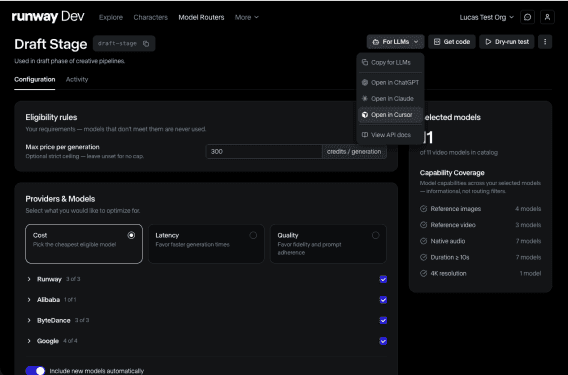
Runway no longer wants to be justanother AI model company. It wants to become the infrastructure layer for generative media. On Thursday, the startup launched Runway Media Router throughRunway Dev, its developer platform, released earlier this month, that provides API access to a growing roster of third-party image, video, and audio models alongside Runway’s own. The Media Router is a tool that automatically selects the best image, video, or audio generation model for a request based on whether a developer prioritizes quality, speed, or cost. While model routers have become increasingly common in the world of large language models, Runway says this is the first built specifically for generative media. “The routing really fits into that overall promise of being the easiest one-stop shop for developers to integrate with any type of generative media model,” Anthony Maggio, Runway’s chief product officer, told TechCrunch. The launch, shared exclusively with TechCrunch, marks another step in Runway’s evolution from an AI video startup into infrastructure for companies building with generative media. Through Runway Dev, customers including Adobe, Cloudflare, ElevenLabs, Expedia, Shutterstock, and Quora can build media generation directly into their own products using Runway’s API rather than sending their users to Runway’s own app or site. The launch of the router comes as the number of generative media models has exploded, making it increasingly difficult and time-consuming for developers to evaluate new releases. Through the Runway Dev platform, developers can access the latest media models when they’re released. “Most developers are not spending the time to really understand the capabilities of each of these models and where they excel or differ based on various types of outputs across video, image, and audio,” Maggio said. “The unique proposition we’re bringing to the table is all of that intelligence around what the best model is for each different use case, and meshing that with preference you apply around the context of your business.” Maggio noted that Chinese generative media models are becoming increasingly popular. However, many businesses building their own products might not be comfortable working with models that come out of China, so they could, he said, potentially set a preference for American model providers — a preference that may become more common as the Trump administration explores bans andsanctions against Chinese open AI models. That’s just one example of preferences that developers can set, though. Maggio says customers are mainly interested in routing the model to account for token pricing and quality. Token pricing has become a hot topic in 2026 as enterprises that went all-in on agentic AI felt the sting ofhigh token bills. In the world of LLMs, model routing for token pricing has become common, so it only makes sense that routing for generative media would follow. The Media Router launch also comes weeks after Runway replaced its unlimited subscription plans with token-based pricing, a move that drew criticism from some users. On the quality front, deciding which models provide the best quality for any given task isn’t as easy for generative media as it is with language models, Maggio says. That’s where the router’s intelligence layer kicks in. It’s based on the expertise Runway’s in-house creative team has developed in evaluating output across every media type — things like how video models handle motion, how image models handle composition, or how voice models handle lip syncing. Runway had already done a lot of the work building that intelligence layer for its agent product, a conversational AI creative partner thatRunway launched in Mayto help turn text prompts into fully edited multi-shot videos and marketing campaigns. The Runway Media Router, Maggio says, takes the same routing technology Runway built for its own products and packages it for outside developers to use. Runway’s strategy today reflects how fragmented and competitive the current generative media landscape is, and how much the startup needs to expand and pivot to stay competitive. Runway’s last AI video model release — Gen 4.5 — was in December. At the time, the model topped leaderboards,outperforming similar modelsfrom incumbents like Google. In the same month,Runway released its first world model. Aside from an upgrade to its video editing model,Aleph 2.0, in May, Runway hasn’t dropped a new dedicated frontier video model in months. (TechCrunch has asked when the startup plans to release Gen 5.) Today, while Aleph 2.0 ranks among the leading video editing models according to Artificial Analysis, the company’s text-to-video and image-to-video models no longer lead the rankings. In the top 20 spots are models from heavy hitters like Google and China’s ByteDance and Alibaba. Rather than asking developers to bet on a single model staying ahead, Media Router assumes that the best model will continue to change — and it keeps Runway in the game so that it can continue to build on the frontier. If not as the best new AI model, then as the best orchestration layer. Anastasis Germanidis, Runway’s co-founder and co-CEO, acknowledged that the startup has been known for a long time primarily for “that end user piece,” but it had to build a full stack to get there, one that includes a developer platform, a creative tool suite, and an inference layer underneath it all. He says the company has seen increasing interest from companies for Runway to live across every part of that stack. “You need great models underneath, but the orchestration increasingly matters a lot because people are building entire campaigns with those models, or they’re building entire finished multi-scene generations out of those models,” Germanidis told TechCrunch. “It’s something that we increasingly had to build — that intelligence layer that comes on top of the pure pixel models. The router is one way in which the benefits of that come to users.” Or as Maggio put it more broadly: “If you zoom out at the one thing Runway has been doing since 2018, it’s that we’re deeply focused on research, while building for where we think the space is going at the same time.” Got a sensitive tip or confidential documents? Rebecca Bellan is reporting on the inner workings of the AI industry, from the companies shaping its future to the people impacted by their decisions. Contact her securely, and off the record, on Signal at rebeccabellan.491or via email at rebecca.bellan@techcrunch.com from a non-work device.
View
AegisAI, founded by former Google security execs, lands $36M to stop AI-driven spear phishing
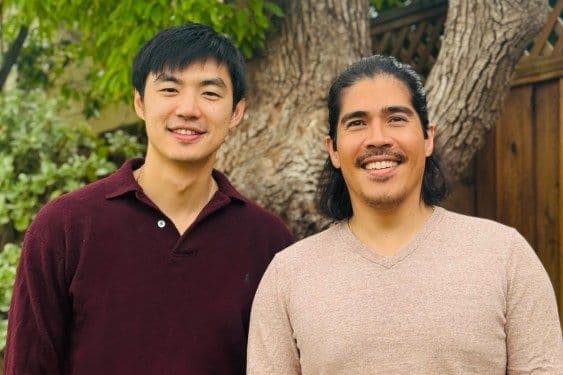
Hackers are increasingly using AI to launch attacks on a massive scale, with email emerging as a primary target. AI can quickly aggregate personal information—such as information about coworkers, active projects, and recent travel itineraries—allowing bad actors to instantly craft convincing messages that look authentic. Last year, former Google security executives Cy Khormaee and Ryan Luo, who previously worked on developing safe browsing technology and reCAPTCHA, teamed up to launch AegisAI, a startup that uses AI agents to stomp out these threats, known as spear phishing. With a decade of experience preventing email hacks, the AegisAI co-founders realized that existing rule-based systems for preventing hacks—relying on “if-then” logic—are too slow and limited to catching AI-crafted malicious emails. So they developed AI agents that quickly analyze each message as a human would, paying attention to small anomalies that even the most elaborate checklist wouldn’t catch. Less than a year after its launch, AegisAI says its tech has been adopted by dozens of customers, including crypto payments company Mash, AI startup LangChain, and Google-owned privacy compliance platform Lokker. That demand has just helped AegisAI raise a $36 million Series A led by Battery Ventures, with participation from existing backers Accel and Foundation Capital. The fresh funding brings the startup’s total capital to$49 million. “AI-powered attacks bypass existing controls more than half the time now, which means they’re almost twice as effective as they used to be,” Khormaee told TechCrunch. “They’ve researched you, they understand everything about you, and they’re targeting attacks that are perfectly bespoke to you.” Khormaee claims that AegisAI’s agents can spot threats traditional email security systems may miss entirely. For instance, the startup’s AI can catch malicious PDF attachments that look legitimate at first, including ones with built-in passwords and CAPTCHAs, which are often used to fool standard spam filters. When Dharmesh Thakker, general partner at Battery Ventures, noticed an increase in email attacks, he set out to invest in a startup that could defend against AI with AI, one aiming to replace legacy email security tools with agentic-driven defense. “The bad guys are using email to attack us using AI at a much faster pace than we can keep up with,” Thakker told TechCrunch. “Defending against that is going to be a number one priority for a lot of companies.” AegisAI isn’t the only startup using AI to analyze the context of every incoming email to detect fraud and impersonation attempts. Lightspeed-backedOceanis also trying to displace established vendors like Proofpoint and Mimecast, along with newer players like Abnormal Security. However, given that AegisAI is led by experts who helped secure Gmail, the most popular email system in the world, Thakker believes the startup has the best shot at becoming the leading new hack-prevention company. While AegisAI is starting with email, the startup has its sights on eventually expanding to other areas of defense, such as data security. “The core idea of building customized, highly advanced agents that can do investigations is going to [determine] who becomes the next dominant security company,” Khormaee said.
View
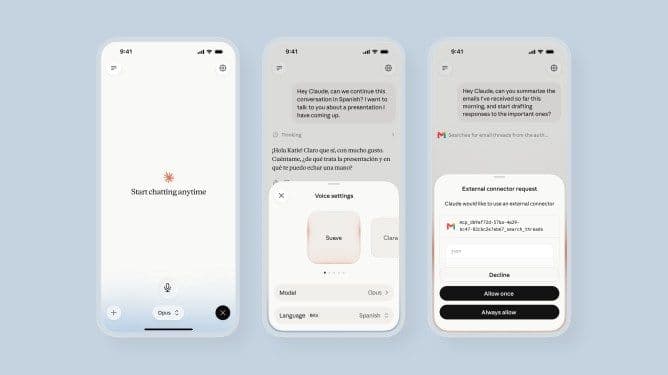
Anthropic updates Claude voice mode with more capable models
Weeks after OpenAI rolled out a new family of conversational models andupdated ChatGPT’s voice mode, rival Anthropic is making its move to make Claude more voice-friendly with a new update. The company said Thursday that users can choose between Opus, Sonnet, and Haiku models. Claude’s voice mode, whichwas released last yearand powered by the Haiku model, provided quick responses, but wasn’t well suited for complex work. The company said that with the new update, voice mode picks the last model people used in the text chat and uses its fastest version by default. Anthropic said that the new voice mode can help users with longer conversations, including providing feedback on their communication style, talking through a pitch to a client, and brainstorming product market research. What’s more, Claude’s voice mode can tap into other apps like Gmail, Google Calendar, Slack, Canva, and Notion. This means that users can ask it to update a meeting slot, draft an email, or create a document in Notion. Notably, this is a big difference from OpenAI’s voice mode, which updated its conversational style but still isn’t able to use different tools to get work done. Earlier this year, Anthropic added multilingual support to Claude’s voice mode in beta. It said that now users can talk in various languages, but they have to manually specify the language. At the moment, Anthropic supports English, French, German, Hindi, Indonesian, Italian, Japanese, Korean, Portuguese (Brazilian), and Spanish (Latin America/Spain). The new voice mode is available to all users in beta across platforms. However, free users will be restricted to using the Haiku model with only one connected app. Anthropic didn’t make any changes to the voice model with this release, and it hasn’t detailed what kind of voice stack it uses. That means, unlike OpenAI’s release, users might not find any coversational improvements such as better interruption handling.
View

AMD, Cerebras Enter Partnership to Combine Helios and Wafer Scale Engine
By separating inference processing across the two compute platforms, the companies say the architecture can deliver up to 5x higher tokens per second per watt than a Cerebras Wafer-Scale Engine-only configuration.
View

AMD Expands Roadmap Through 2030, Helios in Full Production
AMD confirmed that the Instinct MI500 Series will launch in 2027, followed by the MI600 Series in 2028.
View
Google closes in on another billion- user product with Gemini
Google is about to add another name to its long list of products with more than a billion users, a list that already includes Search, Gmail, Drive, Android, YouTube, and Chrome. The company said during its Q2 2026 call that the AI assistant Gemini now has over 950 million monthly users. The company noted that Gemini users have tripled from last year. Earlier in February, it said that the Gemini app crossed750 million monthly active users. With this growth, Google’s assistant is in line to compete more closely with OpenAI’s ChatGPT, which hit 1 billion monthly active usersin June. “Users love new agentic features like Daily Brief and our personalized agent, Gemini Spark, which is now available in the U.S. and internationally. We’ve been shipping helpful new features like this at an incredible pace,” Alphabet CEO Sundar Pichai said during the call. Apart from users on Android, the Gemini app has found astrong user base on iOS with launches like the Nano Banana image generation model. According to Appfigures, the app has been downloaded over 137 million times on iOS in the last 12 months. Inits latest “State of AI” report, the analytics firm Sensor Tower noted that ChatGPT’s market share among AI assistants fell below 50% for the first time. The report, which looked at H1 2026, also noted that Gemini’s share rose to 27.7%. Many people already use AI assistant apps as a substitute for search. However, Google reported that its search vertical is going strong, partially thanks tothe AI-centric overhaul. During this quarter, its Q&A-style AI mode crossed 1 billion users. The company said that it is driving “an incremental increase” in search queries. Google also noted that through hardware engineering, it has reduced the cost of AI mode for the company, despite introducing new models and features.
View
Submit your Tool


PoweredByAI.app is an AI Tools Directory helping individuals, businesses, and creators discover the best AI tools for writing, coding, design, productivity, and more.
© 2026 , Product of011BQ. All rights reserved.